Department of Neurology, Emory University School of Medicine, Atlanta, GA, USA.
Center for Neurodegenerative Disease, Emory University School of Medicine, Atlanta, GA, USA.
Sci Adv. 2020 Oct 21;6(43). doi: 10.1126/sciadv.aaz9360. Print 2020 Oct.
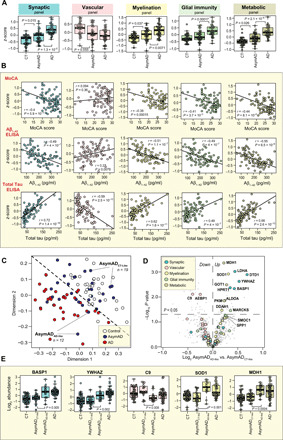
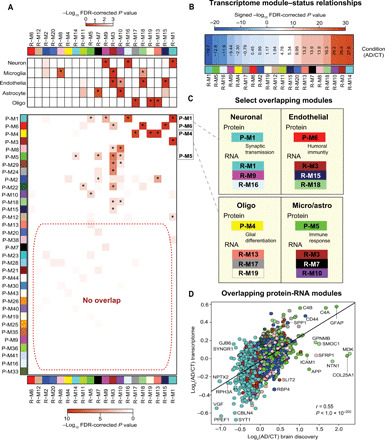
Alzheimer's disease (AD) lacks protein biomarkers reflective of its diverse underlying pathophysiology, hindering diagnostic and therapeutic advancements. Here, we used integrative proteomics to identify cerebrospinal fluid (CSF) biomarkers representing a wide spectrum of AD pathophysiology. Multiplex mass spectrometry identified ~3500 and ~12,000 proteins in AD CSF and brain, respectively. Network analysis of the brain proteome resolved 44 biologically diverse modules, 15 of which overlapped with the CSF proteome. CSF AD markers in these overlapping modules were collapsed into five protein panels representing distinct pathophysiological processes. Synaptic and metabolic panels were decreased in AD brain but increased in CSF, while glial-enriched myelination and immunity panels were increased in brain and CSF. The consistency and disease specificity of panel changes were confirmed in >500 additional CSF samples. These panels also identified biological subpopulations within asymptomatic AD. Overall, these results are a promising step toward a network-based biomarker tool for AD clinical applications.
阿尔茨海默病(AD)缺乏反映其多种潜在病理生理学的蛋白质生物标志物,这阻碍了诊断和治疗的进展。在这里,我们使用整合蛋白质组学来鉴定代表广泛 AD 病理生理学的脑脊液(CSF)生物标志物。多重质谱法分别在 AD 患者的 CSF 和大脑中鉴定出约 3500 种和 12000 种蛋白质。大脑蛋白质组的网络分析解析出 44 个具有不同生物学特性的模块,其中 15 个与 CSF 蛋白质组重叠。这些重叠模块中的 CSF AD 标志物被合并为代表不同病理生理过程的五个蛋白质组学面板。突触和代谢面板在 AD 大脑中减少,但在 CSF 中增加,而富含神经胶质的髓鞘形成和免疫面板在大脑和 CSF 中增加。在超过 500 个额外的 CSF 样本中证实了面板变化的一致性和疾病特异性。这些面板还鉴定了无症状 AD 中的生物学亚群。总的来说,这些结果是朝着用于 AD 临床应用的基于网络的生物标志物工具迈出的有希望的一步。