Vaccine and Infectious Disease Division, Fred Hutchinson Cancer Research Center, Seattle, WA, USA.
Clinical Research Division, Fred Hutchinson Cancer Research Center, Seattle, WA, USA.
Sci Adv. 2020 Nov 20;6(47). doi: 10.1126/sciadv.abc7112. Print 2020 Nov.
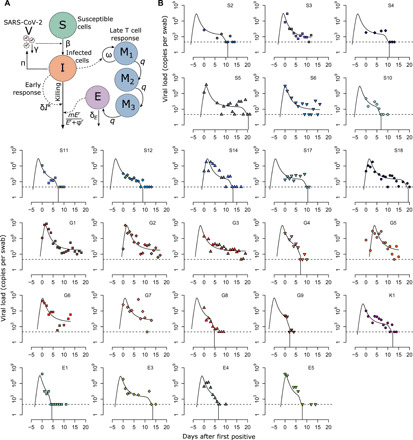
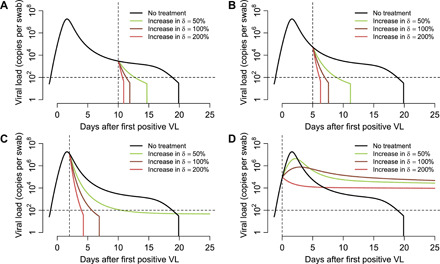
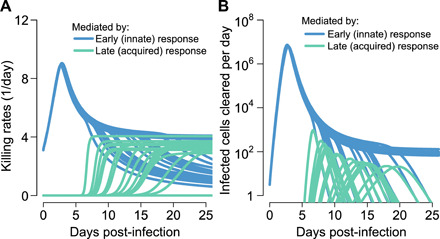
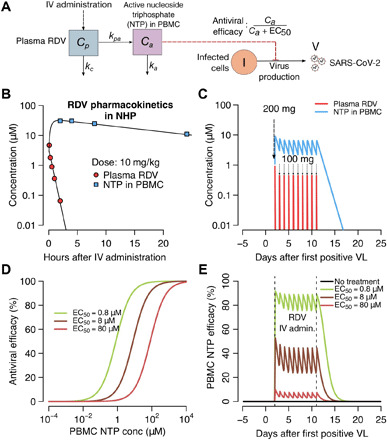
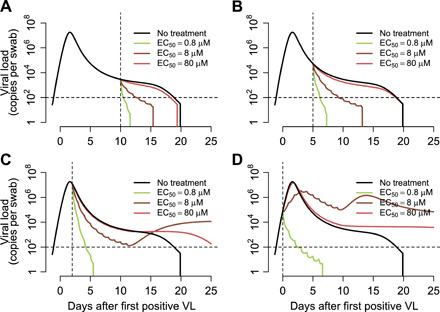
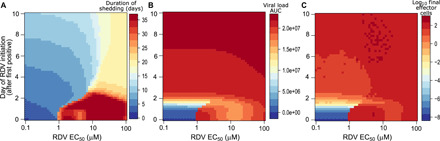
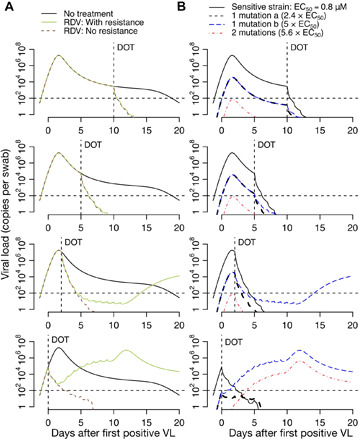
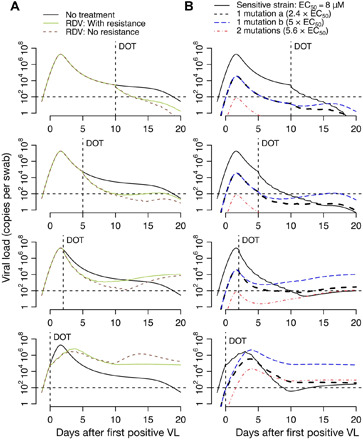
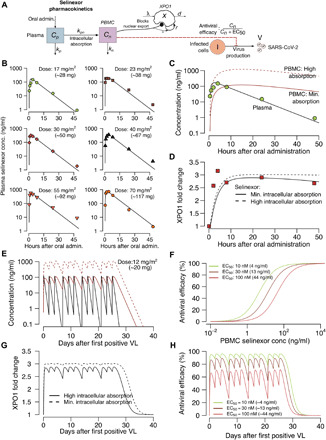
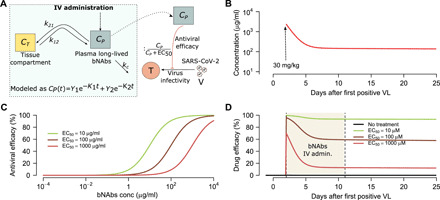
To affect the COVID-19 pandemic, lifesaving antiviral therapies must be identified. The number of clinical trials that can be performed is limited. We developed mathematical models to project multiple therapeutic approaches. Our models recapitulate off-treatment viral dynamics and predict a three-phase immune response. Simulated treatment with remdesivir, selinexor, neutralizing antibodies, or cellular immunotherapy demonstrates that rapid viral elimination is possible if in vivo potency is sufficiently high. Therapies dosed soon after peak viral load when symptoms develop may decrease shedding duration and immune response intensity but have little effect on viral area under the curve (AUC), which is driven by high early viral loads. Potent therapy dosed before viral peak during presymptomatic infection could lower AUC. Drug resistance may emerge with a moderately potent agent dosed before viral peak. Our results support early treatment for COVID-19 if shedding duration, not AUC, is most predictive of clinical severity.
为了应对 COVID-19 大流行,必须确定救生的抗病毒疗法。可以进行的临床试验数量有限。我们开发了数学模型来预测多种治疗方法。我们的模型再现了治疗后的病毒动力学,并预测了三阶段免疫反应。模拟使用瑞德西韦、塞来昔布、中和抗体或细胞免疫疗法治疗表明,如果体内效力足够高,则可以快速消除病毒。在出现症状时,在病毒载量峰值后不久进行治疗,可以减少脱落持续时间和免疫反应强度,但对病毒 AUC(由早期高病毒载量驱动)影响不大。在有症状感染之前病毒峰值之前进行强效治疗可以降低 AUC。在病毒峰值之前使用中等效力的药物进行治疗可能会产生耐药性。如果脱落持续时间而不是 AUC 最能预测临床严重程度,我们的研究结果支持对 COVID-19 进行早期治疗。