Interdisciplinary Biology Laboratory (iBLab), Division of Biological Science, Graduate School of Science, Nagoya University, Nagoya, Japan.
Department of Biology, Faculty of Sciences, Kyushu University, Fukuoka, Japan.
Life Sci Alliance. 2021 Aug 3;4(10). doi: 10.26508/lsa.202101049. Print 2021 Oct.
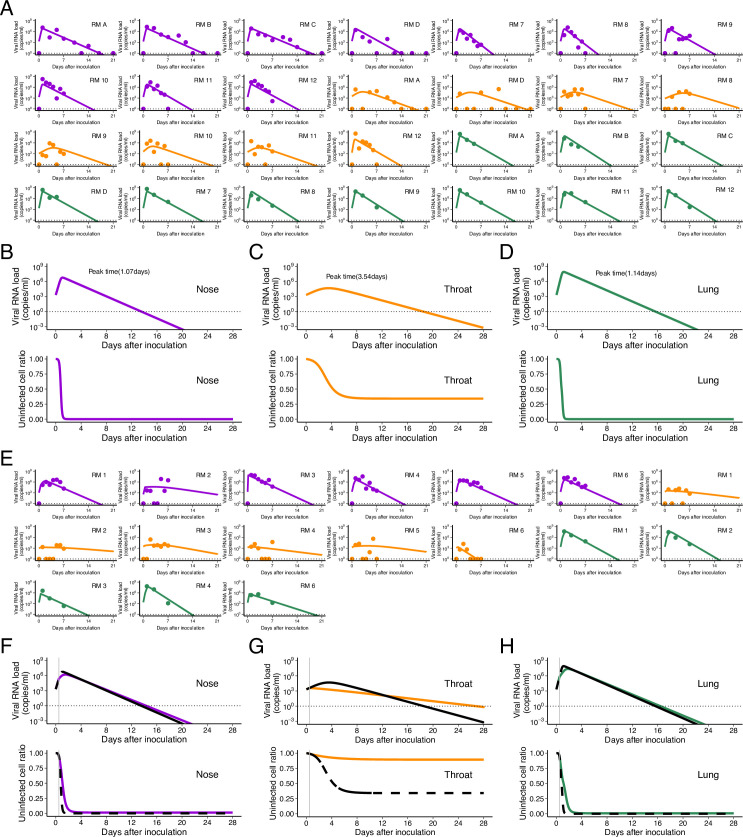
The duration of viral shedding is determined by a balance between de novo infection and removal of infected cells. That is, if infection is completely blocked with antiviral drugs (100% inhibition), the duration of viral shedding is minimal and is determined by the length of virus production. However, some mathematical models predict that if infected individuals are treated with antiviral drugs with efficacy below 100%, viral shedding may last longer than without treatment because further de novo infections are driven by entry of the virus into partially protected, uninfected cells at a slower rate. Using a simple mathematical model, we quantified SARS-CoV-2 infection dynamics in non-human primates and characterized the kinetics of viral shedding. We counterintuitively found that treatments initiated early, such as 0.5 d after virus inoculation, with intermediate to relatively high efficacy (30-70% inhibition of virus replication) yield a prolonged duration of viral shedding (by about 6.0 d) compared with no treatment.
病毒脱落的持续时间取决于新感染和感染细胞清除之间的平衡。也就是说,如果用抗病毒药物完全阻断感染(100%抑制),病毒脱落的持续时间最短,由病毒产生的时间决定。然而,一些数学模型预测,如果感染个体用疗效低于 100%的抗病毒药物治疗,病毒脱落可能持续更长时间,因为病毒以较慢的速度进入部分受保护的未感染细胞,从而导致新的感染进一步发生。我们使用一个简单的数学模型,量化了非人类灵长类动物中的 SARS-CoV-2 感染动力学,并描述了病毒脱落的动力学。我们出乎意料地发现,与未治疗相比,早期(例如在接种病毒后 0.5 天开始)、疗效中等至较高(抑制病毒复制 30-70%)的治疗会导致病毒脱落的持续时间延长(约 6.0 天)。