Department of Nuclear Medicine, Heidelberg University Hospital, Heidelberg, Germany
Department of Radiation Oncology, Heidelberg University Hospital, Heidelberg, Germany.
J Nucl Med. 2021 Jun 1;62(6):779-786. doi: 10.2967/jnumed.120.253062. Epub 2020 Oct 23.
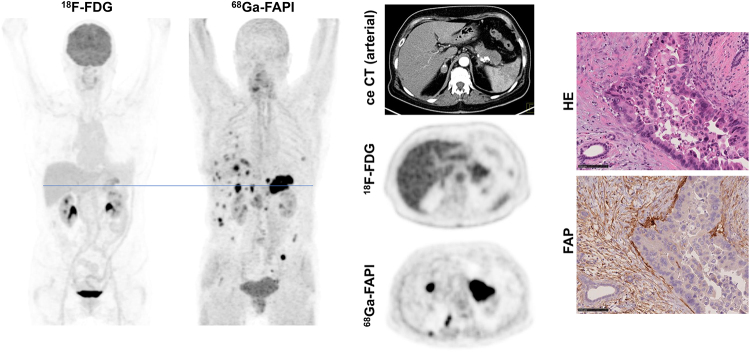
Pancreatic ductal carcinoma (PDAC) is a highly lethal cancer, and early detection and accurate staging are critical to prolonging survival. PDAC typically has a prominent stroma including cancer-associated fibroblasts that express fibroblast activation protein (FAP). FAP is a new target molecule for PET imaging of various tumors. In this retrospective study, we describe the clinical impact of PET/CT imaging using Ga-labeled FAP-inhibitors (Ga-FAPI PET/CT) in 19 patients with PDAC (7 primary, 12 progressive/recurrent). All patients underwent contrast-enhanced CT (ceCT) for TNM staging before Ga-FAPI PET/CT imaging. PET scans were acquired 60 min after administration of 150-250 MBq of Ga-labeled FAP-specific tracers. To characterize Ga-FAPI uptake over time, additional scans after 10 or 180 min were acquired in 6 patients. SUV and SUV values of PDAC manifestations and healthy organs were analyzed. The tumor burden according to Ga-FAPI PET/CT was compared with TNM staging based on ceCT and changes in oncologic management were recorded. Compared with ceCT, Ga-FAPI PET/CT results led to changes in TNM staging in 10 of 19 patients. Eight of 12 patients with recurrent/progressive disease were upstaged, 1 was downstaged, and 3 had no change. In newly diagnosed PDAC, 1 of 7 patients was upstaged, and the staging of 6 patients did not change. Changes in oncologic management occurred in 7 patients. Markedly elevated uptake of Ga-FAPI in PDAC manifestations after 1 h was seen in most cases. Differentiation from pancreatitis based on static imaging 1 h after injection was challenging. With respect to imaging after multiple time points, PDAC and pancreatitis showed a trend for differential uptake kinetics. Ga-FAPI PET/CT led to restaging in half of the patients with PDAC and most patients with recurrent disease compared with standard of care imaging. The clinical value of Ga-FAPI PET/CT should be further investigated.
胰腺导管腺癌 (PDAC) 是一种高度致命的癌症,早期检测和准确分期对于延长生存时间至关重要。PDAC 通常具有突出的基质,包括表达成纤维细胞激活蛋白 (FAP) 的癌相关成纤维细胞。FAP 是各种肿瘤 PET 成像的新靶分子。在这项回顾性研究中,我们描述了 19 例 PDAC 患者使用 Ga 标记的 FAP 抑制剂 (Ga-FAPI PET/CT) 的 PET/CT 成像的临床影响 (7 例原发性,12 例进展/复发性)。所有患者在 Ga-FAPI PET/CT 成像前均进行了增强 CT (ceCT) 进行 TNM 分期。PET 扫描在给予 150-250MBq Ga 标记的 FAP 特异性示踪剂后 60 分钟进行。为了随时间描述 Ga-FAPI 的摄取情况,在 6 例患者中还进行了 10 或 180 分钟后的额外扫描。分析了 PDAC 表现和健康器官的 SUV 和 SUV 值。根据 Ga-FAPI PET/CT 评估肿瘤负荷,并记录肿瘤学管理的变化。与 ceCT 相比,Ga-FAPI PET/CT 结果导致 19 例患者中的 10 例 TNM 分期发生变化。12 例复发性/进展性疾病患者中有 8 例分期升高,1 例分期降低,3 例无变化。在新诊断的 PDAC 中,7 例患者中有 1 例分期升高,6 例患者的分期不变。7 例患者的肿瘤学管理发生变化。大多数情况下,在注射后 1 小时,PDAC 表现中 Ga-FAPI 的摄取明显升高。基于注射后 1 小时的静态成像来区分胰腺炎具有挑战性。关于多点成像,PDAC 和胰腺炎的摄取动力学呈差异趋势。与标准影像学相比,Ga-FAPI PET/CT 使一半的 PDAC 患者和大多数复发性疾病患者的分期重新得到评估。Ga-FAPI PET/CT 的临床价值应进一步研究。