Department of Environmental Sciences, Faculty of Natural Resources, University of Tehran, Karaj, Iran.
Institute of Terrestrial Ecosystems, ETH Zurich, Zurich, Switzerland.
Sci Rep. 2020 Oct 23;10(1):18167. doi: 10.1038/s41598-020-74867-3.
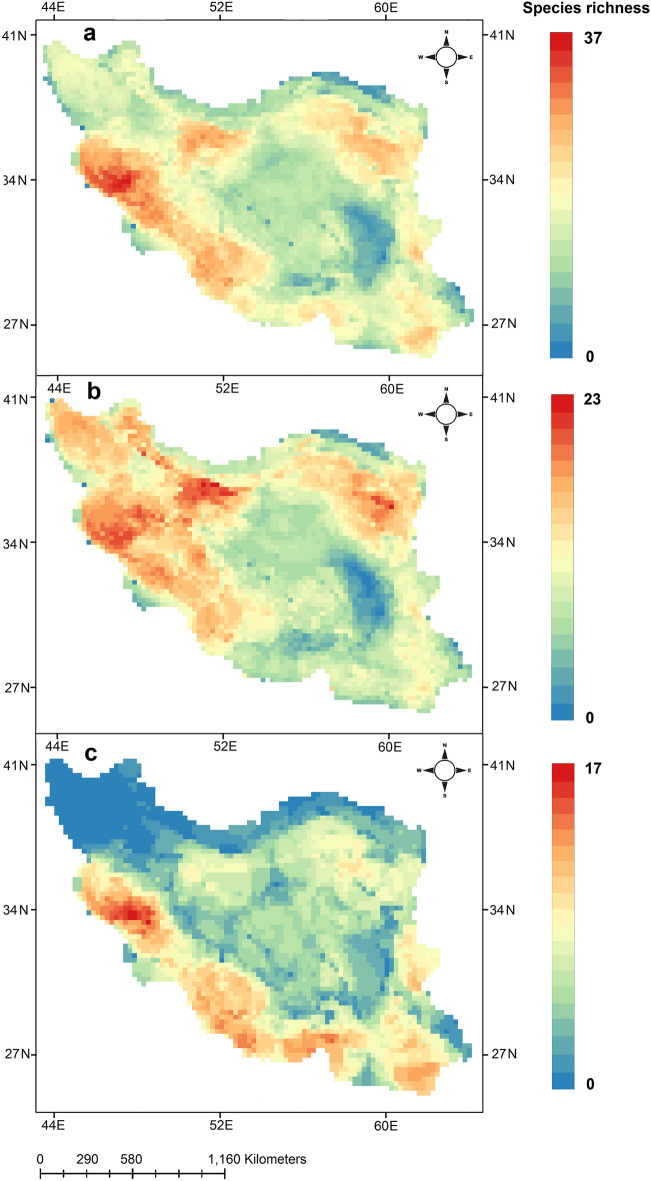
Spatial gradients of species richness can be shaped by the interplay between historical and ecological factors. They might interact in particularly complex ways in heterogeneous mountainous landscapes with strong climatic and geological contrasts. We mapped the distribution of 171 lizard species to investigate species richness patterns for all species (171), diurnal species (101), and nocturnal species (70) separately. We related species richness with the historical (past climate change, mountain uplifting) and ecological variables (climate, topography and vegetation). We found that assemblages in the Western Zagros Mountains, north eastern and north western parts of Central Iranian Plateau have the highest number of lizard species. Among the investigated variables, annual mean temperature explained the largest variance for all species (10%) and nocturnal species (31%). For diurnal species, temperature change velocity shows strongest explained variance in observed richness pattern (26%). Together, our results reveal that areas with annual temperature of 15-20 °C, which receive 400-600 mm precipitation and experienced moderate level of climate change since the Last Glacial Maximum (LGM) have highest number of species. Documented patterns of our study provide a baseline for understanding the potential effect of ongoing climate change on lizard diversity in Iran.
物种丰富度的空间梯度可以通过历史和生态因素的相互作用来塑造。在具有强烈气候和地质对比的多山异质景观中,它们可能以特别复杂的方式相互作用。我们绘制了 171 种蜥蜴物种的分布情况,以分别调查所有物种(171 种)、昼行性物种(101 种)和夜行性物种(70 种)的丰富度模式。我们将物种丰富度与历史因素(过去的气候变化、山脉抬升)和生态变量(气候、地形和植被)联系起来。我们发现,在西扎格罗斯山脉、伊朗高原中东部和西北部地区的蜥蜴物种数量最多。在所研究的变量中,年平均温度对所有物种(10%)和夜行性物种(31%)的方差解释最大。对于昼行性物种,温度变化速度在观察到的丰富度模式中表现出最强的解释方差(26%)。总之,我们的研究结果表明,在过去的末次冰期以来,温度在 15-20°C 之间、年降水量在 400-600 毫米之间、气候变化程度适中的地区拥有最多的物种。我们的研究结果为了解伊朗蜥蜴多样性受当前气候变化的潜在影响提供了一个基线。