Department of Neurosurgery, All India Institute of Medical Sciences, Veerbhadra Road, Rishikesh, Uttarakhand 249203, India.
Department of Neurosurgery, All India Institute of Medical Sciences, Veerbhadra Road, Rishikesh, Uttarakhand 249203, India.
J Clin Neurosci. 2020 Oct;80:156-161. doi: 10.1016/j.jocn.2020.07.055. Epub 2020 Aug 19.
There has been a dramatic change in the pattern of patients being seen in hospitals and surgeries performed during the ongoing COVID-19 pandemic. The objective of this study is to study the change in the volume and spectrum of surgeries performed during the ongoing COVID-19 pandemic compared to pre-COVID-19 era.
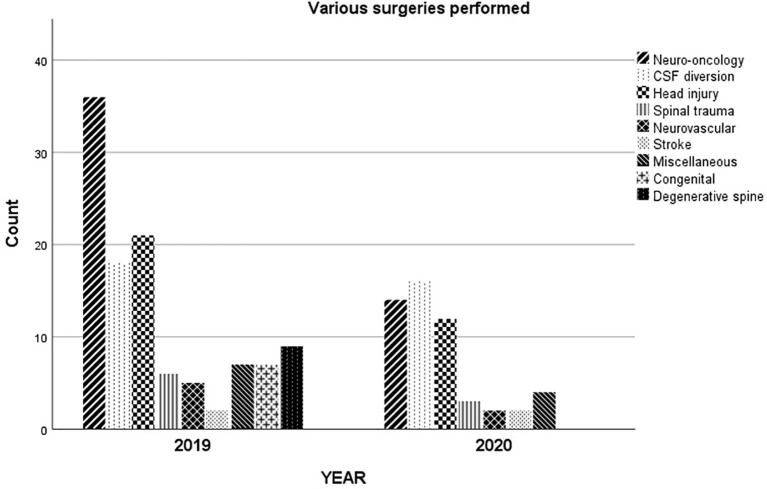
Details of all patients who were operated under department of neurosurgery at our institute since the onset of COVID-19 pandemic in India were collected and compared to the same time period last year. The demographic profile, diagnosis, surgery performed, type of surgery (routine/emergency, cranial/spinal and major/minor) in these two groups were compared. They were further categorized into various categories [neuro-oncology (brain and spine tumors), neuro-trauma (head injury and spinal trauma), congenital cases, degenerative spine, neuro-vascular, CSF diversion procedures, etc.] and compared between the two groups.
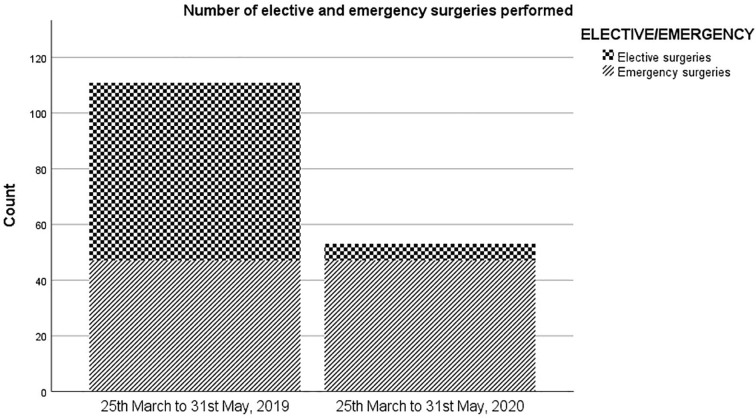
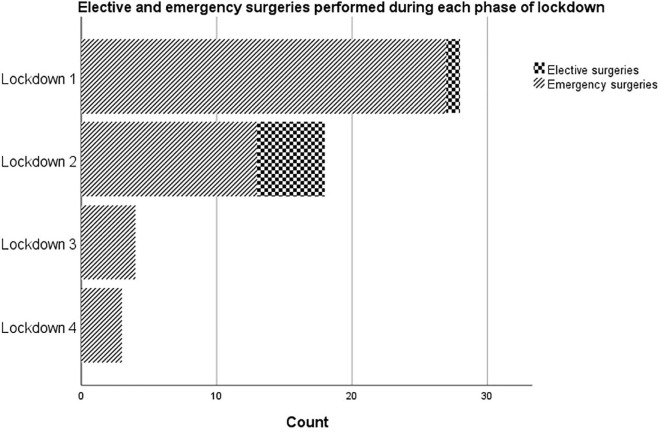
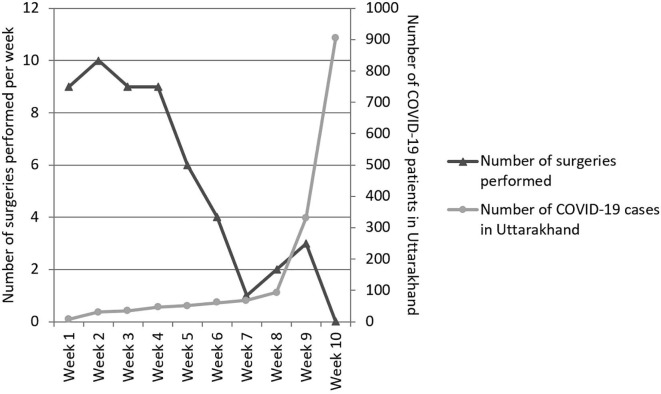
Our study showed a drastic fall (52.2%) in the number of surgeries performed during the pandemic compared to pre-COVID era. 11.3% of patients operated during COVID-19 pandemic were non-emergent surgeries compared to 57.7% earlier (p = 0.000). There was increase in proportion of minor cases from 28.8% to 41.5% (p = 0.106). The proportion of spinal cases decreased from 27.9% to 11.3% during the COVID-19 pandemic (p = 0.043).
The drastic decrease in the number of surgeries performed will result in large backlog of patients waiting for 'elective' surgery. There is a risk of these patients presenting at a later stage with progressed disease and the best way forward would be to resume work with necessary precautions and universal effective COVID-19 testing.
在持续的 COVID-19 大流行期间,医院就诊患者的模式和进行的手术发生了巨大变化。本研究旨在研究与 COVID-19 大流行前相比,在持续的 COVID-19 大流行期间进行的手术数量和范围的变化。
收集自印度 COVID-19 大流行开始以来在我院神经外科接受手术的所有患者的详细信息,并与去年同期进行比较。比较两组患者的人口统计学特征、诊断、手术方式、手术类型(常规/紧急、颅脑/脊柱和大/小手术)。然后将它们进一步分为各种类别[神经肿瘤学(脑和脊柱肿瘤)、神经创伤学(头部损伤和脊柱创伤)、先天性病例、退行性脊柱、神经血管、CSF 引流程序等],并在两组之间进行比较。
我们的研究表明,与 COVID-19 大流行前相比,大流行期间进行的手术数量急剧下降(52.2%)。在 COVID-19 大流行期间接受手术的患者中有 11.3%是非紧急手术,而之前这一比例为 57.7%(p=0.000)。小手术的比例从 28.8%增加到 41.5%(p=0.106)。在 COVID-19 大流行期间,脊柱病例的比例从 27.9%下降到 11.3%(p=0.043)。
手术数量的急剧减少将导致大量等待“择期”手术的患者积压。这些患者可能会在后期出现疾病进展,最佳的前进方向是在采取必要的预防措施和普遍有效的 COVID-19 检测的情况下恢复工作。