Vanderbilt University School of Medicine, Nashville, Tennessee, USA.
Vanderbilt University School of Medicine, Nashville, Tennessee, USA.
World Neurosurg. 2020 Oct;142:e183-e194. doi: 10.1016/j.wneu.2020.06.176. Epub 2020 Jun 27.
In the present study, we quantified the effect of the coronavirus disease 2019 (COVID-19) on the volume of adult and pediatric neurosurgical procedures, inpatient consultations, and clinic visits at an academic medical center.
Neurosurgical procedures, inpatient consultations, and outpatient appointments at Vanderbilt University Medical Center were identified from March 23, 2020 through May 8, 2020 (during COVID-19) and March 25, 2019 through May 10, 2019 (before COVID-19). The neurosurgical volume was compared between the 2 periods.
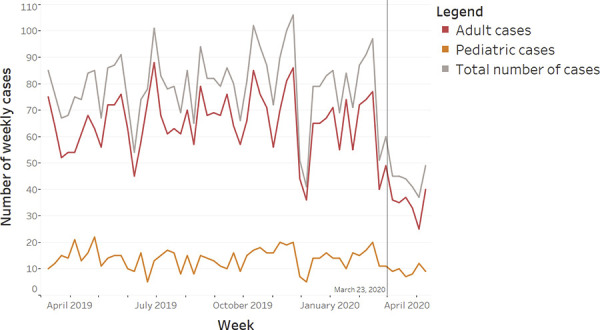
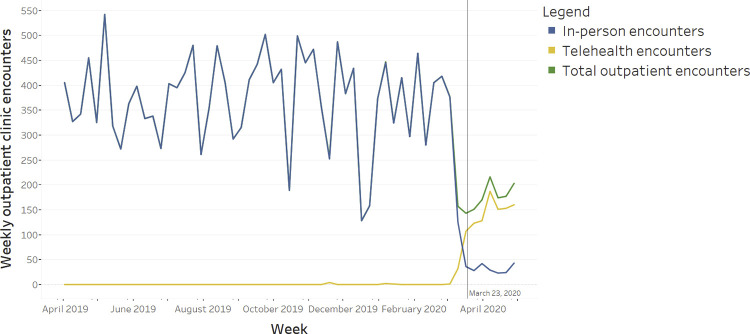
A 40% reduction in weekly procedural volume was demonstrated during COVID-19 (median before, 75; interquartile range [IQR], 72-80; median during, 45; IQR, 43-47; P < 0.001). A 42% reduction occurred in weekly adult procedures (median before, 62; IQR, 54-70; median during, 36; IQR, 34-39; P < 0.001), and a 31% reduction occurred in weekly pediatric procedures (median before, 13; IQR, 12-14; median during, 9; IQR, 8-10; P = 0.004). Among adult procedures, the most significant decreases were seen for spine (P < 0.001) and endovascular (P < 0.001) procedures and cranioplasty (P < 0.001). A significant change was not found in the adult open vascular (P = 0.291), functional (P = 0.263), cranial tumor (P = 0.143), or hydrocephalus (P = 0.173) procedural volume. Weekly inpatient consultations to neurosurgery decreased by 24% (median before, 99; IQR, 94-114; median during, 75; IQR, 68-84; P = 0.008) for adults. Weekly in-person adult and pediatric outpatient clinic visits witnessed a 91% decrease (median before, 329; IQR, 326-374; median during, 29; IQR, 26-39; P < 0.001). In contrast, weekly telehealth encounters increased from a median of 0 (IQR, 0-0) before to a median of 151 (IQR, 126-156) during COVID-19 (P < 0.001).
Significant reductions occurred in neurosurgical operations, clinic visits, and inpatient consultations during COVID-19. Telehealth was increasingly used for assessments. The long-term effects of the reduced neurosurgical volume and increased telehealth usage on patient outcomes should be explored.
在本研究中,我们量化了 2019 年冠状病毒病(COVID-19)对学术医疗中心成人和儿科神经外科手术、住院咨询和门诊量的影响。
2020 年 3 月 23 日至 5 月 8 日(COVID-19 期间)和 2019 年 3 月 25 日至 5 月 10 日(COVID-19 前)期间,从范德比尔特大学医学中心确定神经外科手术、住院咨询和门诊预约。比较了这两个时期的神经外科手术量。
COVID-19 期间每周手术量减少 40%(中位数前,75;四分位距[IQR],72-80;中位数后,45;IQR,43-47;P < 0.001)。每周成人手术减少 42%(中位数前,62;IQR,54-70;中位数后,36;IQR,34-39;P < 0.001),每周儿科手术减少 31%(中位数前,13;IQR,12-14;中位数后,9;IQR,8-10;P = 0.004)。在成人手术中,脊柱(P < 0.001)、血管内(P < 0.001)和颅骨成形术(P < 0.001)的降幅最大。成人开放性血管(P = 0.291)、功能性(P = 0.263)、颅肿瘤(P = 0.143)和脑积水(P = 0.173)手术量未见明显变化。成人神经外科住院咨询每周减少 24%(中位数前,99;IQR,94-114;中位数后,75;IQR,68-84;P = 0.008)。每周面对面的成人和儿科门诊就诊量减少了 91%(中位数前,329;IQR,326-374;中位数后,29;IQR,26-39;P < 0.001)。相比之下,COVID-19 期间每周远程医疗就诊次数中位数从 0(IQR,0-0)增加到 151(IQR,126-156)(P < 0.001)。
COVID-19 期间神经外科手术、门诊就诊和住院咨询量显著减少。远程医疗越来越多地用于评估。应探讨神经外科手术量减少和远程医疗使用增加对患者预后的长期影响。