Duval Fabrice, Mokrani Marie-Claude, Erb Alexis, Danila Vlad, Gonzalez Lopera Felix, Jeanjean Ludovic
Pôle 8/9-APF2R, Centre Hospitalier, Rouffach, France.
Front Psychiatry. 2020 Sep 18;11:533872. doi: 10.3389/fpsyt.2020.533872. eCollection 2020.
This study aimed to assess hypothalamic-pituitary dopaminergic (DA), noradrenergic (NA), thyroid (HPT), and adrenal (HPA) activity in schizophrenia, in schizoaffective disorder, and in bipolar disorder.
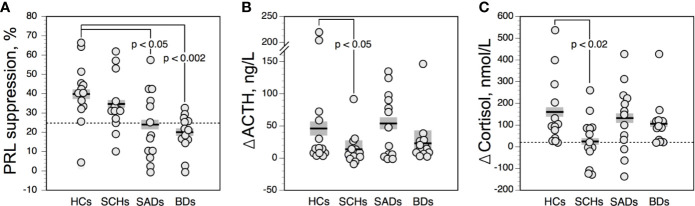
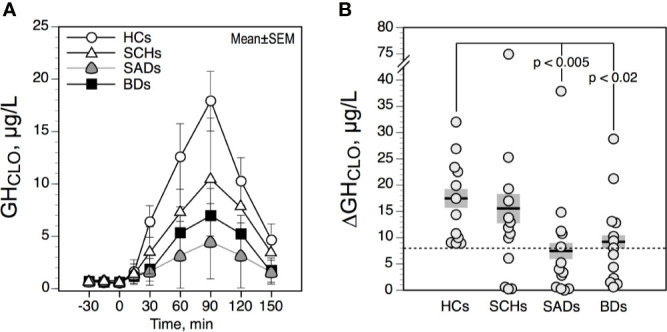
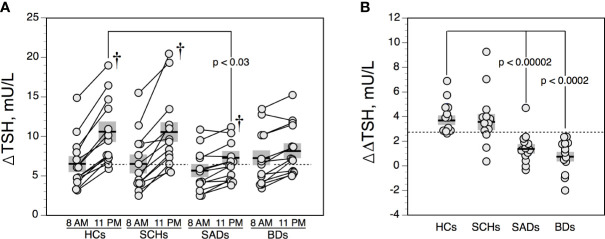
We investigated a combined approach of hormone responses to (1) apomorphine (APO), a short-acting DA receptor agonist which decreases prolactin secretion (PRL), and stimulates secretion of growth hormone (GH), adrenocorticotropin (ACTH), and cortisol; (2) clonidine (CLO), an alpha 2-adrenoceptor agonist which stimulates GH secretion; (3) 8 AM and 11 PM protirelin (TRH) which stimulates thyrotropin (TSH) secretion; and (4) dexamethasone which suppresses cortisol secretion, in 13 hospitalized healthy male controls and 39 untreated male inpatients: 13 with DSM-IV paranoid schizophrenia, 13 with DSM-IV schizoaffective disorder (bipolar subtype, depressed at the time of the study), and 13 with DSM-IV bipolar disorder (depressed).
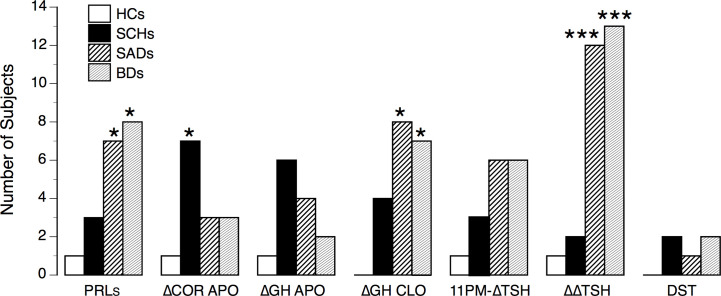
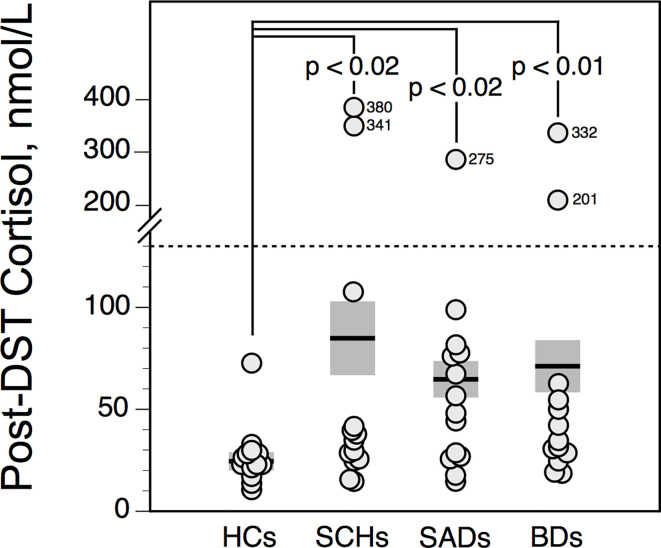
Compared to controls, paranoid schizophrenic patients showed (1) lower APO-induced ACTH and cortisol stimulation, and (2) higher post-dexamethasone cortisol values. Compared to controls, schizoaffective and bipolar patients showed (1) lower ΔΔTSH values (i.e., difference between 11 PM and 8 AM TRH-TSH responses), (2) lower APO-induced PRL suppression, (3) lower CLO-induced GH stimulation, and (4) higher post-dexamethasone cortisol values.
Although results must be interpreted with caution because of the small sample, this preliminary study suggests that depressed bipolar and schizoaffective patients share common biological dysregulations, distinct from that of paranoid schizophrenic patients. From a pathophysiological viewpoint, paranoid schizophrenic patients can be characterized by hyposensitivity of the hypothalamic DA receptors (possibly resulting from an increase in presynaptic DA release) associated with increased HPA axis activity, while depressed bipolar and schizoaffective patients can be characterized by hyposensitivity of the pituitary TRH and DA-D receptors (possibly linked to the activation of the hypothalamic TRH and tuberoinfundibular DA neurons, respectively), together with subsensitive postsynaptic α-adrenoreceptors at the hypothalamic level (possibly secondary to an erratic release of NA) and increased HPA axis activity.
本研究旨在评估精神分裂症、分裂情感性障碍和双相情感障碍患者下丘脑 - 垂体多巴胺能(DA)、去甲肾上腺素能(NA)、甲状腺(HPT)及肾上腺(HPA)的活性。
我们采用联合方法研究激素反应,具体如下:(1)阿扑吗啡(APO),一种短效DA受体激动剂,可降低催乳素(PRL)分泌,并刺激生长激素(GH)、促肾上腺皮质激素(ACTH)和皮质醇分泌;(2)可乐定(CLO),一种α2 - 肾上腺素能受体激动剂,可刺激GH分泌;(3)上午8点和晚上11点的促甲状腺激素释放激素(TRH),可刺激促甲状腺激素(TSH)分泌;(4)地塞米松,可抑制皮质醇分泌。研究对象为13名住院健康男性对照者和39名未接受治疗的男性住院患者:13例符合DSM - IV偏执型精神分裂症,13例符合DSM - IV分裂情感性障碍(双相亚型,研究时为抑郁状态),13例符合DSM - IV双相情感障碍(抑郁状态)。
与对照组相比,偏执型精神分裂症患者表现为:(1)APO诱导的ACTH和皮质醇刺激反应较低;(2)地塞米松后皮质醇值较高。与对照组相比,分裂情感性障碍和双相情感障碍患者表现为:(1)ΔΔTSH值较低(即晚上11点和上午8点TRH - TSH反应之间的差异);(2)APO诱导的PRL抑制较低;(3)CLO诱导的GH刺激较低;(4)地塞米松后皮质醇值较高。
尽管由于样本量小,结果解读需谨慎,但这项初步研究表明,抑郁的双相情感障碍和分裂情感性障碍患者存在共同的生物调节异常,与偏执型精神分裂症患者不同。从病理生理学角度来看,偏执型精神分裂症患者的特征可能是下丘脑DA受体低敏(可能是由于突触前DA释放增加),同时HPA轴活性增加;而抑郁的双相情感障碍和分裂情感性障碍患者的特征可能是垂体TRH和DA - D受体低敏(可能分别与下丘脑TRH和结节漏斗部DA神经元的激活有关),同时下丘脑水平的突触后α - 肾上腺素能受体反应迟钝(可能继发于NA的不稳定释放),以及HPA轴活性增加。