Steinert Tilman, Bechdolf Andreas, Mahler Lieselotte, Muche Rainer, Baumgardt Johanna, Bühling-Schindowski Felix, Cole Celline, Kampmann Marie, Sauter Dorothea, Vandamme Angelika, Weinmann Stefan, Hirsch Sophie
Center for Psychiatry Suedwuerttemberg, Ulm University, Ravensburg-Weissenau, Germany.
Department of Psychiatry, Psychotherapy and Psychosomatic Medicine, Vivantes Hospital Am Urban and Vivantes Hospital am Friedrichshain, Berlin, Germany.
Front Psychiatry. 2020 Sep 15;11:579176. doi: 10.3389/fpsyt.2020.579176. eCollection 2020.
Coercive measures are among the most controversial interventions in psychiatry. There is a large discrepancy between the sheer number of high-quality guidelines and the small number of scientifically accompanied initiatives to promote and evaluate their implementation into clinical routine. In Germany, an expert group developed guidelines to provide evidence- and consensus-based recommendations on how to deal with violence and coercion in psychiatry.
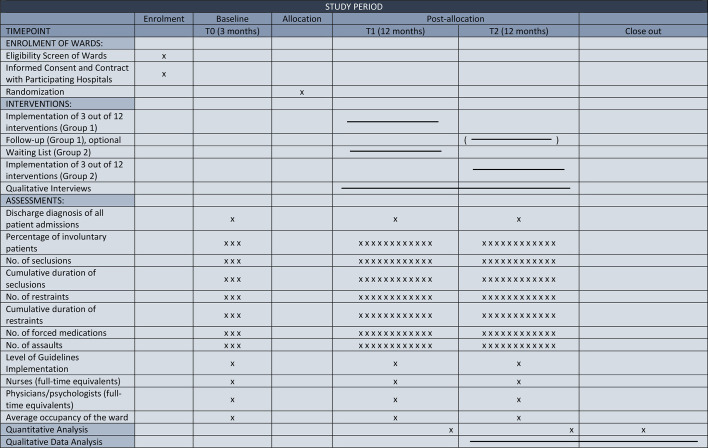
The study presented examines whether coercive measures on psychiatric wards can be reduced by means of an operationalized implementation of the guidelines "Prevention of coercion: prevention and therapy of aggressive behavior in adults". Out of a set of 12 interventions offered, wards are free to choose three interventions they want to implement. The primary outcome is the number of coercive measures per bed and month/year. Secondary outcomes are cumulative duration of coercive measures per bed and month/year. The most important control variable is the number of aggressive incidents. We plan to recruit 52 wards in Germany. Wards treating both voluntary and compulsorily admitted patients will be included. A 1:1 stratified randomized controlled trial will be conducted stratified by the amount of coercive measures and implemented aspects of the guidelines. In addition to the control group analysis, a waiting list design allows a pre-post analysis for all participating wards of the waiting list group. A parallel qualitative study will examine factors related to successful implementation and to successful reduction of coercion as well as relevant barriers.
We are planning a nationwide study on the implementation of evidence- and consensus-based guidelines in psychiatric hospitals. This study intends to promote the transfer of expert knowledge as well as results from clinical trials into clinical routine with the potential to change supply structures in mental health sector.
www.isrctn.com, identifier ISRCTN71467851.
强制手段是精神病学中最具争议的干预措施之一。高质量指南的数量众多与促进和评估其在临床常规中实施的科学配套举措数量稀少之间存在巨大差异。在德国,一个专家小组制定了指南,以提供基于证据和共识的建议,说明如何应对精神病学中的暴力和强制问题。
本研究考察了通过对“预防强制:成人攻击行为的预防和治疗”指南进行可操作的实施,是否可以减少精神病病房的强制手段。在提供的12项干预措施中,病房可自由选择三项他们想要实施的措施。主要结局是每张床位每月/每年的强制手段数量。次要结局是每张床位每月/每年强制手段的累积时长。最重要的对照变量是攻击事件的数量。我们计划在德国招募52个病房。收治自愿和非自愿住院患者的病房都将纳入。将进行1:1分层随机对照试验,根据强制手段的数量和指南的实施情况进行分层。除了对照组分析外,等待名单设计允许对等待名单组的所有参与病房进行前后分析。一项平行的定性研究将考察与成功实施、成功减少强制以及相关障碍相关的因素。
我们正在计划一项关于在精神病医院实施基于证据和共识的指南的全国性研究。本研究旨在促进专家知识以及临床试验结果向临床常规的转化,有可能改变心理健康领域的服务结构。