Guangul Fiseha M, Suhail Adeel H, Khalit Muhammad I, Khidhir Basim A
Department of Mechanical Engineering, Middle East College, PB 79, PC 124, Al Rusayl, Muscat Oman.
Educ Assess Eval Account. 2020;32(4):519-535. doi: 10.1007/s11092-020-09340-w. Epub 2020 Oct 21.
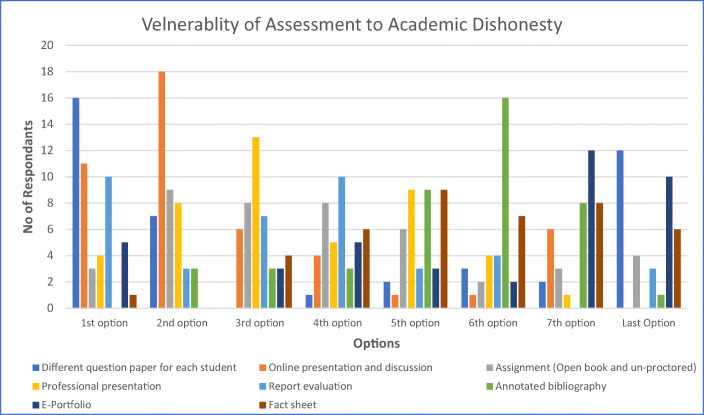
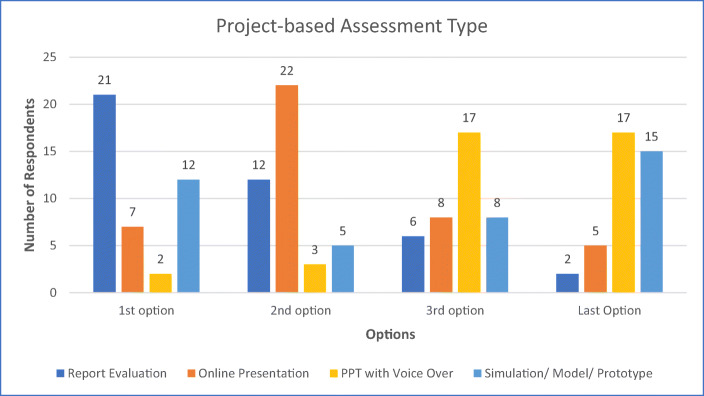
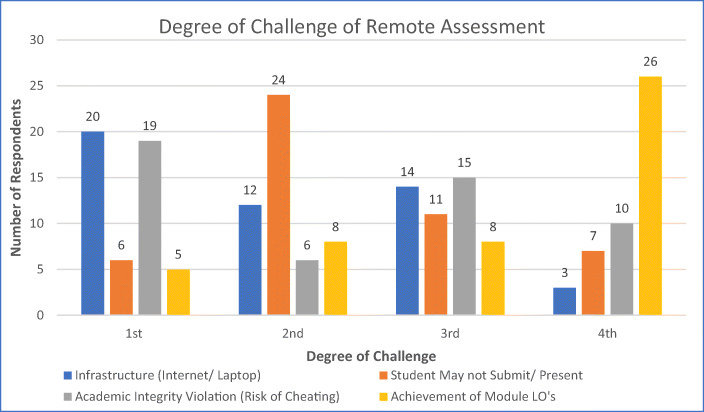
Due to the unprecedented COVID-19 incident, higher education institutions have faced different challenges in their teaching-learning activities. Particularly conducting assessments remotely during COVID-19 has posed extraordinary challenges for higher education institutions owing to lack of preparation superimposed with the inherent problems of remote assessment. In the current study, the challenges of remote assessment during COVID-19 incident in higher education institutions were investigated taking Middle East College as a case study. For the study, questionnaires were prepared and data from 50 faculties were collected and analyzed. The study focused on the challenges of remote assessment in general and academic dishonesty in particular. The main challenges identified in remote assessment were academic dishonesty, infrastructure, coverage of learning outcomes, and commitment of students to submit assessments. To minimize academic dishonesty, preparing different questions to each student was found to be the best approach. Online presentation was also found to be good option to control academic integrity violations. Combining various assessment methods, for instance report submission with online presentation, helps to minimize academic dishonesty since the examiner would have a chance to confirm whether the submitted work is the work of the student.
由于前所未有的新冠疫情事件,高等教育机构在其教学活动中面临着不同的挑战。特别是在新冠疫情期间进行远程评估,由于缺乏准备以及远程评估本身存在的问题,给高等教育机构带来了巨大挑战。在本研究中,以中东学院为例,调查了高等教育机构在新冠疫情期间远程评估的挑战。为此研究准备了问卷,并收集和分析了来自50名教师的数据。该研究主要关注远程评估的总体挑战,尤其是学术诚信问题。远程评估中确定的主要挑战包括学术诚信、基础设施、学习成果覆盖范围以及学生提交评估的积极性。为了尽量减少学术诚信问题,发现为每个学生准备不同的问题是最佳方法。在线展示也被认为是控制学术诚信违规行为的好选择。结合多种评估方法,例如报告提交与在线展示相结合,有助于尽量减少学术诚信问题,因为考官将有机会确认提交的作品是否为学生本人的作品。