da Silva Laura C E, Borges Antonio C, de Oliveira Marcelo G, de Farias Marcelo A
Institute of Chemistry, University of Campinas, UNICAMP, 13083-970 Campinas, SP, Brazil.
Brazilian Nanotechnology National Laboratory (LNNano), Brazilian Center for Research in Energy and Materials (CNPEM),13083-970 Campinas, SP, Brazil.
MethodsX. 2020 Sep 28;7:101084. doi: 10.1016/j.mex.2020.101084. eCollection 2020.
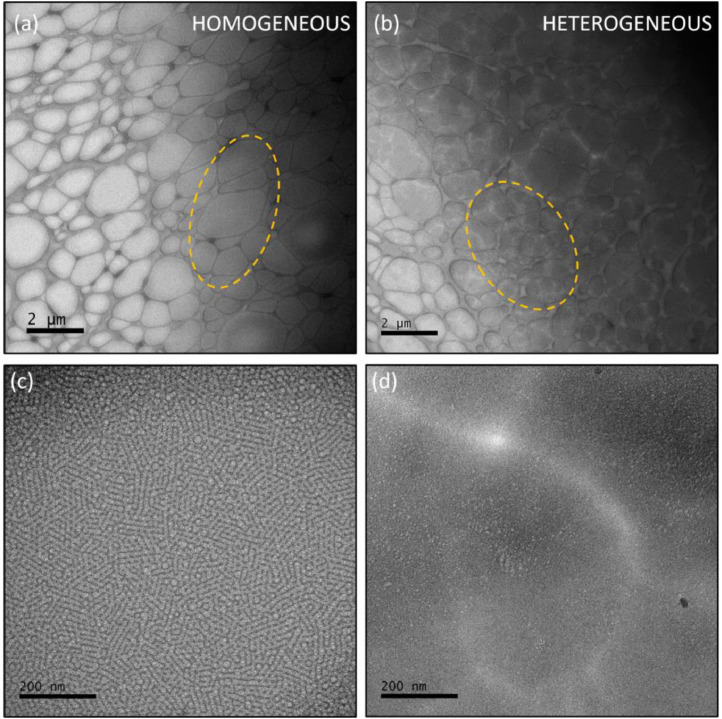
Pluronic® F127 micellar hydrogels are of growing interest to the biomedical field due to their versatility as drug delivery systems. Pluronic® F127 is a symmetric and amphiphilic triblock copolymer which in aqueous medium self-assembles into micelles that pack togetherwith increasing temperature or concentration, leading to non-flowable hydrogels. The microstructure of these hydrogels is usually investigated by small-angle X-ray scattering, which is not a readily available technique. Conversely, cryo-TEM is a widespread technique used for investigating the morphology of aqueous systems. In the case of Pluronic® F127 micellar systems, the elevated viscosity poses a significant challenge for specimen preparation and, consequently, for cryo-TEM observation. Herein, we show a trustworthy, inexpensive and readily available methodology for preparing specimens of highly viscous micellar solutions and non-flowable hydrogels using an automated vitrification system. With this methodology we were able to visualize not only the morphology of individual Pluronic® F127 micelles -but also the supramolecular structure evolution as a function of concentration. This methodology opens up a wide range of opportunities for hydrogel characterization, although additional systematic studies might be required in order to optimize and replicate it for similar systems.
普朗尼克® F127胶束水凝胶作为药物递送系统具有多功能性,在生物医学领域越来越受到关注。普朗尼克® F127是一种对称的两亲性三嵌段共聚物,在水性介质中会自组装成胶束,随着温度或浓度的增加,这些胶束聚集在一起,形成不可流动的水凝胶。这些水凝胶的微观结构通常通过小角X射线散射来研究,而这不是一种容易获得的技术。相反,冷冻透射电子显微镜(cryo-TEM)是一种广泛用于研究水性体系形态的技术。对于普朗尼克® F127胶束体系,高粘度对样品制备以及因此对冷冻透射电子显微镜观察构成了重大挑战。在此,我们展示了一种可靠、廉价且易于获得的方法,用于使用自动玻璃化系统制备高粘度胶束溶液和不可流动水凝胶的样品。通过这种方法,我们不仅能够观察到单个普朗尼克® F127胶束的形态,还能观察到超分子结构随浓度的演变。这种方法为水凝胶表征开辟了广泛的机会,尽管可能需要进行额外的系统研究,以便针对类似系统对其进行优化和复制。