Denzer Bridget R, Kulchar Rachel J, Huang Richard B, Patterson Jennifer
Department of Chemical and Biological Engineering, Princeton University, Princeton, NJ 08544, USA.
Department of Chemistry, Princeton University, Princeton, NJ 08544, USA.
Gels. 2021 Sep 29;7(4):158. doi: 10.3390/gels7040158.
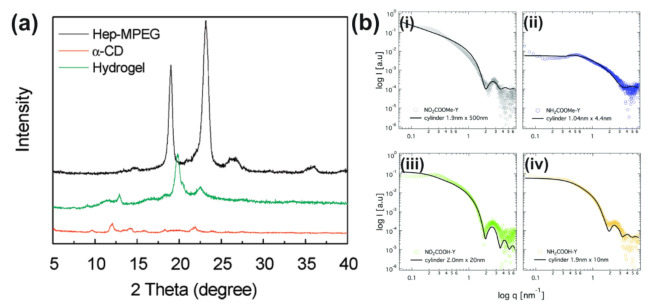
With the increased research on supramolecular hydrogels, many spectroscopic, diffraction, microscopic, and rheological techniques have been employed to better understand and characterize the material properties of these hydrogels. Specifically, spectroscopic methods are used to characterize the structure of supramolecular hydrogels on the atomic and molecular scales. Diffraction techniques rely on measurements of crystallinity and help in analyzing the structure of supramolecular hydrogels, whereas microscopy allows researchers to inspect these hydrogels at high resolution and acquire a deeper understanding of the morphology and structure of the materials. Furthermore, mechanical characterization is also important for the application of supramolecular hydrogels in different fields. This can be achieved through atomic force microscopy measurements where a probe interacts with the surface of the material. Additionally, rheological characterization can investigate the stiffness as well as the shear-thinning and self-healing properties of the hydrogels. Further, mechanical and surface characterization can be performed by micro-rheology, dynamic light scattering, and tribology methods, among others. In this review, we highlight state-of-the-art techniques for these different characterization methods, focusing on examples where they have been applied to supramolecular hydrogels, and we also provide future directions for research on the various strategies used to analyze this promising type of material.
随着对超分子水凝胶研究的增加,许多光谱、衍射、显微镜和流变学技术已被用于更好地理解和表征这些水凝胶的材料特性。具体而言,光谱方法用于在原子和分子尺度上表征超分子水凝胶的结构。衍射技术依赖于结晶度的测量,并有助于分析超分子水凝胶的结构,而显微镜则使研究人员能够以高分辨率检查这些水凝胶,并更深入地了解材料的形态和结构。此外,力学表征对于超分子水凝胶在不同领域的应用也很重要。这可以通过原子力显微镜测量来实现,其中探针与材料表面相互作用。此外,流变学表征可以研究水凝胶的刚度以及剪切变稀和自愈特性。此外,力学和表面表征可以通过微流变学、动态光散射和摩擦学方法等进行。在这篇综述中,我们重点介绍了这些不同表征方法的最新技术,重点关注它们应用于超分子水凝胶的实例,并且我们还为用于分析这种有前途的材料类型的各种策略提供了未来的研究方向。