Salfi Federico, Lauriola Marco, Amicucci Giulia, Corigliano Domenico, Viselli Lorenzo, Tempesta Daniela, Ferrara Michele
Department of Biotechnological and Applied Clinical Sciences, University of L'Aquila, L'Aquila, Italy.
Department of Social and Developmental Psychology, Sapienza University of Rome, Rome, Italy.
Neurobiol Stress. 2020 Nov;13:100259. doi: 10.1016/j.ynstr.2020.100259. Epub 2020 Oct 20.
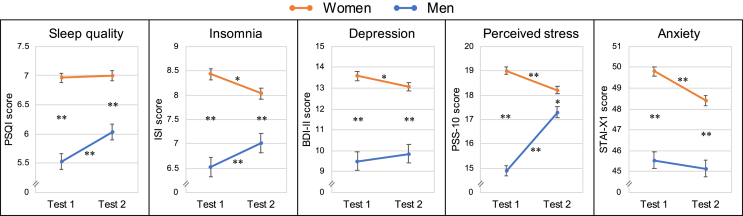
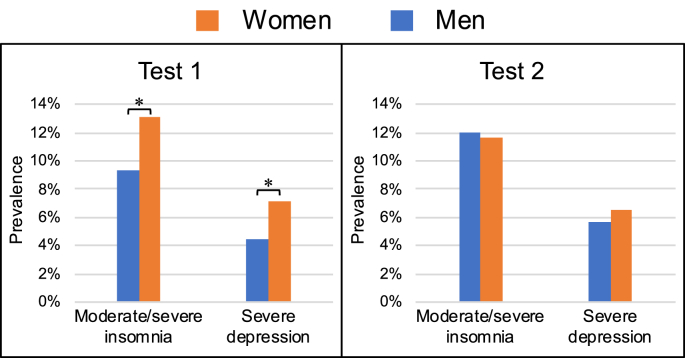
Italy was the first western hotspot of the COVID-19 pandemic. In order to contain the spread of the virus, the Italian Government imposed home confinement to the entire population for almost two months. The present study is the first large-scale longitudinal report of the sleep and mental health changes during the prolonged lockdown due to the COVID-19 outbreak. We focused on the gendered vulnerability in a sample of the Italian population since cross-sectional research identified women to be more at-risk than men during this unprecedented situation. A total of 2701 individuals (mean age ± standard deviation, 32.37 ± 11.62; range, 18-82) participated in a web-based longitudinal survey consisting of two measurements. Participants were first-time recruited on social networks and via telephone messages through a snowball sampling and tested during the third week of the lockdown period. Subsequently, a follow-up evaluation was carried out during the seventh week of restraining measures. The survey assessed sleep quality, insomnia and depression symptoms, perceived stress, and anxiety, using the following questionnaires: the Pittsburgh Sleep Quality Index, the Insomnia Severity Index, the Beck Depression Inventory-second edition, the 10-item Perceived Stress Scale, and the State-Anxiety Inventory. Female gender showed the worst condition for all the examined dimensions in both the assessments. Nevertheless, at the follow-up women reported a reduction in insomnia and depression severity symptoms, perceived stress, and anxiety. On the other hand, male participants showed a worsening of sleep quality, insomnia symptoms, and perceived stress. Consequently, the gender prevalence gap of clinical conditions such as insomnia and depression was largely reduced under lockdown. Our investigation pointed to a different time course of sleep and mental health between genders during the home confinement period. Women seemed to show greater long-term resilience during the lockdown. Meanwhile, the male gender emerges as the most vulnerable category to the extension of the restraining measures. Our results suggest that there is no "weaker gender" after a prolonged lockdown. Indeed, the Italian population transversely presented signs of psychological suffering and significant sleep disturbances after the protracted and stressful lockdown period due to the COVID-19 pandemic.
意大利是新冠疫情在西方的首个热点地区。为遏制病毒传播,意大利政府对全体民众实施了近两个月的居家隔离。本研究是关于新冠疫情爆发导致长期封锁期间睡眠和心理健康变化的首份大规模纵向报告。由于横断面研究表明在这一前所未有的情况下女性比男性面临更高风险,我们聚焦于意大利人群样本中的性别脆弱性。共有2701人(平均年龄±标准差,32.37±11.62;范围18 - 82岁)参与了一项基于网络的纵向调查,该调查包括两次测量。参与者通过滚雪球抽样首次在社交网络上以及通过电话信息招募,并在封锁期的第三周进行测试。随后,在限制措施实施的第七周进行了随访评估。该调查使用以下问卷评估睡眠质量、失眠和抑郁症状、感知压力及焦虑:匹兹堡睡眠质量指数、失眠严重程度指数、贝克抑郁量表第二版、10项感知压力量表和状态焦虑量表。在两次评估中,女性在所有被检查维度上的状况都最差。然而,在随访中,女性报告失眠和抑郁严重程度症状、感知压力及焦虑有所减轻。另一方面,男性参与者的睡眠质量、失眠症状及感知压力则有所恶化。因此,在封锁期间,失眠和抑郁等临床状况的性别患病率差距大幅缩小。我们的调查指出,在居家隔离期间,男女在睡眠和心理健康方面存在不同的时间进程。女性在封锁期间似乎表现出更强的长期恢复力。与此同时,男性成为限制措施延长后最脆弱的群体。我们的结果表明,长期封锁后不存在“更脆弱的性别”。事实上,由于新冠疫情导致的漫长且压力巨大的封锁期过后,意大利人群普遍出现了心理痛苦迹象和严重的睡眠障碍。