Aluzaite Kristina, Nuttall James W, O'Connor Maree, Harvie Ruth, Schultz Michael
Department of Medicine Dunedin School of Medicine, University of Otago Dunedin New Zealand.
Gastroenterology Unit Southern District Health Board, Dunedin Hospital Dunedin New Zealand.
JGH Open. 2020 Jul 15;4(5):987-994. doi: 10.1002/jgh3.12383. eCollection 2020 Oct.
Ostomy is a radical treatment that is sometimes required due to severe inflammatory bowel disease (IBD), colorectal cancer (CRC), and so on. Around 8000 people in New Zealand live with stoma bags. We studied factors associated with poor quality of life (QoL) in ostomy patients to improve patient care.
Eligible adult patients identified through the Southern District Health Board database were invited to participate. The survey consisted of the general stoma QoL, IBD, CRC QoL, and dietary and lifestyle questionnaires.
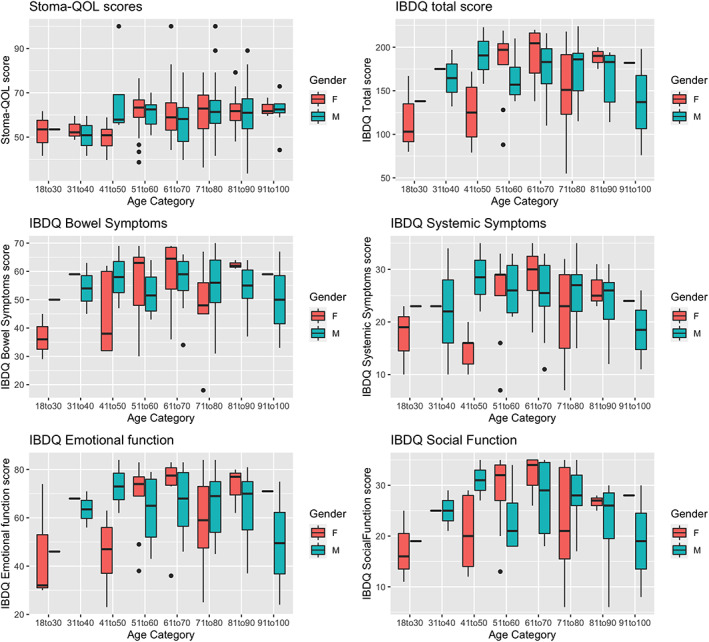
Response rate was 54.5% ( = 241/448). Study participants were a mean (SD) 70.9 (14.2) years old, 60.6% were male, and 89.5% were New Zealand European; 52.5% of the study participants had a colostomy, and 56.4 and 22.4% received their stoma due to CRC and IBD, respectively. Median (first-third interquartile range) duration since ostomy for overall study sample was 6.9 (3.3-15.1) years. Mean (SD) Stoma-QoL score for all the patients was 60.3 (10.8) points (scale 20-80). Stoma-underlying disease ( = 0.28) and type of stoma ( = 0.60) were not associated with Stoma-QoL scores. Older adults had higher Stoma-QoL, IBD questionnaire and QLQ-C30 quality-of-life scores; 73.1% received dietary recommendations for the stoma, And 56.4% changed their diet, 51.4% found it easy to adhere to dietary recommendations, and 9.2% found it quite/very difficult.
This study found high-quality life scores in postostomy patients and no significant association between the underlying disease, time since ostomy, level of comorbidities, and how the appliance worked, which highlight the multifactorial nature of the quality of life concept and difficulties measuring it.
造口术是一种根治性治疗方法,有时因严重炎症性肠病(IBD)、结直肠癌(CRC)等疾病而需要进行。新西兰约有8000人使用造口袋生活。我们研究了造口患者生活质量(QoL)差的相关因素,以改善患者护理。
通过南区卫生局数据库确定符合条件的成年患者受邀参与。该调查包括一般造口生活质量、IBD、CRC生活质量以及饮食和生活方式问卷。
回复率为54.5%(=241/448)。研究参与者的平均(标准差)年龄为70.9(14.2)岁,60.6%为男性,89.5%为新西兰欧洲人;52.5%的研究参与者进行了结肠造口术,56.4%和22.4%分别因CRC和IBD接受了造口手术。整个研究样本造口术后的中位(第一至第三四分位数范围)持续时间为6.9(3.3 - 15.1)年。所有患者的平均(标准差)造口生活质量评分是60.3(10.8)分(范围20 - 80)。造口基础疾病(=0.28)和造口类型(=0.60)与造口生活质量评分无关。老年人的造口生活质量、IBD问卷和QLQ - C30生活质量评分较高;73.1%的人收到了造口饮食建议,56.4%的人改变了饮食,51.4%的人认为容易遵守饮食建议,9.2%的人认为相当/非常困难。
本研究发现造口术后患者的生活质量评分较高,且基础疾病、造口术后时间、合并症程度以及造口器具的使用情况之间无显著关联,这突出了生活质量概念的多因素性质以及测量它的困难。