Vascular Surgery Department Hospital Santa Maria Centro Hospitalar Universitário Lisboa Norte (CHULN) Lisboa Portugal.
Faculty of Medicine University of Lisbon Lisboa Portugal.
J Am Heart Assoc. 2020 Nov 3;9(21):e017468. doi: 10.1161/JAHA.120.017468. Epub 2020 Oct 26.
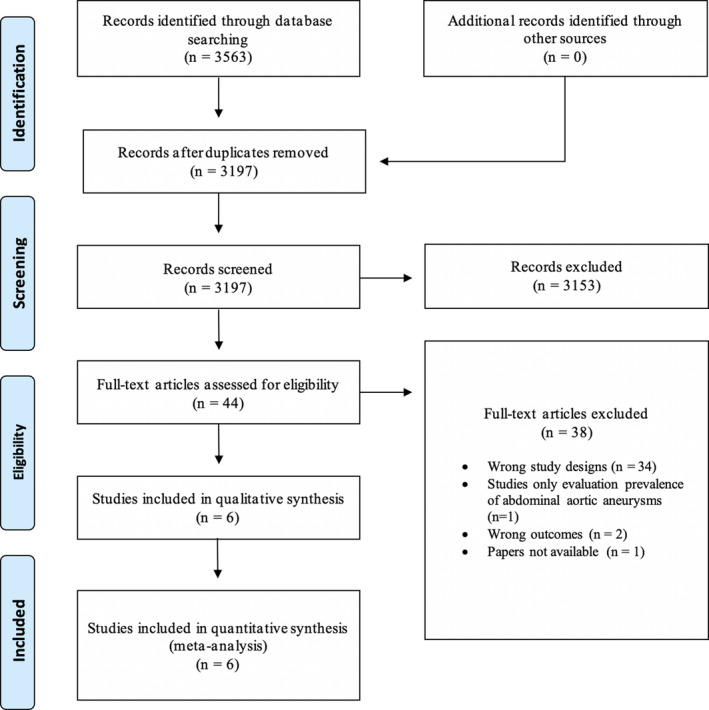
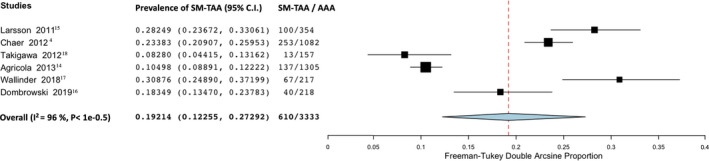
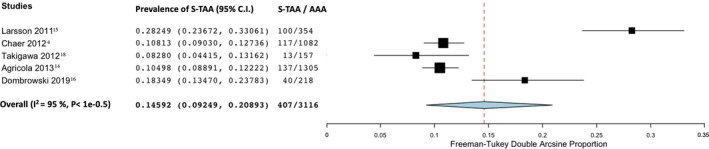
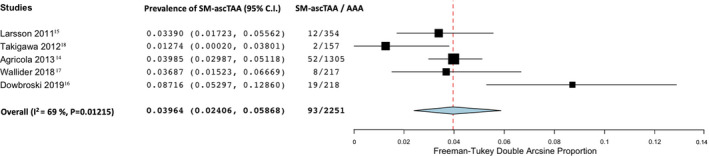
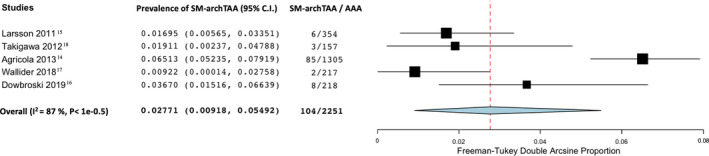
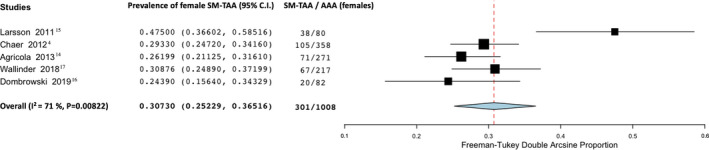
Background The prevalence of thoracic aortic aneurysms (TAA) in patients with known abdominal aortic aneurysms (AAA) is not well known and understudied. Our aim was to conduct a systematic review and meta-analysis of the overall prevalence of synchronous and metachronous TAA (SM-TAA) in patients with a known AAA and to understand the characteristics of this sub-population. Methods and Results We searched MEDLINE, EMBASE, and CENTRAL (Cochrane Central Register of Controlled Trials) from inception to November 2019 for all population-based studies reporting on the prevalence of SM-TAAs in a cohort of patients with AAA. Article screening and data extraction were performed by 2 authors and data were pooled using a random-effects model of proportions using Freeman-Tukey double arcsine transformation. The main outcome was the prevalence of SM-TAAs in patients with AAAs. Secondary outcomes were the prevalence of synchronous TAAs, metachronous TAAs, prevalence of TAAs in patients with AAA according to the anatomic location (ascending, arch, and descending) and the differences in prevalence of these aneurysms according to sex and risk factors. Six studies were included. The pooled-prevalence of SM-TAA in AAA patients was 19.2% (95% CI, 12.3-27.3). Results revealed that 15.2% (95% CI, 7.1-25.6) of men and 30.7% (95% CI, 25.2-36.5) of women with AAA had an SM-TAA. Women with AAA had a 2-fold increased risk of having an SM-TAA than men (relative risk [RRs], 2.16; 95% CI, 1.32-3.55). Diabetes mellitus was associated with a 43% decreased risk of having SM-TAA (RRs, 0.57; 95% CI, 0.41-0.80). Conclusions Since a fifth of AAA patients will have an SM-TAA, routine screening of SM-TAA and their clinical impact should be more thoroughly studied in patients with known AAA.
已知患有腹主动脉瘤(AAA)的患者中,胸主动脉瘤(TAA)的患病率尚不清楚且研究较少。我们旨在对已知 AAA 患者中同步和异时性 TAA(SM-TAA)的总体患病率进行系统评价和荟萃分析,并了解该亚人群的特征。
我们从建库至 2019 年 11 月,通过 MEDLINE、EMBASE 和 Cochrane 中心对照试验注册库(Cochrane Central Register of Controlled Trials),对所有报道了 AAA 患者队列中 SM-TAA 患病率的基于人群的研究进行了文章筛选和数据提取。由 2 名作者进行文章筛选和数据提取,使用 Freeman-Tukey 双反正弦变换的随机效应模型对数据进行汇总。主要结局是 AAA 患者中 SM-TAA 的患病率。次要结局为同步 TAA、异时性 TAA、AAA 患者中 TAA 的患病率(根据解剖部位:升主动脉、主动脉弓和降主动脉)以及这些动脉瘤根据性别和危险因素的患病率差异。纳入了 6 项研究。AAA 患者中 SM-TAA 的汇总患病率为 19.2%(95%CI,12.3-27.3)。结果显示,15.2%(95%CI,7.1-25.6)的男性和 30.7%(95%CI,25.2-36.5)的女性 AAA 患者存在 SM-TAA。与男性相比,女性 AAA 患者发生 SM-TAA 的风险增加了 2 倍(相对风险 [RR],2.16;95%CI,1.32-3.55)。糖尿病与发生 SM-TAA 的风险降低 43%相关(RRs,0.57;95%CI,0.41-0.80)。
由于五分之一的 AAA 患者将存在 SM-TAA,因此应更深入地研究已知 AAA 患者中 SM-TAA 的常规筛查及其对临床的影响。