
菊粉补充可改善 Uox 敲除小鼠的高尿酸血症并调节肠道微生物群。
Inulin supplementation ameliorates hyperuricemia and modulates gut microbiota in Uox-knockout mice.
机构信息
Department of Gastroenterology, The Affiliated Hospital of Qingdao University, Qingdao, 266000, Shandong, China.
Institute of Metabolic Diseases, Qingdao University, Qingdao, 266003, Shandong, China.
出版信息
Eur J Nutr. 2021 Jun;60(4):2217-2230. doi: 10.1007/s00394-020-02414-x. Epub 2020 Oct 26.
PURPOSE
Inulin is a type of fermentable dietary fiber, which is non-digestible, and can improve metabolic function by modulating intestinal microbiota. This study aimed to evaluate the role of inulin in hyperuricemia and microbial composition of the gut microbiota in a mouse model of hyperuricemia established through knockout of Uox (urate oxidase) gene.
METHODS
KO (Uox-knockout) and WT (wild-type) mice were given inulin or saline by gavage for 7 weeks. The effect of inulin to combat hyperuricemia was determined by assessing the changes in serum UA (uric acid) levels, inflammatory parameters, epithelial barrier integrity, fecal microbiota alterations, and SCFA (short-chain fatty acid) concentrations in KO mice.
RESULTS
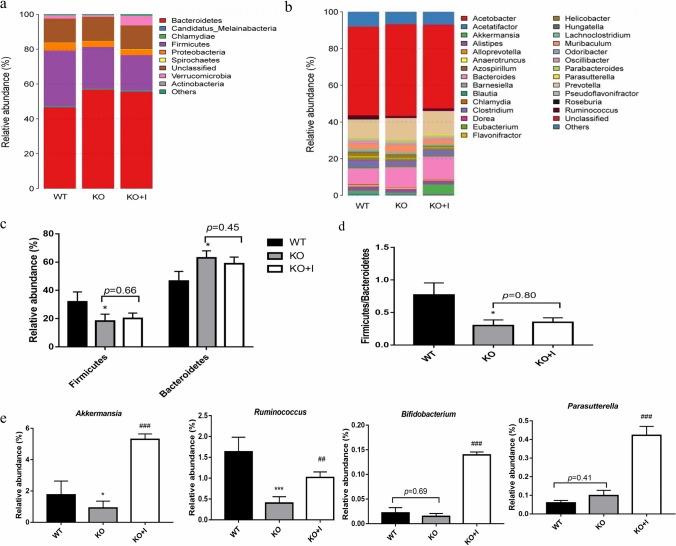
Inulin supplementation can effectively alleviate hyperuricemia, increase the expressions of ABCG2 in intestine, and downregulate expression and activity of hepatic XOD (xanthine oxidase) in KO mice. It was revealed that the levels of inflammatory cytokines and the LPS (lipopolysaccharide) were remarkably higher in the KO group than those in the WT group, indicating systemic inflammation of hyperuricemic mice, but inulin treatment ameliorated inflammation in KO mice. Besides, inulin treatment repaired the intestinal epithelial barrier as evidenced by increased levels of intestinal TJ (tight junction) proteins [ZO-1 (zonula occludens-1) and occluding] in KO mice. Moreover, serum levels of uremic toxins, including IS (indoxyl sulfate) and PCS (p-cresol sulfate), were reduced in inulin-treated KO mice. Further investigation unveiled that inulin supplementation enhanced microbial diversity and raised the relative abundance of beneficial bacteria, involving SCFAs-producing bacteria (e.g., Akkermansia and Ruminococcus). Additionally, inulin treatment increased the production of gut microbiota-derived SCFAs (acetate, propionate and butyrate concentrations) in KO mice, which was positively correlated with the effectiveness of hyperuricemia relief.
CONCLUSIONS
Our findings showed that inulin may be a promising therapeutic candidate for the treatment of hyperuricemia. Moreover, alleviation of hyperuricemia by inulin supplementation was, at least, partially conciliated by modulation of gut microbiota and its metabolites.
目的
菊粉是一种可发酵膳食纤维,不可消化,可通过调节肠道微生物群来改善代谢功能。本研究旨在评估菊粉在黄嘌呤氧化酶(urate oxidase)基因敲除建立的高尿酸血症小鼠模型中的作用及其对肠道微生物群组成的影响。
方法
给予 KO(黄嘌呤氧化酶基因敲除)和 WT(野生型)小鼠菊粉或生理盐水灌胃 7 周。通过评估 KO 小鼠血清 UA(尿酸)水平、炎症参数、上皮屏障完整性、粪便微生物群变化和 SCFA(短链脂肪酸)浓度的变化来确定菊粉对抗高尿酸血症的作用。
结果
菊粉补充可有效缓解高尿酸血症,增加肠道 ABCG2 的表达,并下调 KO 小鼠肝脏 XOD(黄嘌呤氧化酶)的表达和活性。结果表明,KO 组的炎症细胞因子和 LPS(脂多糖)水平明显高于 WT 组,表明高尿酸血症小鼠存在全身炎症,但菊粉治疗改善了 KO 小鼠的炎症。此外,菊粉治疗修复了 KO 小鼠的肠道上皮屏障,表现为肠道 TJ(紧密连接)蛋白[ZO-1(封闭蛋白-1)和闭合]水平升高。此外,血清尿毒症毒素水平,包括 IS(吲哚硫酸)和 PCS(对甲酚硫酸),在菊粉治疗的 KO 小鼠中降低。进一步研究表明,菊粉补充增加了微生物多样性,并提高了有益细菌的相对丰度,包括产生 SCFAs(短链脂肪酸)的细菌(如 Akkermansia 和 Ruminococcus)。此外,菊粉治疗增加了 KO 小鼠肠道微生物群衍生的 SCFAs(乙酸盐、丙酸盐和丁酸盐浓度)的产生,这与高尿酸血症缓解的效果呈正相关。
结论
我们的研究结果表明,菊粉可能是治疗高尿酸血症的一种有前途的治疗候选物。此外,菊粉补充缓解高尿酸血症至少部分是通过调节肠道微生物群及其代谢物来实现的。



 Zotero 插件