Department of Pathology, Microbiology and Immunology, School of Medicine, University of South Carolina, Columbia, SC 29208, USA.
Int J Mol Sci. 2020 Oct 22;21(21):7849. doi: 10.3390/ijms21217849.
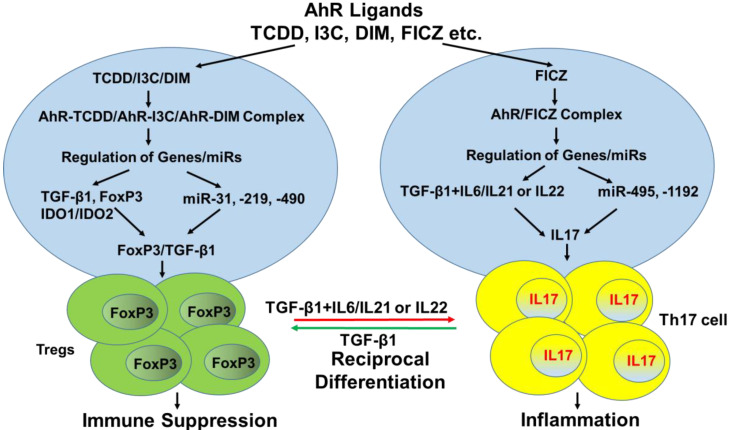
Aryl hydrocarbon receptor (AhR) was identified in the early 1970s as a receptor for the ubiquitous environmental contaminant 2,3,7,8-tetrachlorodibenzo-p-dioxin (TCDD, dioxin), which is a member of halogenated aromatic hydrocarbons (HAHs). TCDD was found to be highly toxic to the immune system, causing thymic involution and suppression of a variety of T and B cell responses. The fact that environmental chemicals cause immunosuppression led to the emergence of a new field, immunotoxicology. While studies carried out in early 1980s demonstrated that TCDD induces suppressor T cells that attenuate the immune response to antigens, further studies on these cells were abandoned due to a lack of specific markers to identify such cells. Thus, it was not until 2001 when FoxP3 was identified as a master regulator of Regulatory T cells (Tregs) that the effect of AhR activation on immunoregulation was rekindled. The more recent research on AhR has led to the emergence of AhR as not only an environmental sensor but also as a key regulator of immune response, especially the differentiation of Tregs vs. Th17 cells, by a variety of endogenous, microbial, dietary, and environmental ligands. This review not only discusses how the role of AhR emerged from it being an environmental sensor to become a key immunoregulator, but also confers the identification of new AhR ligands, which are providing novel insights into the mechanisms of Treg vs. Th17 differentiation. Lastly, we discuss how AhR ligands can trigger epigenetic pathways, which may provide new opportunities to regulate inflammation and treat autoimmune diseases.
芳香烃受体 (AhR) 于 20 世纪 70 年代初被鉴定为普遍存在的环境污染物 2,3,7,8-四氯二苯并对二恶英 (TCDD,二恶英) 的受体,后者是卤代芳烃 (HAHs) 的一种。TCDD 被发现对免疫系统具有高度毒性,导致胸腺萎缩和多种 T 细胞和 B 细胞反应受到抑制。环境化学物质引起免疫抑制的事实导致了一个新领域的出现,即免疫毒理学。虽然 20 世纪 80 年代早期的研究表明 TCDD 诱导抑制性 T 细胞,从而减弱对抗原的免疫反应,但由于缺乏识别此类细胞的特异性标志物,对这些细胞的进一步研究被放弃。因此,直到 2001 年 FoxP3 被鉴定为调节性 T 细胞 (Tregs) 的主调控因子时,AhR 激活对免疫调节的影响才重新受到关注。对 AhR 的更深入研究导致 AhR 不仅作为环境传感器,而且作为免疫反应的关键调节剂而出现,特别是通过各种内源性、微生物、饮食和环境配体调节 Tregs 与 Th17 细胞的分化。这篇综述不仅讨论了 AhR 的作用如何从作为环境传感器转变为关键免疫调节剂,还介绍了新的 AhR 配体的鉴定,这为 Tregs 与 Th17 分化的机制提供了新的见解。最后,我们讨论了 AhR 配体如何触发表观遗传途径,这可能为调节炎症和治疗自身免疫性疾病提供新的机会。