School of Population Health, University of Auckland, Auckland, New Zealand.
Menzies Centre for Health Policy, The University of Sydney, Sydney, NSW, Australia.
Int J Health Policy Manag. 2021 Dec 1;10(12):745-765. doi: 10.34172/ijhpm.2020.189.
Achieving healthy food systems will require regulation across the supply chain; however, binding international economic agreements may be constraining policy space for regulatory intervention in a way that limits uptake of 'best-practice' nutrition policy. A deeper understanding of the mechanisms through which this occurs, and under which conditions, can inform public health engagement with the economic policy sector.
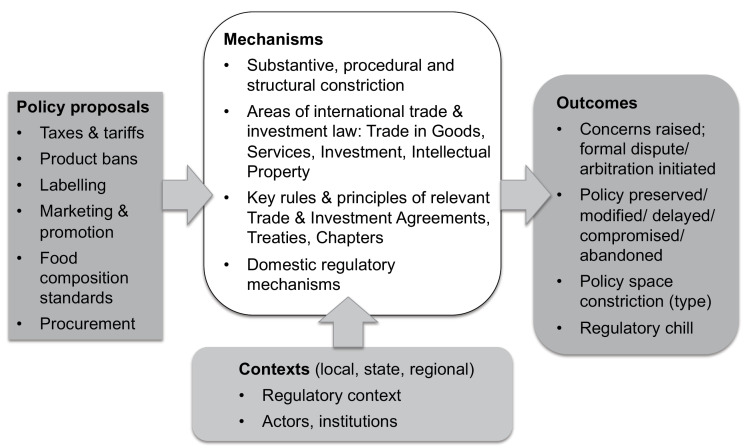
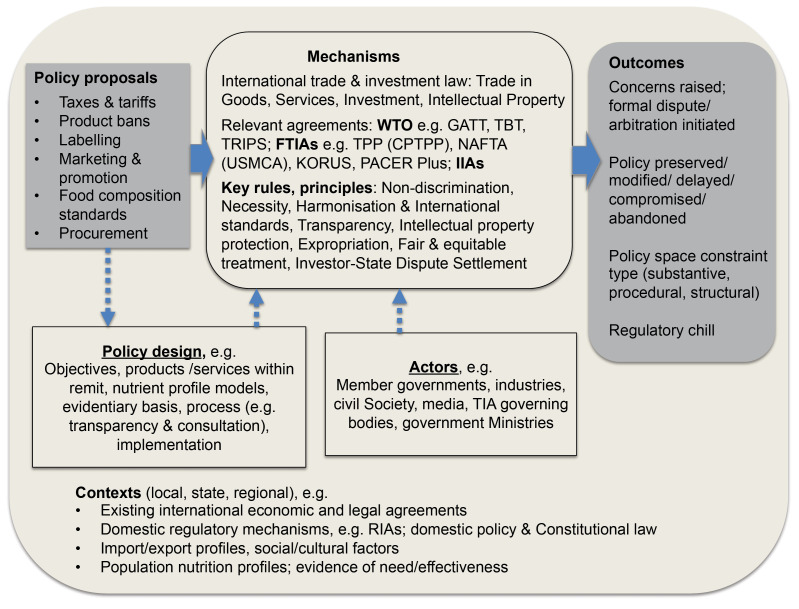
We conducted a realist review of nutrition, policy and legal literature to identify mechanisms through which international trade and investment agreements (TIAs) constrain policy space for priority food environment regulations to prevent non-communicable diseases (NCDs). Recommended regulations explored include fiscal policies, product bans, nutrition labelling, advertising restrictions, nutrient composition regulations, and procurement policies. The process involved 5 steps: initial conceptual framework development; search for relevant empirical literature; study selection and appraisal; data extraction; analysis and synthesis, and framework revision.
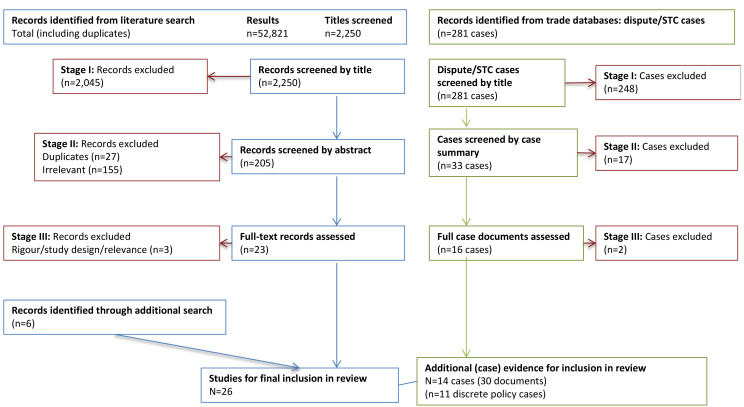
Twenty-six studies and 30 institutional records of formal trade/investment disputes or specific trade concerns (STCs) raised were included. We identified 13 cases in which TIA constraints on nutrition policy space could be observed. Significant constraints on nutrition policy space were documented with respect to fiscal policies, product bans, and labelling policies in 4 middle-income country jurisdictions, via 3 different TIAs. In 7 cases, trade-related concerns were raised but policies were ultimately preserved. Two of the included cases were ongoing at the time of analysis. TIAs constrained policy space through 1) TIA rules and principles (non- discrimination, necessity, international standards, transparency, intellectual property rights, expropriation, and fair and equitable treatment), and 2) interaction with policy design (objectives framed, products/services affected, nutrient thresholds chosen, formats, and time given to comment or implement). Contextual factors of importance included: actors/institutions, and political/regulatory context.
Available evidence suggests that there are potential TIA contributors to policy inertia on nutrition. Strategic policy design can avoid most substantive constraints. However, process constraints in the name of good regulatory practice (investor-state dispute settlement (ISDS), transparency, regulatory coherence, and harmonisation) pose a more serious threat of reducing government policy space to enact healthy food policies.
实现健康的食品体系需要对供应链进行监管;然而,具有约束力的国际经济协议可能会限制监管干预的政策空间,从而限制了“最佳实践”营养政策的采用。更深入地了解这种情况发生的机制以及在哪些情况下发生,可以为公共卫生部门参与经济政策提供信息。
我们对营养、政策和法律文献进行了真实主义审查,以确定国际贸易和投资协定(TIA)如何通过限制优先食品环境法规的政策空间来防止非传染性疾病(NCD)的机制。探讨的建议法规包括财政政策、产品禁令、营养标签、广告限制、营养成分法规和采购政策。该过程涉及 5 个步骤:初始概念框架的制定;搜索相关的实证文献;研究选择和评估;数据提取;分析和综合以及框架修订。
共纳入 26 项研究和 30 项正式贸易/投资争端或具体贸易关注(STC)的机构记录。我们发现,在 4 个中等收入国家司法管辖区,可以观察到 TIA 对营养政策空间的限制。通过 3 个不同的 TIA,在财政政策、产品禁令和标签政策方面,记录了对营养政策空间的重大限制。在 7 个案例中,提出了与贸易相关的问题,但最终保留了政策。在分析时,包括两个案例仍在进行中。TIA 通过以下方式限制了政策空间:1)TIA 规则和原则(非歧视、必要性、国际标准、透明度、知识产权、征收和公平公正待遇),以及 2)与政策设计的相互作用(目标框架、受影响的产品/服务、选择的营养阈值、格式以及提出意见或实施的时间)。重要的背景因素包括:行为体/机构以及政治/监管背景。
现有证据表明,国际贸易协定可能是营养政策惰性的促成因素。战略性政策设计可以避免大多数实质性限制。然而,以良好监管实践(投资者-国家争端解决(ISDS)、透明度、监管一致性和协调)为名的程序限制对减少政府实施健康食品政策的政策空间构成了更严重的威胁。