Ranisch Robert, Nijsingh Niels, Ballantyne Angela, van Bergen Anne, Buyx Alena, Friedrich Orsolya, Hendl Tereza, Marckmann Georg, Munthe Christian, Wild Verina
International Center for Ethics in the Sciences and Humanities, University of Tübingen, Tübingen, Germany.
Institute of Ethics, History and Theory of Medicine, Ludwig-Maximilians-University Munich, Munich, Germany.
Ethics Inf Technol. 2021;23(3):285-294. doi: 10.1007/s10676-020-09566-8. Epub 2020 Oct 21.
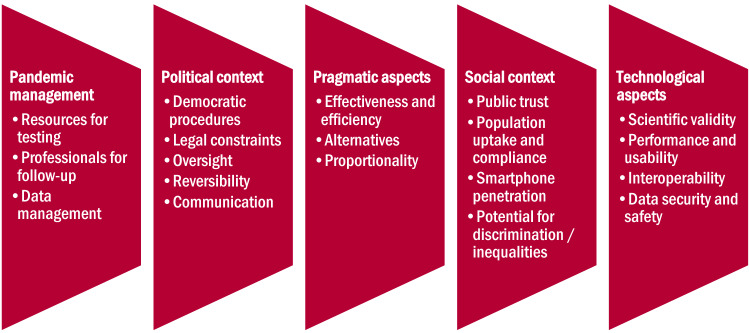
There is growing interest in contact tracing apps (CT apps) for pandemic management. It is crucial to consider ethical requirements before, while, and after implementing such apps. In this paper, we illustrate the complexity and multiplicity of the ethical considerations by presenting an ethical framework for a responsible design and implementation of CT apps. Using this framework as a starting point, we briefly highlight the interconnection of social and political contexts, available measures of pandemic management, and a multi-layer assessment of CT apps. We will discuss some trade-offs that arise from this perspective. We then suggest that public trust is of major importance for population uptake of contact tracing apps. Hasty, ill-prepared or badly communicated implementations of CT apps will likely undermine public trust, and as such, risk impeding general effectiveness.
对于大流行管理而言,人们对接触者追踪应用程序(CT应用程序)的兴趣与日俱增。在实施此类应用程序之前、期间和之后,考虑道德要求至关重要。在本文中,我们通过提出一个负责任地设计和实施CT应用程序的道德框架,来说明道德考量的复杂性和多样性。以这个框架为起点,我们简要强调社会和政治背景、可用的大流行管理措施以及对CT应用程序的多层评估之间的相互联系。我们将讨论从这个角度产生的一些权衡。然后我们认为,公众信任对于接触者追踪应用程序的民众接受度至关重要。仓促、准备不足或沟通不畅地实施CT应用程序可能会破坏公众信任,因此有可能阻碍总体效果。