Dipartimento Scienze Mediche e Chirurgiche, UOC di Chirurgia Generale, Fondazione Policlinico Universitario A. Gemelli IRCCS, Largo Agostino Gemelli n. 8, 00168, Rome, Italy.
Università Cattolica del Sacro Cuore, Largo Francesco Vito n. 1, 00168, Rome, Italy.
Surg Endosc. 2021 Nov;35(11):6190-6200. doi: 10.1007/s00464-020-08115-0. Epub 2020 Oct 26.
Transanal total mesorectal excision (TaTME) was introduced in 2009 as a dedicated approach for the treatment of mid-low rectal cancer. We aimed to describe and discuss the learning curve for 121 consecutive TaTME procedures performed by the same team.
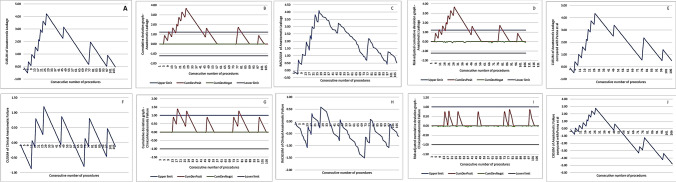
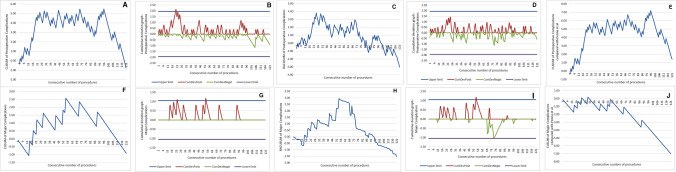
The primary outcome was the number of operations required to decrease the mean operative time (mOT). The secondary outcomes were the number of operations required to decrease the major complication (MC) rate, the anastomotic leakage (AL) rate, the clinical anastomotic failure rate, and the reoperation rate. A cumulative sum (CUSUM) curve analysis was used to identify the inflection points. As an integrative analysis, Bernoulli CUSUM curves, risk-adjusted CUSUM curves based on the observed-expected outcomes, and CUSUM curves targeting results reported in the literature were created.
Seventy-one cases were needed to overcome the OT learning curve sufficiently to reach mastery. The MC and reoperation rates started to decrease after the 54th case and further decreased after the 69th case. The AL rate started to decrease after the 27th case and remained stable at 5-5.1%. The comparison between the different phases of the learning curves confirmed these turning points.
TaTME had a learning curve of 71 cases for the mOT, 55-69 cases for MCs and reoperation, and 27 cases for AL. According to our results, attention should be paid during the first part of the learning curve to avoid an increased rate of MCs and AL.
经肛门全直肠系膜切除术(TaTME)于 2009 年作为一种专门的方法被引入,用于治疗中低位直肠癌。我们旨在描述和讨论由同一团队进行的 121 例连续 TaTME 手术的学习曲线。
主要结局是操作次数,以减少平均手术时间(mOT)。次要结局是减少主要并发症(MC)率、吻合口漏(AL)率、临床吻合口失败率和再次手术率所需的操作次数。使用累积和(CUSUM)曲线分析来确定拐点。作为综合分析,创建了 Bernoulli CUSUM 曲线、基于观察到的预期结果的风险调整 CUSUM 曲线以及针对文献中报告的结果的 CUSUM 曲线。
需要 71 例来克服足够的 OT 学习曲线以达到精通。MC 和再次手术率在第 54 例后开始下降,在第 69 例后进一步下降。AL 率在第 27 例后开始下降,并保持在 5-5.1%的稳定水平。学习曲线不同阶段之间的比较证实了这些转折点。
TaTME 的 mOT 学习曲线为 71 例,MC 和再次手术为 55-69 例,AL 为 27 例。根据我们的结果,在学习曲线的前半部分应注意避免 MC 和 AL 发生率增加。