Department of Surgery, Cancer Center Amsterdam, Amsterdam UMC, University of Amsterdam, Amsterdam, the Netherlands.
Department of Medical Oncology, Cancer Center Amsterdam, Amsterdam UMC, University of Amsterdam, Amsterdam, the Netherlands.
Cancer Med. 2020 Dec;9(24):9385-9395. doi: 10.1002/cam4.3556. Epub 2020 Oct 27.
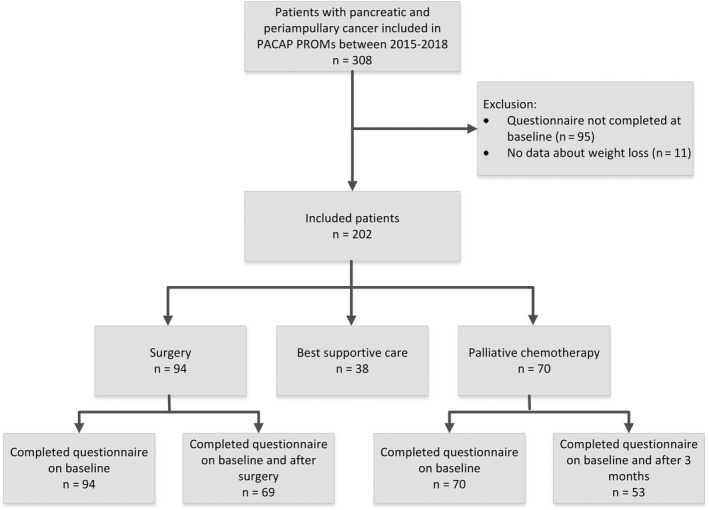
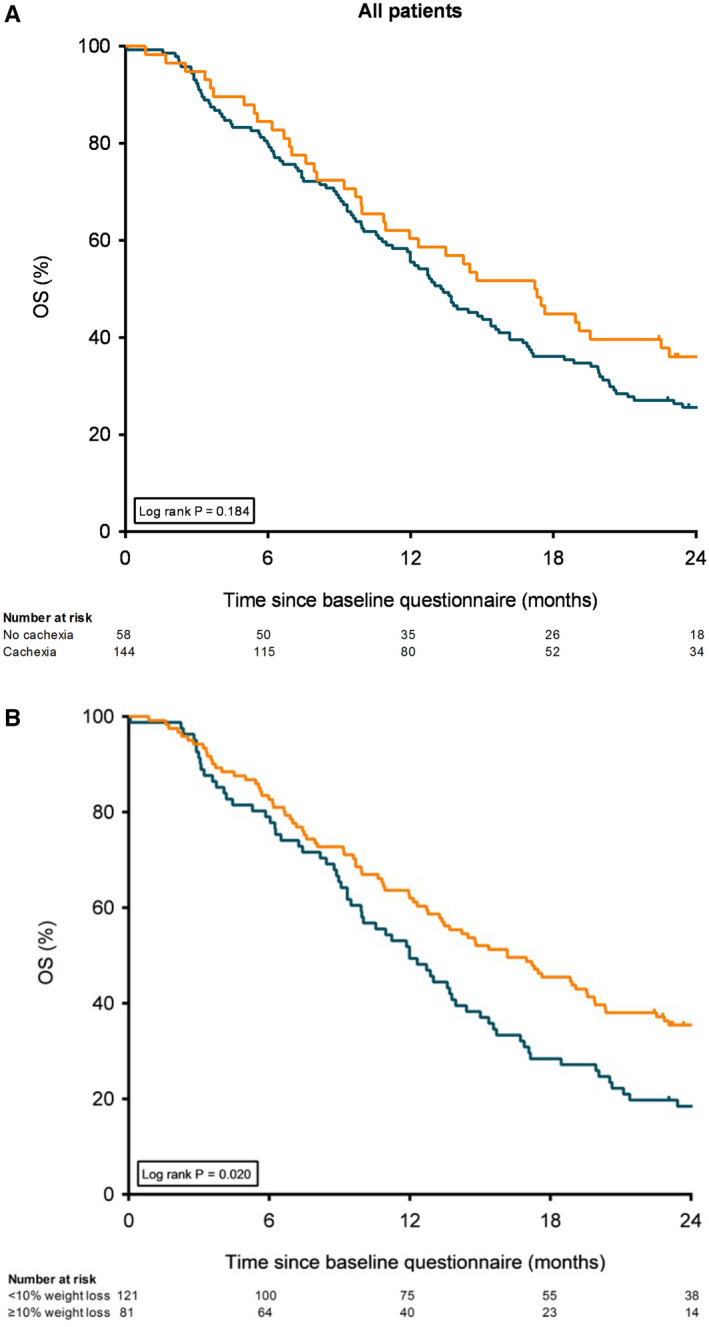
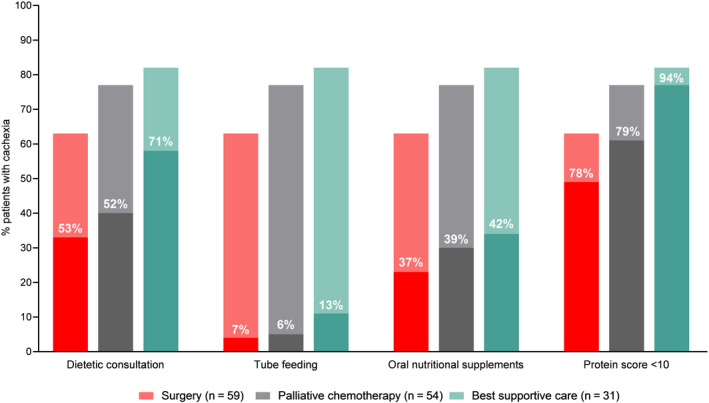
It is unclear to what extent patients with pancreatic cancer have cachexia and had a dietetic consult for nutritional support. The aim was to assess the prevalence of cachexia, dietitian consultation, and overall survival in these patients. This prospective multicenter cohort study included patients with pancreatic cancer, who participated in the Dutch Pancreatic Cancer Project and completed patient reported outcome measures (2015-2018). Additional data were obtained from the Netherlands Cancer Registry. Cachexia was defined as self-reported >5% body weight loss, or >2% in patients with a BMI <20 kg/m over the past half year. The Kaplan-Meier method was used to analyze overall survival. In total, 202 patients were included from 18 centers. Cachexia was present in 144 patients (71%) and 81 of those patients (56%) had dietetic consultation. Cachexia was present in 63% of 94 patients who underwent surgery, 77% of 70 patients who received palliative chemotherapy and 82% of 38 patients who had best supportive care. Dietitian consultation was reported in 53%, 52%, and 71%, respectively. Median overall survival did not differ between patients with and without cachexia, but decreased in those with severe weight loss (12 months (IQR 7-20) vs. 16 months (IQR 8-31), p = 0.02), as compared to those with <10% weight loss during the past half year. Two-thirds of patients with pancreatic cancer present with cachexia of which nearly half had no dietetic consultation. Survival was comparable in patients with and without cachexia, but decreased in patients with more severe weight loss.
目前尚不清楚胰腺癌患者中有多少人患有恶病质,以及有多少人接受过营养师的营养支持咨询。本研究旨在评估这些患者恶病质、营养师咨询和总生存率的流行程度。这项前瞻性多中心队列研究纳入了参加荷兰胰腺癌项目并完成患者报告结局测量(2015-2018 年)的胰腺癌患者。额外的数据来自荷兰癌症登记处。恶病质的定义为自我报告的体重减轻>5%,或 BMI<20kg/m2的患者在过去半年内体重减轻>2%。采用 Kaplan-Meier 法分析总生存率。共纳入来自 18 个中心的 202 名患者。144 名患者(71%)存在恶病质,其中 81 名患者(56%)接受了营养师咨询。接受手术的 94 名患者中 63%存在恶病质,接受姑息化疗的 70 名患者中 77%存在恶病质,接受最佳支持治疗的 38 名患者中 82%存在恶病质。报告营养师咨询的分别为 53%、52%和 71%。有恶病质和无恶病质患者的中位总生存率无差异,但与过去半年体重减轻<10%的患者相比,体重严重减轻的患者(12 个月(IQR 7-20)比 16 个月(IQR 8-31),p=0.02)的生存率降低。三分之二的胰腺癌患者存在恶病质,其中近一半患者未接受营养师咨询。有恶病质和无恶病质的患者的生存率无差异,但体重减轻更严重的患者的生存率降低。