Scholey Jessica E, Chandramohan Dharshan, Naren Tarun, Liu William, Larson Peder Eric Zufall, Sudhyadhom Atchar
Department of Radiation Oncology, The University of California, San Francisco, CA, USA.
Department of Radiology and Biomedical Imaging, The University of California, San Francisco, CA, USA.
Med Phys. 2021 Jan;48(1):342-353. doi: 10.1002/mp.14555. Epub 2020 Nov 20.
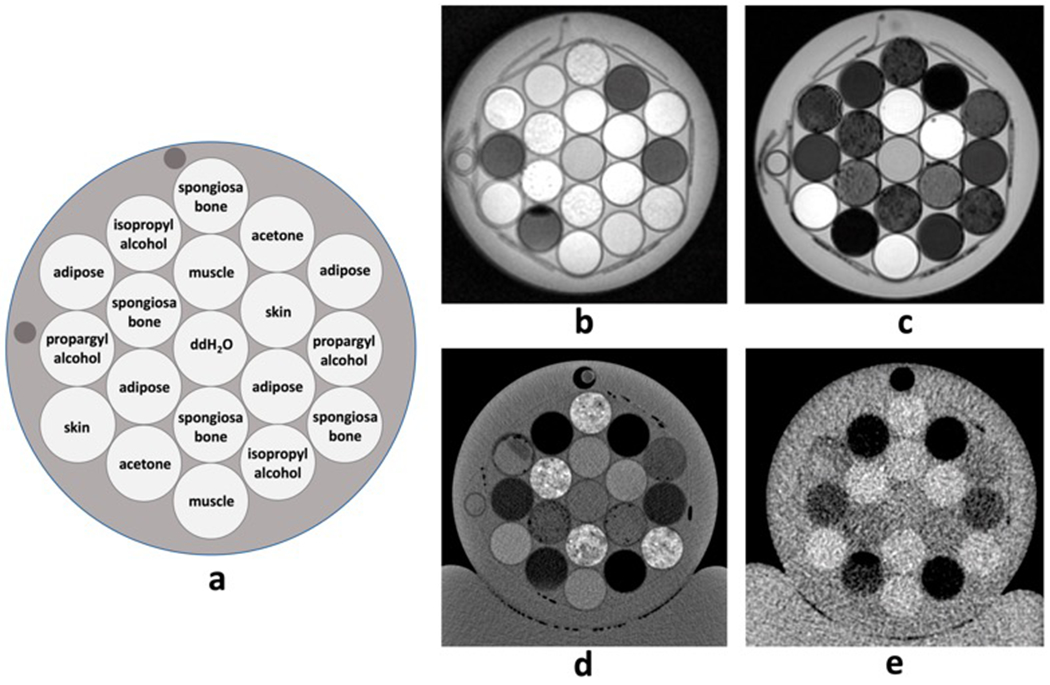
Proton therapy is becoming an increasingly popular cancer treatment modality due to the proton's physical advantage in that it deposits the majority of its energy at the distal end of its track where the tumor is located. The proton range in a material is determined from the stopping power ratio (SPR) of the material. However, SPR is typically estimated based on a computed tomography (CT) scan which can lead to range estimation errors due to the difference in x-ray and proton interactions in matter, which can preclude the ability to utilize protons to their full potential. Applications of magnetic resonance imaging (MRI) in radiotherapy have increased over the past decade and using MRI to calculate SPR directly could provide numerous advantages. The purpose of this study was to develop a practical implementation of a novel multimodal imaging method for estimating SPR and compare the results of this method to physical measurements in which values were computed directly using tissue substitute materials fabricated to mimic skin, muscle, adipose, and spongiosa bone.
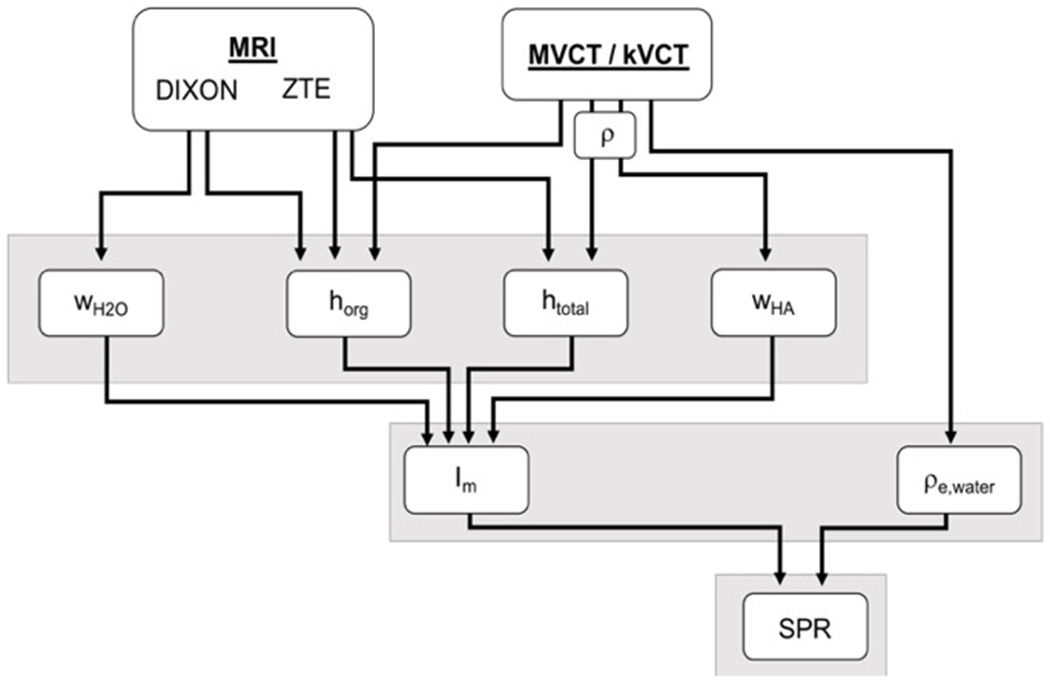
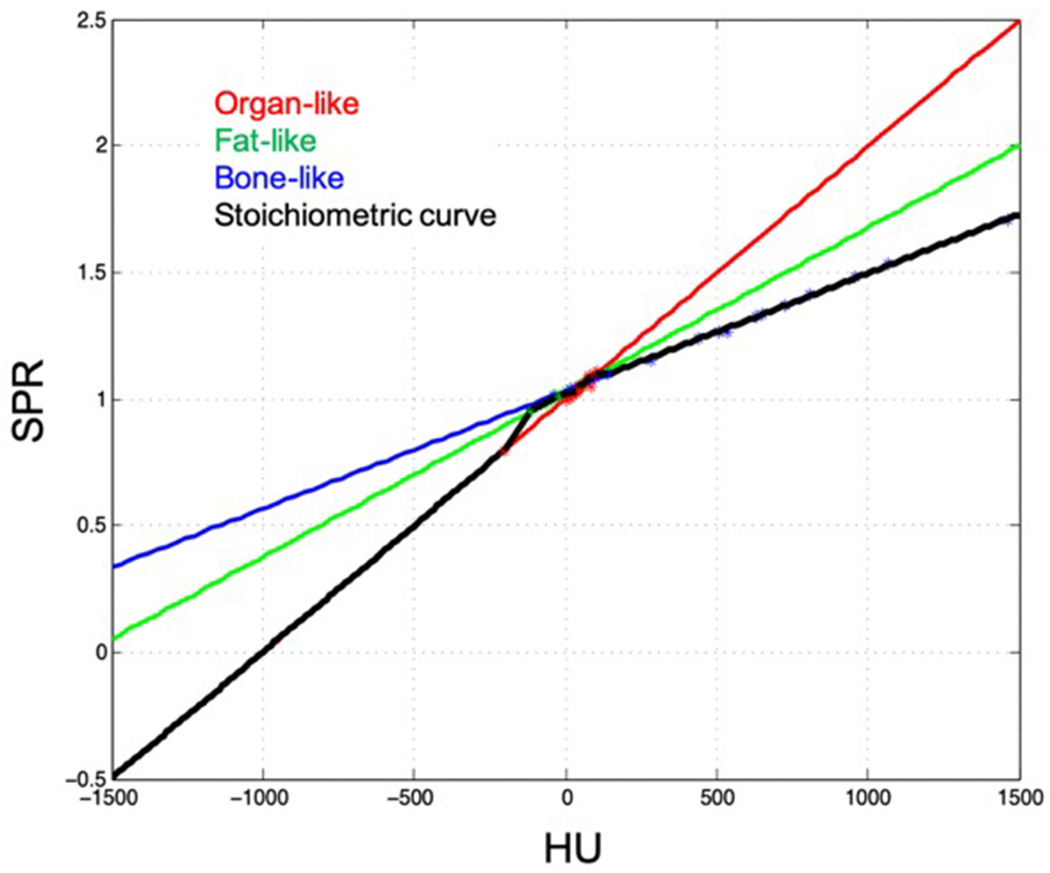
For both the multimodal imaging method and physical measurements, SPR was calculated using the Bethe-Bloch equation from values of relative electron density and mean ionization potential determined for each tissue. Parameters used to estimate SPR using the multimodal imaging method were extracted from Dixon water-only and ( H) proton density-weighted zero echo time MRI sequences and CT, with both kVCT and MVCT used separately to evaluate the performance of each. For comparison, SPR was also computed from kVCT using the stoichiometric method, the current clinical standard.
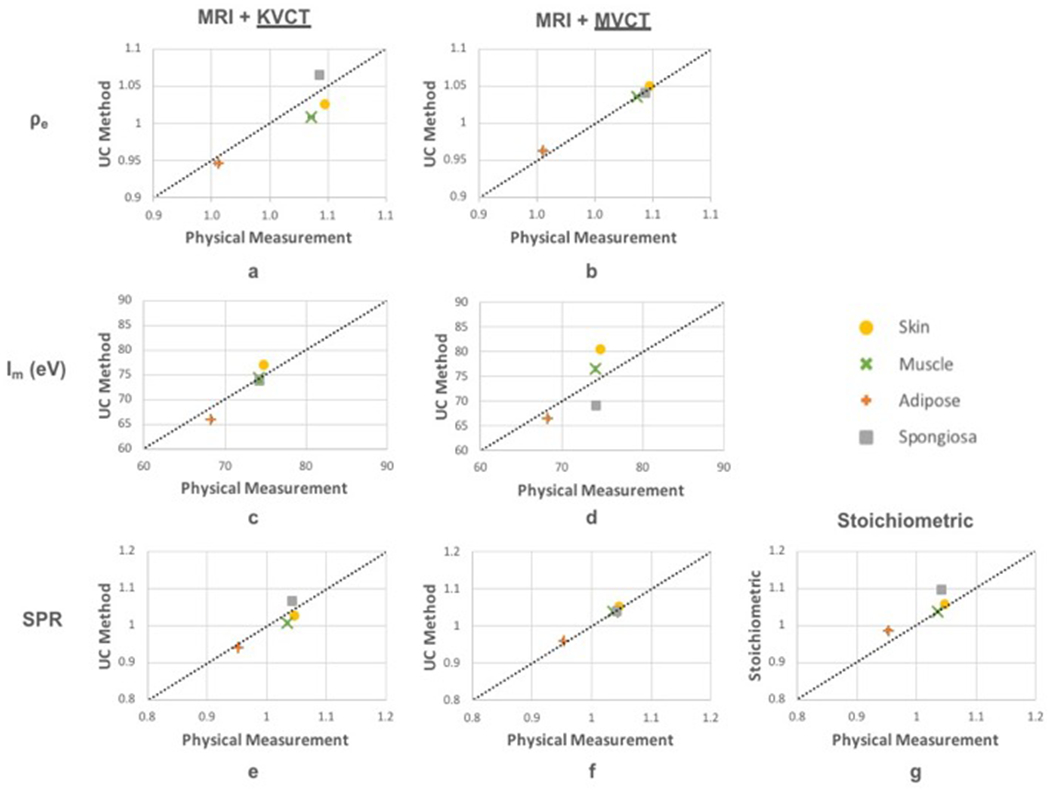
Results showed that our multimodal imaging approach using MRI with either kVCT or MVCT was in close agreement to SPR calculated from physical measurements for the four tissue substitutes evaluated. Using MRI and MVCT, SPR values estimated using our method were within 1% of physical measurements and were more accurate than the stoichiometric method for the tissue types studied.
We have demonstrated the methodology for improved estimation of SPR using the proposed multimodal imaging framework.
质子治疗正成为一种越来越受欢迎的癌症治疗方式,这是因为质子具有物理优势,即它将大部分能量沉积在其径迹的远端,也就是肿瘤所在的位置。材料中的质子射程由该材料的阻止本领比(SPR)确定。然而,SPR通常是基于计算机断层扫描(CT)来估计的,由于X射线与质子在物质中的相互作用存在差异,这可能会导致射程估计误差,进而可能妨碍充分发挥质子的治疗潜力。在过去十年中,磁共振成像(MRI)在放射治疗中的应用有所增加,直接使用MRI来计算SPR可能会带来诸多优势。本研究的目的是开发一种用于估计SPR的新型多模态成像方法的实际实施方案,并将该方法的结果与通过使用模拟皮肤、肌肉、脂肪和松质骨制造的组织替代材料直接计算得到的物理测量值进行比较。
对于多模态成像方法和物理测量,均使用贝特 - 布洛赫方程根据为每个组织确定的相对电子密度和平均电离势的值来计算SPR。使用多模态成像方法估计SPR所使用的参数是从仅水的狄克逊序列和(氢)质子密度加权零回波时间MRI序列以及CT中提取的,分别使用千伏CT(kVCT)和兆伏CT(MVCT)来评估各自的性能。为作比较,SPR也使用化学计量法从kVCT计算得出,这是当前的临床标准方法。
结果表明,我们使用kVCT或MVCT的MRI多模态成像方法与针对所评估的四种组织替代物通过物理测量计算得到的SPR非常吻合。使用MRI和MVCT时,我们的方法估计的SPR值与物理测量值相差在1%以内,并且对于所研究的组织类型比化学计量法更准确。
我们已经证明了使用所提出的多模态成像框架改进SPR估计的方法。