Department of General Surgery, Zhongda Hospital, School of Medicine, Southeast University, Nanjing, Jiangsu, China.
BMC Surg. 2020 Oct 27;20(1):255. doi: 10.1186/s12893-020-00908-3.
To explore the long-term oncological safety of using self-expanding metal stents (SEMS) as a bridge to surgery for acute obstructive colorectal cancer by comparing the pathological results of emergency surgery (ES) with elective surgery after the placement of SEMS.
Studies comparing SEMS as a bridge to surgery with emergency surgery for acute obstructive colorectal cancer were retrieved through the databases of Pubmed, Embase, and Cochrane libraries, and a meta-analysis was conducted based on the pathological results of the two treatments. Risk ratios (OR) or mean differences (MD) with 95% confidence intervals (CI) were calculated for the outcomes under random effects model.
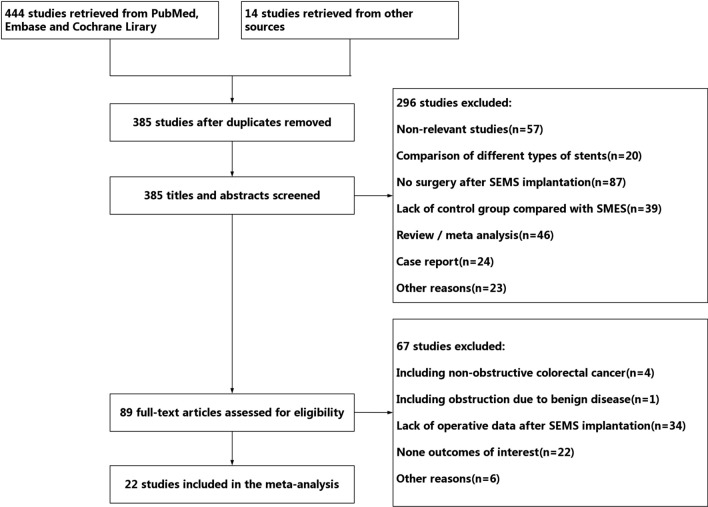
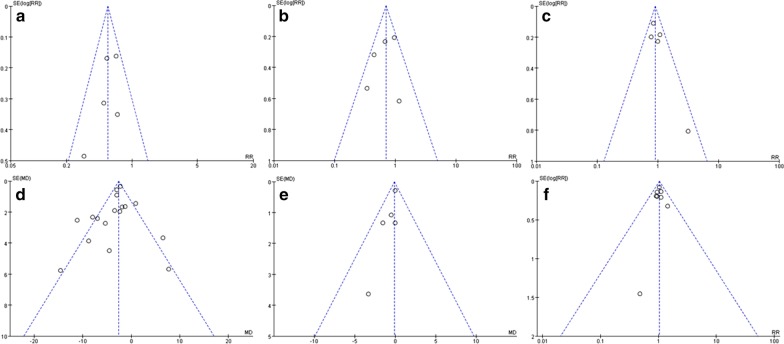
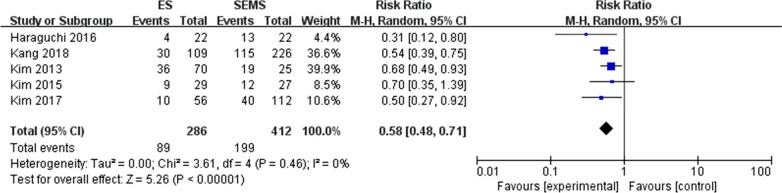
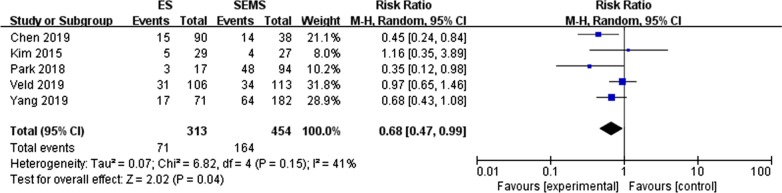
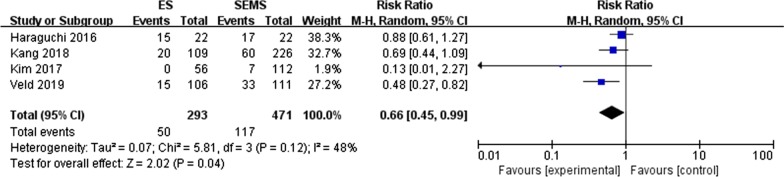
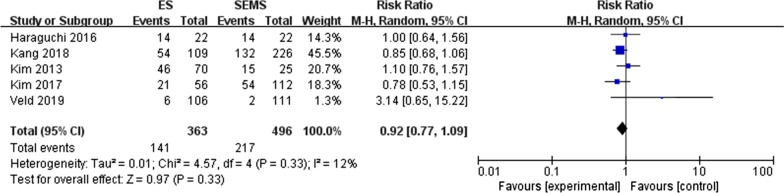
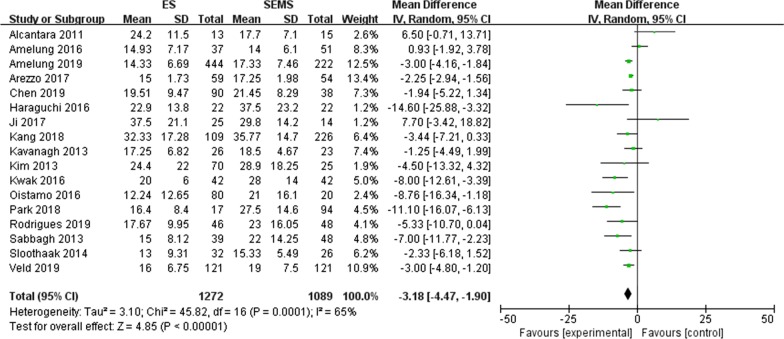
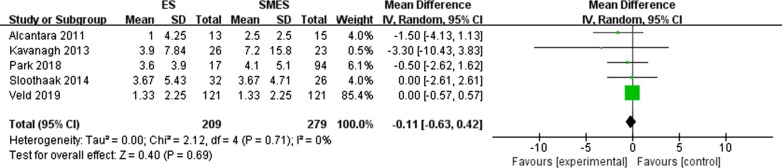
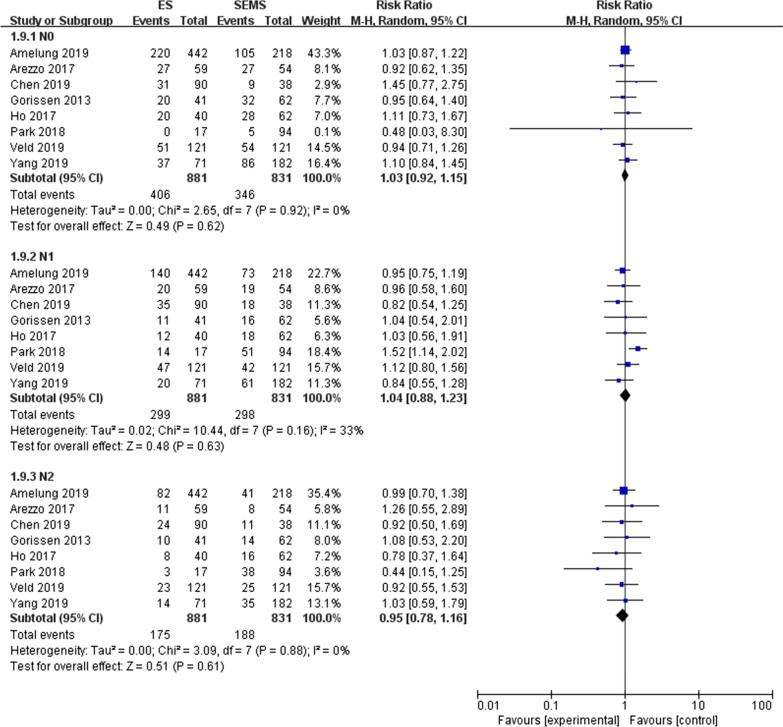
A total of 27 studies were included, including 3 randomized controlled studies, 2 prospective studies, and 22 retrospective studies, with a total of 3737 patients. The presence of perineural invasion (RR = 0.58, 95% CI 0.48, 0.71, P < 0.00001), lymphovascular invasion (RR = 0.68, 95% CI 0.47, 0.99, P = 0.004) and vascular invasion (RR = 0.66, 95% CI 0.45, 0.99, P = 0.04) in SEMS group were significantly higher than those in ES group, and there was no significant difference in lymphatic invasion (RR = 0.92, 95% CI 0.77, 1.09, P = 0.33). The number of lymph nodes harvested in SEMS group was significantly higher than that in ES group (MD = - 3.18, 95% CI - 4.47, - 1.90, P < 0.00001). While no significant difference was found in the number of positive lymph nodes (MD = - 0.11, 95% CI - 0.63, 0.42, P = 0.69) and N stage [N0 (RR = 1.03, 95% CI 0.92, 1.15, P = 0.60), N1 (RR = 0.99, 95% CI 0.87, 1.14, P = 0.91), N2 (RR = 0.94, 95% CI 0.77, 1.15, P = 0.53)].
SEMS implantation in patients with acute malignant obstructive colorectal cancer may lead to an increase in adverse tumor pathological characteristics, and these characteristics are mostly related to the poor prognosis of colorectal cancer. Although the adverse effect of SEMS on long-term survival has not been demonstrated, their adverse effects cannot be ignored. The use of SEMS as the preferred treatment for patients with resectable obstructive colorectal cancer remains to be carefully weighed, especially when patients are young or the surgical risk is not very high.
通过比较急性梗阻性结直肠癌患者使用自膨式金属支架(SEMS)桥接手术与急诊手术的病理结果,探讨 SEMS 桥接手术治疗急性梗阻性结直肠癌的长期肿瘤安全性。
通过 Pubmed、Embase 和 Cochrane 数据库检索比较 SEMS 桥接手术与急性梗阻性结直肠癌急诊手术的研究,并基于两种治疗方法的病理结果进行荟萃分析。采用随机效应模型计算结局的风险比(OR)或均数差值(MD)及其 95%置信区间(CI)。
共纳入 27 项研究,包括 3 项随机对照研究、2 项前瞻性研究和 22 项回顾性研究,共纳入 3737 例患者。SEMS 组的神经周围侵犯(RR=0.58,95%CI 0.48,0.71,P<0.00001)、脉管侵犯(RR=0.66,95%CI 0.45,0.99,P=0.04)和血管侵犯(RR=0.68,95%CI 0.47,0.99,P=0.04)的发生率明显高于急诊手术组,而两组间的淋巴血管侵犯(RR=0.92,95%CI 0.77,1.09,P=0.33)的发生率无显著差异。SEMS 组的淋巴结检出数明显多于急诊手术组(MD=-3.18,95%CI-4.47,-1.90,P<0.00001)。然而,两组间阳性淋巴结数(MD=-0.11,95%CI-0.63,0.42,P=0.69)和 N 分期[N0(RR=1.03,95%CI 0.92,1.15,P=0.60)、N1(RR=0.99,95%CI 0.87,1.14,P=0.91)、N2(RR=0.94,95%CI 0.77,1.15,P=0.53)]的差异无统计学意义。
在急性恶性梗阻性结直肠癌患者中植入 SEMS 可能导致不良肿瘤病理特征增加,这些特征主要与结直肠癌的不良预后有关。虽然 SEMS 对长期生存的不良影响尚未得到证实,但不能忽视其不良作用。SEMS 作为可切除性梗阻性结直肠癌患者的首选治疗方法仍需慎重考虑,尤其是在患者较年轻或手术风险不高的情况下。