From the Department of Anaesthesiology, Perioperative Medicine and General Intensive Care Medicine, Paracelsus Medical University, Salzburg (BZ), Department of General and Surgical Critical Care Medicine, (MB, BS, DF ), Department of Anaesthesiology and Intensive Care Medicine (HH, PI, MK, EO, MT, BT), Department of Pediatrics, Pediatrics I, Intensive Care Unit, Medical University of Innsbruck, Innsbruck (CN), Department of Mathematics, Faculty of Mathematics, Computer Science and Physics, University of Innsbruck, Technikerstrasse, Austria (TH), Department of Trauma and Orthopedic Surgery, Cologne-Merheim Medical Center (CMMC), University Witten/Herdecke (UW/H), Campus Cologne-Merheim, Cologne, Germany (MM), Institute of Thrombosis and Haemostasis and the National Haemophilia Centre, The Chaim Sheba Medical Centre, Tel Hashomer, Israel (UM), Sportclinic Zillertal GmbH, Mayrhofen, Austria (CN), Department of Anaesthesiology and Intensive Care Medicine, AUVA Trauma Centre Salzburg, Academic Teaching Hospital of the Paracelsus Medical University, Salzburg, Austria (HS, WV), Department of Anesthesiology and Intensive Care, Liberec Regional Hospital, Liberec, Czech Republic (IZ), Christophorus 14, Niederöblarn, Austria (CW).
Eur J Anaesthesiol. 2021 Apr 1;38(4):348-357. doi: 10.1097/EJA.0000000000001366.
Trauma-induced coagulopathy (TIC) substantially contributes to mortality in bleeding trauma patients.
The aim of the study was to administer fibrinogen concentrate in the prehospital setting to improve blood clot stability in trauma patients bleeding or presumed to bleed.
A prospective, randomised, placebo-controlled, double-blinded, international clinical trial.
This emergency care trial was conducted in 12 Helicopter Emergency Medical Services (HEMS) and Emergency Doctors' vehicles (NEF or NAW) and four trauma centres in Austria, Germany and Czech Republic between 2011 and 2015.
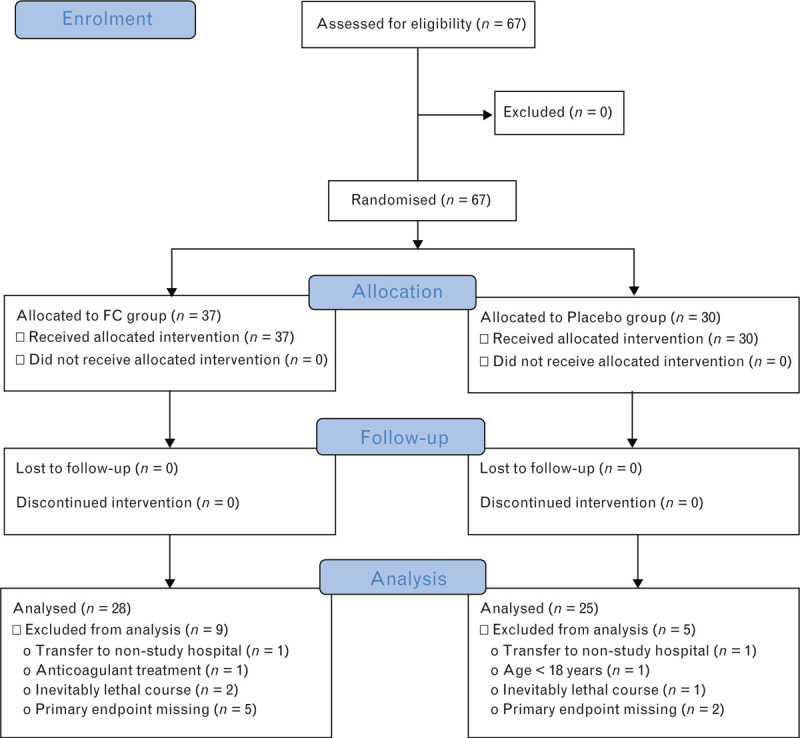
A total of 53 evaluable trauma patients aged at least 18 years with major bleeding and in need of volume therapy were included, of whom 28 received fibrinogen concentrate and 25 received placebo.
Patients were allocated to receive either fibrinogen concentrate or placebo prehospital at the scene or during transportation to the study centre.
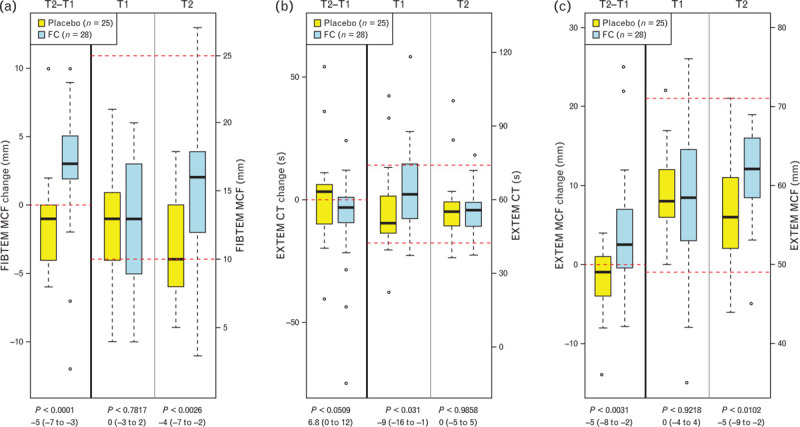
Primary outcome was the assessment of clot stability as reflected by maximum clot firmness in the FIBTEM assay (FIBTEM MCF) before and after administration of the study drug.
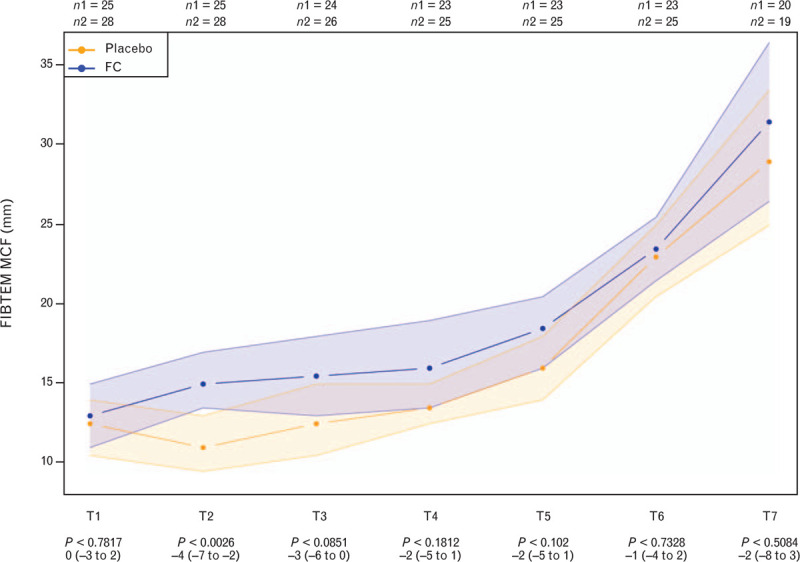
Median FIBTEM MCF decreased in the placebo group between baseline (before administration of study treatment) and admission to the Emergency Department, from a median of 12.5 [IQR 10.5 to 14] mm to 11 [9.5 to 13] mm (P = 0.0226), but increased in the FC Group from 13 [11 to 15] mm to 15 [13.5 to 17] mm (P = 0.0062). The median between-group difference in the change in FIBTEM MCF was 5 [3 to 7] mm (P < 0.0001). Median fibrinogen plasma concentrations in the fibrinogen concentrate Group were kept above the recommended critical threshold of 2.0 g l-1 throughout the observation period.
Early fibrinogen concentrate administration is feasible in the complex and time-sensitive environment of prehospital trauma care. It protects against early fibrinogen depletion, and promotes rapid blood clot initiation and clot stability.
EudraCT: 2010-022923-31 and ClinicalTrials.gov: NCT01475344.
创伤性凝血病(TIC)在出血性创伤患者的死亡率中占很大比例。
本研究的目的是在院前环境中给予纤维蛋白原浓缩物,以改善出血或疑似出血的创伤患者的血液凝块稳定性。
一项前瞻性、随机、安慰剂对照、双盲、国际临床试验。
这项急救护理试验于 2011 年至 2015 年在奥地利、德国和捷克共和国的 12 个直升机紧急医疗服务(HEMS)和急诊医生车辆(NEF 或 NAW)和四个创伤中心进行。
共纳入 53 名可评估的年龄至少 18 岁的创伤患者,有大出血且需要容量治疗,其中 28 名患者接受纤维蛋白原浓缩物治疗,25 名患者接受安慰剂治疗。
患者在现场或在送往研究中心的过程中被分配接受纤维蛋白原浓缩物或安慰剂的院前治疗。
主要结局是通过纤维蛋白原原纤维蛋白凝块(FIBTEM MCF)最大硬度评估给药前后的凝块稳定性,该指标通过纤维蛋白原原纤维蛋白凝块(FIBTEM)检测。
安慰剂组在基线(给予研究治疗前)和急诊科入院时,FIBTEM MCF 的中位数从 12.5 [IQR 10.5 至 14] mm 下降至 11 [9.5 至 13] mm(P = 0.0226),而 FC 组从 13 [11 至 15] mm 增加至 15 [13.5 至 17] mm(P = 0.0062)。两组间 FIBTEM MCF 变化的中位数差异为 5 [3 至 7] mm(P < 0.0001)。纤维蛋白原浓缩物组的纤维蛋白原血浆浓度中位数在整个观察期间保持在推荐的临界阈值 2.0 g/l-1以上。
在院前创伤护理复杂且时间敏感的环境中,早期给予纤维蛋白原浓缩物是可行的。它可以防止早期纤维蛋白原耗竭,并促进快速的血凝块启动和血凝块稳定性。
EudraCT:2010-022923-31 和 ClinicalTrials.gov:NCT01475344。