Amare Abebe Belay, Reda Terefe Mulu
Department of Midwifery, College Medicine and Health Sciences, University of Hawassa, PO Box-1560, Hawassa, Ethiopia.
Department Statistics, College of Natural and Computational Science, University of Hawassa, PO Box-1560, Hawassa, Ethiopia.
Contracept Reprod Med. 2020 Oct 23;5:29. doi: 10.1186/s40834-020-00128-3. eCollection 2020.
Despite improving the availability and use of Implants, discontinuation is becoming a public health concern. A significant proportion of women discontinuing the service before its due date, which is of concern in the health system and its consequence may lead to a program failure. This might have also social and economic consequences for users. Only 8% of married women in Ethiopia use implants. Apart from its low utilization, premature removal is common for unknown reasons. However, there is paucity of information on discontinuation of implants use and associated factors in the study area.
The study was aimed to assess discontinuation of implants use and associated factors among women attending health facility clinics in Hawassa city, southern Ethiopia, from March, 01-April, 01/2019.
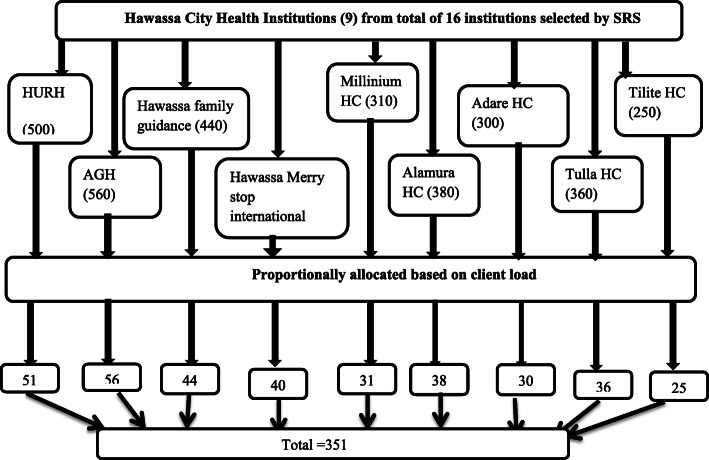
Facility based cross sectional study design was used. Out of 16 health facilities, 9 of them were selected for this study using simple random sampling. Total sample size of this study was determined to be 351. Data were collected from study subjects using pretested, structured questionnaire through a face-to-face interview. Data was analyzed using descriptive statistics and logistic regression. The result is presented using the Crude Odds ratio as well as Adjusted Odds Ratio with the corresponding 95% confidence level.
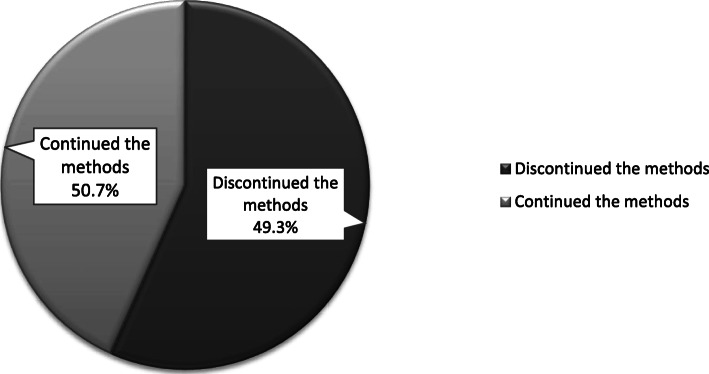
Out of 351 study participants, the overall proportion of implants discontinuation was 49.3%(95% CI: 44.2-55.0). Lack of counseling about side effects (AOR = 2.394; 95% CI: 1.422-4.030), developing side effects (AOR = 6.325; 95% CI: 3.719-10.757) and lack of post insertion follow-up (AOR = 2.241; 95% CI: 1.186-4.234) the major factors associated with discontinuation of Implants.
In this study, the overall proportion of discontinuation of Implants among women who were using Implants was high. Health professionals could give pre-insertion counseling about side effects and post insertion dates for follow-up to improve of utilization of implants.
尽管植入物的可及性和使用情况有所改善,但停用植入物正成为一个公共卫生问题。很大一部分女性在植入物到期前就停止使用了,这在卫生系统中令人担忧,其后果可能导致项目失败。这对使用者来说也可能产生社会和经济后果。在埃塞俄比亚,只有8%的已婚女性使用植入物。除了利用率低之外,不明原因的过早取出也很常见。然而,在研究地区,关于植入物使用的停用情况及其相关因素的信息很少。
本研究旨在评估2019年3月1日至4月1日期间,埃塞俄比亚南部哈瓦萨市医疗机构诊所中女性植入物使用的停用情况及其相关因素。
采用基于机构的横断面研究设计。在16家医疗机构中,通过简单随机抽样选取了9家进行本研究。本研究的总样本量确定为351。通过使用预先测试的结构化问卷,通过面对面访谈从研究对象收集数据。使用描述性统计和逻辑回归分析数据。结果以粗比值比以及调整后的比值比和相应的95%置信水平呈现。
在351名研究参与者中,植入物停用的总体比例为49.3%(95%置信区间:44.2 - 55.0)。缺乏关于副作用的咨询(调整后比值比 = 2.394;95%置信区间:1.422 - 4.030)、出现副作用(调整后比值比 = 6.325;95%置信区间:3.719 - 10.757)以及缺乏植入后随访(调整后比值比 = 2.241;95%置信区间:1.186 - 4.234)是与植入物停用相关的主要因素。
在本研究中,使用植入物的女性中植入物停用的总体比例较高。卫生专业人员可以在植入前提供关于副作用的咨询以及植入后随访日期的咨询,以提高植入物的利用率。