University of Oxford, MRC Weatherall Institute for Molecular Medicine, John Radcliffe, Oxford OX3 9DS, UK.
STAR Protoc. 2020 Jul 31;1(2):100066. doi: 10.1016/j.xpro.2020.100066. eCollection 2020 Sep 18.
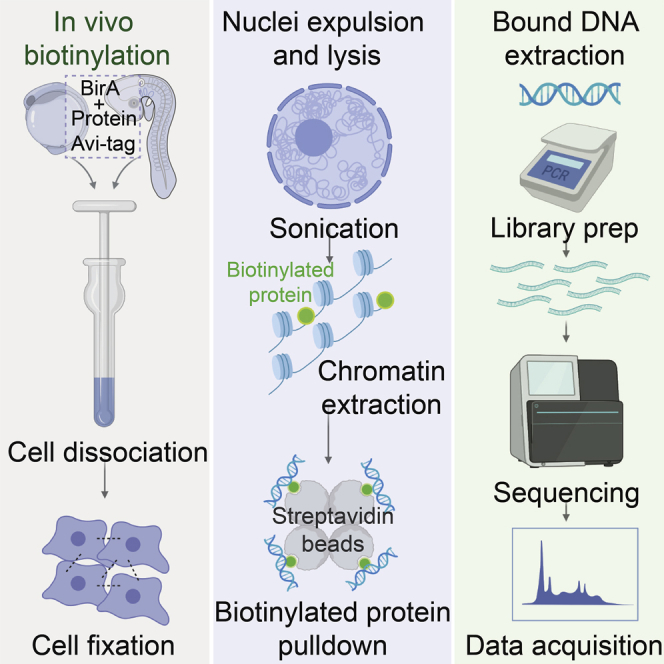
Chromatin immunoprecipitation with sequencing (ChIP-seq) has been instrumental in understanding transcription factor (TF) binding during gene regulation. ChIP-seq requires specific antibodies against desired TFs, which are not available for numerous species. Here, we describe a tissue-specific biotin ChIP-seq protocol for zebrafish and chicken embryos which utilizes AVI tagging of TFs, permitting their biotinylation by a co-expressed nuclear biotin ligase. Subsequently, biotinylated factors can be precipitated with streptavidin beads, enabling the user to construct TF genome-wide binding landscapes like conventional ChIP-seq methods. For complete details on the use and execution of this protocol, please see Lukoseviciute et al. (2018) and Ling and Sauka-Spengler (2019).
染色质免疫沉淀测序(ChIP-seq)在理解基因调控过程中转录因子(TF)结合方面发挥了重要作用。ChIP-seq 需要针对所需 TF 的特异性抗体,但对于许多物种来说,这些抗体并不存在。在这里,我们描述了一种针对斑马鱼和鸡胚胎的组织特异性生物素 ChIP-seq 方案,该方案利用 TF 的 AVI 标签,通过共表达的核生物素连接酶使其生物素化。随后,可以用链霉亲和素珠沉淀生物素化的因子,使用户能够像传统的 ChIP-seq 方法一样构建 TF 全基因组结合图谱。有关此方案使用和执行的完整详细信息,请参阅 Lukoseviciute 等人(2018 年)和 Ling 和 Sauka-Spengler(2019 年)。