Department of Family & Community Medicine, University of California San Francisco, San Francisco, CA, United States.
Center for Vulnerable Populations, University of California San Francisco, San Francisco, CA, United States.
J Med Internet Res. 2020 Oct 28;22(10):e17595. doi: 10.2196/17595.
The social media site Twitter has 145 million daily active users worldwide and has become a popular forum for users to communicate their health care concerns and experiences as patients. In the fall of 2018, a hashtag titled #DoctorsAreDickheads emerged, with almost 40,000 posts calling attention to health care experiences.
This study aims to identify common health care conditions and conceptual themes represented within the phenomenon of this viral Twitter hashtag.
We analyzed a random sample of 5.67% (500/8818) available tweets for qualitative analysis between October 15 and December 31, 2018, when the hashtag was the most active. Team coders reviewed the same 20.0% (100/500) tweets and the remainder individually. We abstracted the user's health care role and clinical conditions from the tweet and user profile, and used phenomenological content analysis to identify prevalent conceptual themes through sequential open coding, memoing, and discussion of concepts until an agreement was reached.
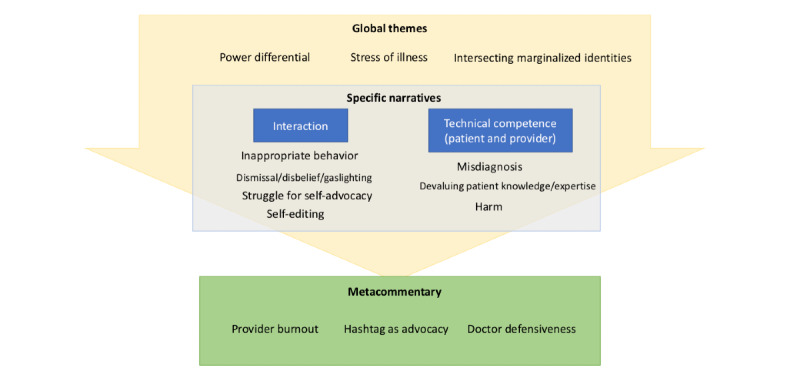
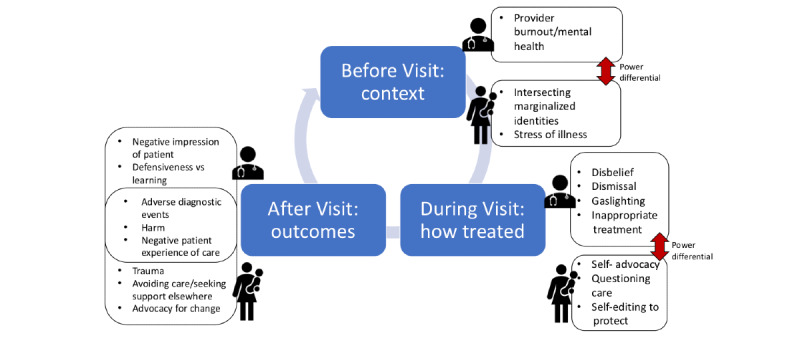
Our final sample comprised 491 tweets and unique Twitter users. Of this sample, 50.5% (248/491) were from patients or patient advocates, 9.6% (47/491) from health care professionals, 4.3% (21/491) from caregivers, 3.7% (18/491) from academics or researchers, 1.0% (5/491) from journalists or media, and 31.6% (155/491) from non-health care individuals or other. The most commonly mentioned clinical conditions were chronic pain, mental health, and musculoskeletal conditions (mainly Ehlers-Danlos syndrome). We identified 3 major themes: disbelief in patients' experience and knowledge that contributes to medical errors and harm, the power inequity between patients and providers, and metacommentary on the meaning and impact of the #DoctorsAreDickheads hashtag.
People publicly disclose personal and often troubling health care experiences on Twitter. This adds new accountability for the patient-provider interaction, highlights how harmful communication affects diagnostic safety, and shapes the public's viewpoint of how clinicians behave. Hashtags such as this offer valuable opportunities to learn from patient experiences. Recommendations include developing best practices for providers to improve communication, supporting patients through challenging diagnoses, and promoting patient engagement.
社交媒体网站 Twitter 在全球拥有 1.45 亿日活跃用户,已成为用户交流医疗保健问题和患者体验的热门论坛。2018 年秋季,出现了一个名为#DoctorsAreDickheads 的话题标签,近 4 万条帖子呼吁关注医疗保健体验。
本研究旨在确定这一病毒式 Twitter 话题标签所代表的常见医疗保健状况和概念主题。
我们分析了 2018 年 10 月 15 日至 12 月 31 日期间(即该话题标签最活跃期间)可用推文的 5.67%(500/8818)作为随机样本进行定性分析。团队编码员审查了相同的 20.0%(100/500)推文和其余的单独推文。我们从推文中提取用户的医疗保健角色和临床状况,并从用户资料中提取,然后使用现象学内容分析通过顺序开放性编码、记笔记和讨论概念来识别常见的概念主题,直到达成一致意见。
我们的最终样本包括 491 条推文和独特的 Twitter 用户。在这个样本中,50.5%(248/491)来自患者或患者代言人,9.6%(47/491)来自医疗保健专业人员,4.3%(21/491)来自护理人员,3.7%(18/491)来自学者或研究人员,1.0%(5/491)来自记者或媒体,31.6%(155/491)来自非医疗保健个人或其他人员。最常提到的临床状况是慢性疼痛、心理健康和肌肉骨骼状况(主要是埃勒斯-当洛斯综合征)。我们确定了 3 个主要主题:不相信患者的体验和知识会导致医疗错误和伤害,患者和提供者之间的权力不平等,以及对#DoctorsAreDickheads 话题标签的意义和影响的元评论。
人们在 Twitter 上公开披露个人且往往令人困扰的医疗保健体验。这为医患互动增加了新的责任,突出了有害沟通如何影响诊断安全,并塑造了公众对临床医生行为的看法。这样的话题标签为从患者体验中学习提供了宝贵的机会。建议包括为提供者制定改善沟通的最佳实践,为患者提供有挑战性的诊断支持,并促进患者参与。