ICAR-Directorate of Weed Research, Jabalpur, Madhya Pradesh 482004, India.
Department of Agronomy, Bidhan Chandra Krishi Viswavidyalaya, Mohanpur, Nadia, West Bengal 741252, India.
Molecules. 2020 Oct 24;25(21):4924. doi: 10.3390/molecules25214924.
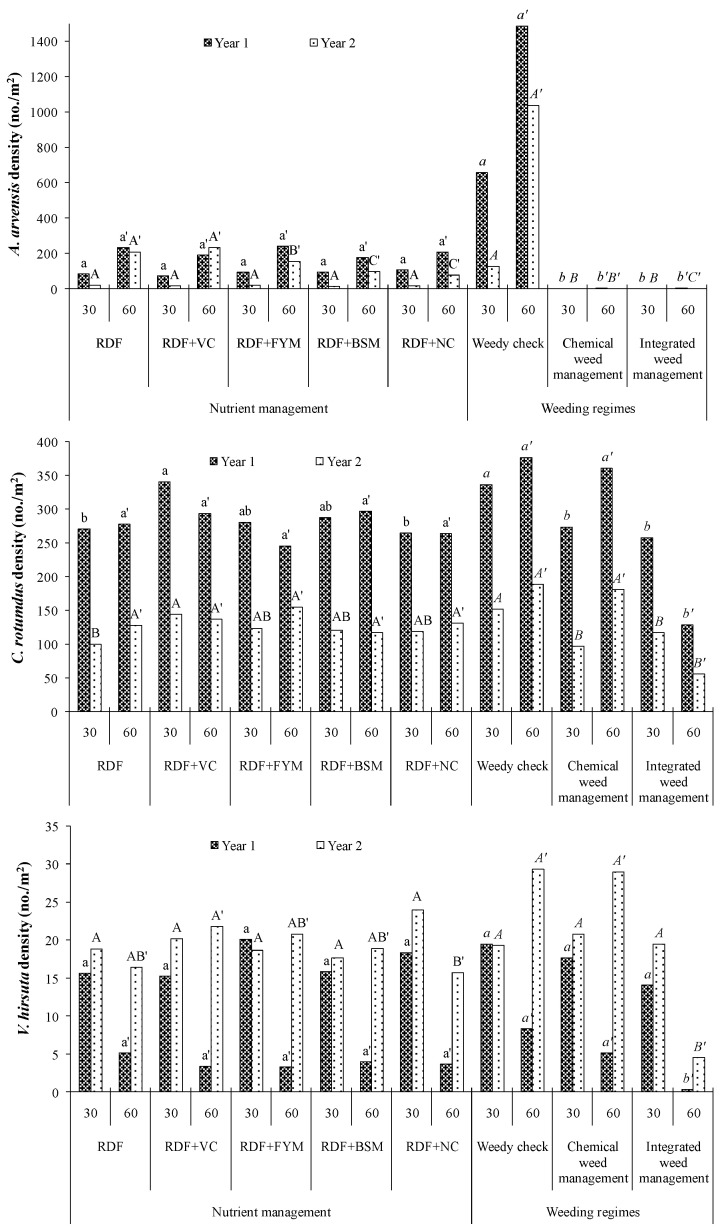
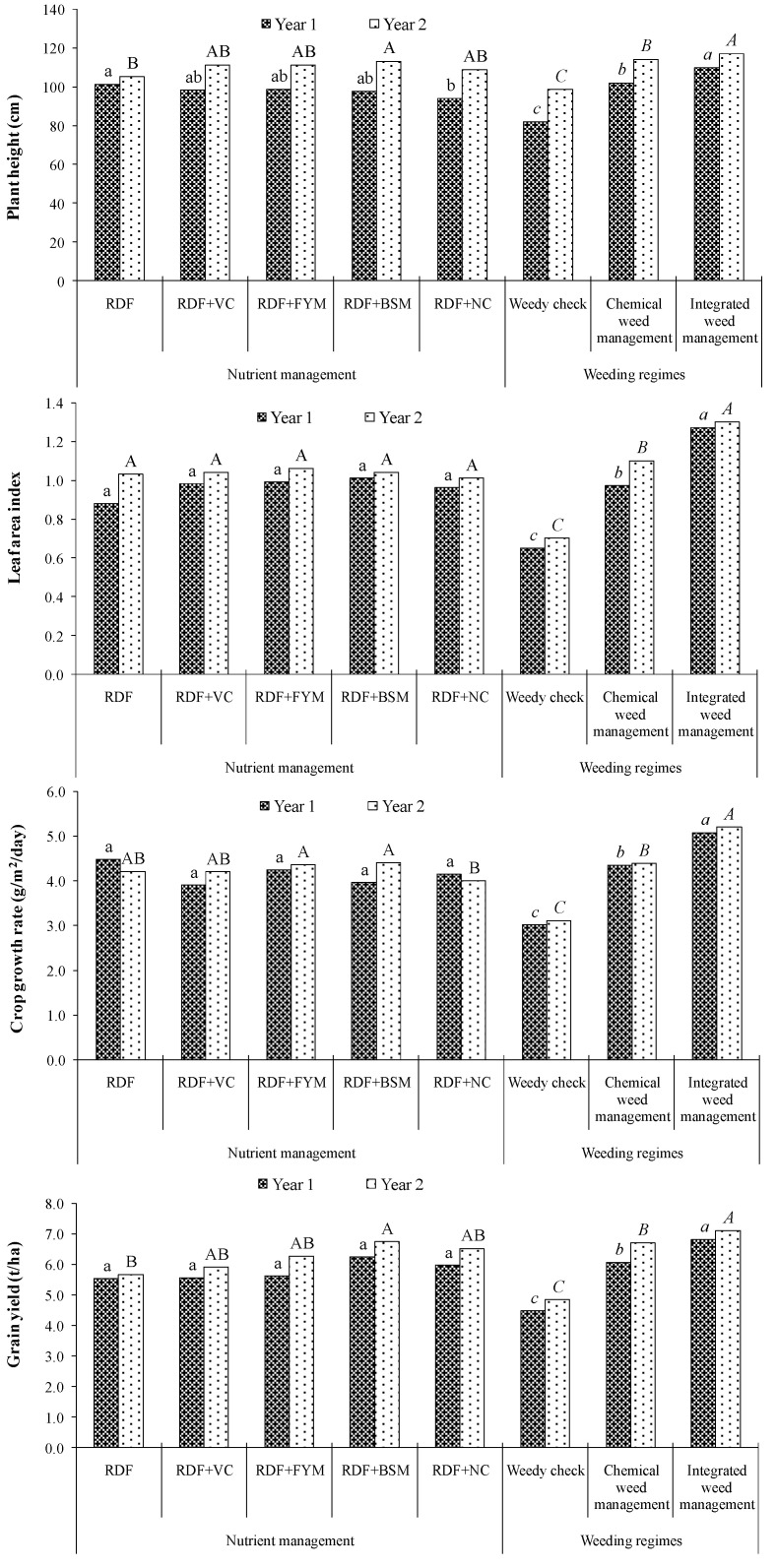
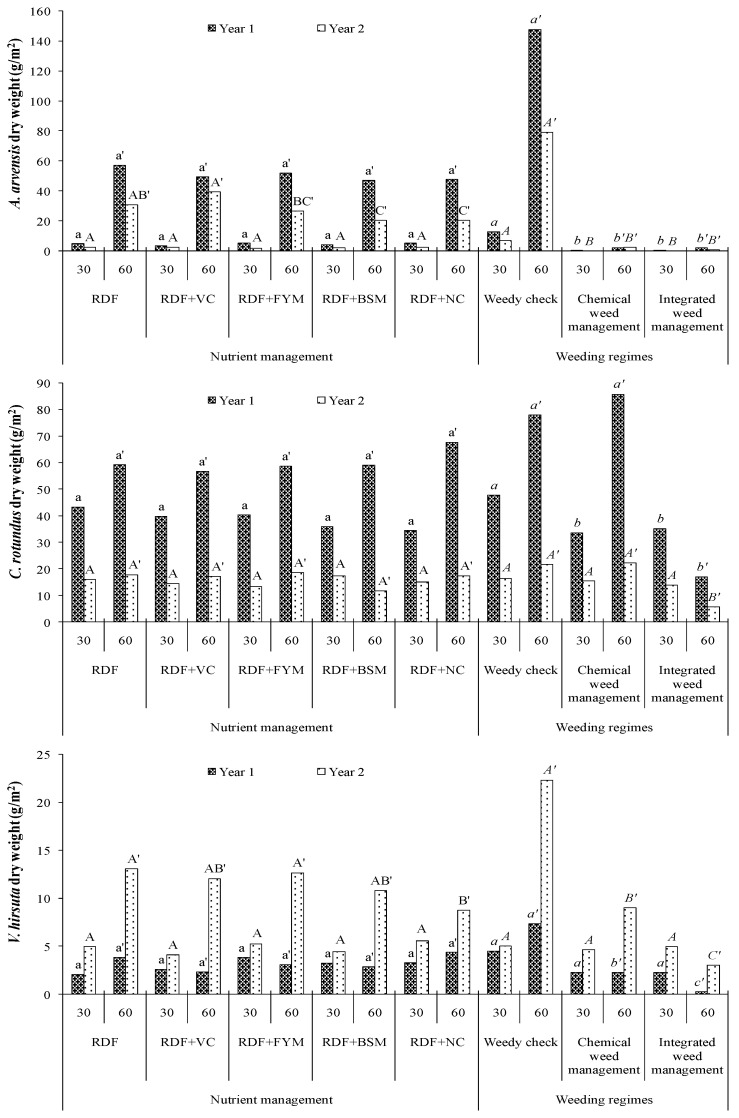
Declining rate of productivity and environmental sustainability is forcing growers to use organic manures as a source of nutrient supplement in maize farming. However, weed is a major constraint to maize production. A field study was carried out over two seasons to evaluate various integrated nutrient and weed management practices in hybrid maize. The treatment combinations comprised of supplementation of inorganic fertilizer (25% nitrogen) through bulky (Farmyard manure and vermicompost) and concentrated ( seed meal (BSM) and neem cake (NC)) organic manures and different mode of weed management practices like chemical (atrazine 1000 g ha) and integrated approach (atrazine 1000 g ha followed by mechanical weeding). Repeated supplementation of nitrogen through concentrated organic manures reduced the density and biomass accumulation of most dominant weed species, by releasing allelochemicals into the soil. But organic manures had no significant impact on restricting the growth of bold seeded weeds like and weed propagated through tubers i.e., in maize. By restricting the weed growth and nutrient removal by most dominating weeds, application of BSM enhanced the growth and yield of maize crop. Repeated addition of organic manures (BSM) enhanced the maize grain yield by 19% over sole chemical fertilizer in the second year of study. Application of atrazine as pre-emergence (PRE) herbicide significantly reduced the density of . , whereas integration of mechanical weeding following herbicide controlled those weeds which were not usually controlled with the application of atrazine. As a result, atrazine at PRE followed by mechanical weeding produced the highest maize grain yield 6.81 and 7.10 t/ha in the first year and second year of study, respectively.
生产力和环境可持续性的下降迫使种植者使用有机肥料作为玉米种植中营养补充的来源。然而,杂草是玉米生产的主要制约因素。本研究在两个季节进行了田间试验,以评估杂交玉米中各种综合养分和杂草管理措施。处理组合包括通过块状(厩肥和腐殖质)和浓缩(种子粉(BSM)和印楝饼(NC))有机肥料补充无机肥料(25%氮),以及不同的杂草管理方式,如化学(莠去津 1000 g/ha)和综合方法(莠去津 1000 g/ha 后机械除草)。通过浓缩有机肥料重复补充氮可以减少大多数优势杂草的密度和生物量积累,这是因为有机肥料向土壤中释放了化感物质。但是,有机肥料对限制玉米中种子较大的杂草和通过块茎传播的杂草的生长没有显著影响,例如 和 。通过限制大多数优势杂草的生长和养分去除,BSM 的应用可以提高玉米作物的生长和产量。在第二年的研究中,有机肥料(BSM)的重复施用比单独使用化肥使玉米籽粒产量提高了 19%。作为芽前(PRE)除草剂的莠去津的应用显著降低了 的密度。而在施药后进行机械除草,可以控制那些通常不能用莠去津控制的杂草。因此,PRE 莠去津加机械除草的方法在研究的第一年和第二年分别产生了最高的玉米籽粒产量 6.81 和 7.10 t/ha。