Lara Pablo, Chan Alan B, Cruz Luis J, Quest Andrew F G, Kogan Marcelo J
Percuros B.V., 2333 CL Leiden, The Netherlands.
Translational Nanobiomaterials and Imaging (TNI) Group, Radiology Department, Leiden University Medical Center, Albinusdreef 2, 2333 ZD Leiden, The Netherlands.
Pharmaceutics. 2020 Oct 26;12(11):1022. doi: 10.3390/pharmaceutics12111022.
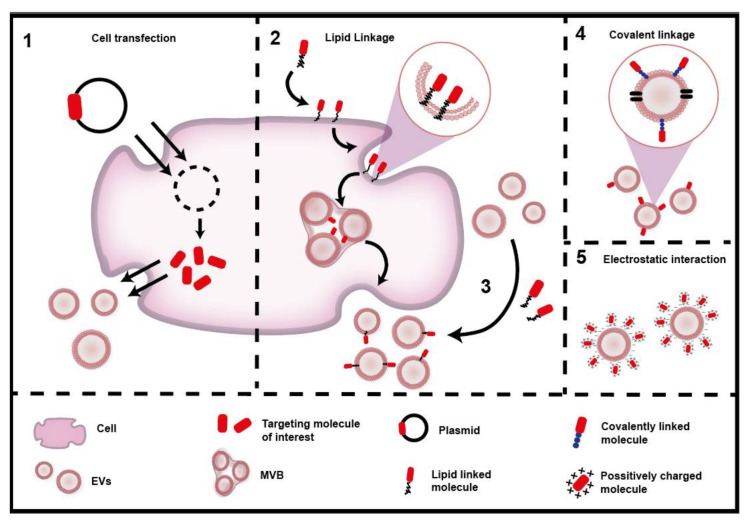
Extracellular vesicles (EVs) are important mediators of intercellular communication that participate in many physiological/pathological processes. As such, EVs have unique properties related to their origin, which can be exploited for drug delivery applications in cell regeneration, immunosuppression, inflammation, cancer treatment or cardioprotection. Moreover, their cell-like membrane organization facilitates uptake and accumulation in specific tissues and organs, which can be exploited to improve selectivity of cargo delivery. The combination of these properties with the inclusion of drugs or imaging agents can significantly improve therapeutic efficacy and selectivity, reduce the undesirable side effects of drugs or permit earlier diagnosis of diseases. In this review, we will describe the natural properties of EVs isolated from different cell sources and discuss strategies that can be applied to increase the efficacy of targeting drugs or other contents to specific locations. The potential risks associated with the use of EVs will also be addressed.
细胞外囊泡(EVs)是细胞间通讯的重要介质,参与许多生理/病理过程。因此,EVs具有与其来源相关的独特特性,可用于细胞再生、免疫抑制、炎症、癌症治疗或心脏保护等药物递送应用。此外,它们类似细胞的膜结构有助于在特定组织和器官中摄取和积累,可用于提高货物递送的选择性。这些特性与药物或成像剂的结合可显著提高治疗效果和选择性,减少药物的不良副作用或实现疾病的早期诊断。在本综述中,我们将描述从不同细胞来源分离的EVs的天然特性,并讨论可用于提高靶向药物或其他内容物到特定位置的功效的策略。还将探讨与使用EVs相关的潜在风险。