Department of Psychiatry, University of Pittsburgh, Pittsburgh, Pennsylvania.
Department of Biostatistics, University of Pittsburgh, Pittsburgh, Pennsylvania.
Biol Psychiatry. 2017 Oct 15;82(8):594-600. doi: 10.1016/j.biopsych.2017.03.018. Epub 2017 Apr 4.
Impairments in certain cognitive processes (e.g., working memory) are typically most pronounced in schizophrenia (SZ), intermediate in bipolar disorder, and least in major depressive disorder. Given that working memory depends, in part, on neural circuitry that includes pyramidal cells in layer 3 (L3) and layer 5 (L5) of the dorsolateral prefrontal cortex (DLPFC), we sought to determine if transcriptome alterations in these neurons were shared or distinctive for each diagnosis.
Pools of L3 and L5 pyramidal cells in the DLPFC were individually captured by laser microdissection from 19 matched tetrads of unaffected comparison subjects and subjects with SZ, bipolar disorder, and major depressive disorder, and the messenger RNA was subjected to transcriptome profiling by microarray.
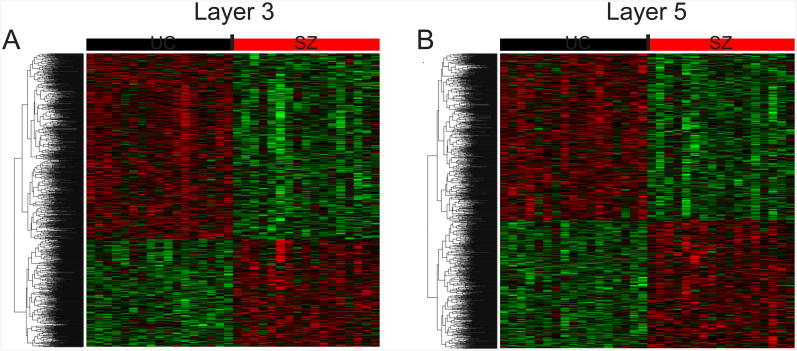
In DLPFC L3 and L5 pyramidal cells, transcriptome alterations were numerous in subjects with SZ, but rare in subjects with bipolar disorder and major depressive disorder. The leading molecular pathways altered in subjects with SZ involved mitochondrial energy production and the regulation of protein translation. In addition, we did not find any significant transcriptome signatures related to psychosis or suicide.
In concert, these findings suggest that molecular alterations in DLPFC L3 and L5 pyramidal cells might be characteristic of the disease processes operative in individuals diagnosed with SZ and thus might contribute to the circuitry alterations underlying cognitive dysfunction in individuals with SZ.
在某些认知过程(例如工作记忆)方面的损伤在精神分裂症(SZ)中最为明显,在双相情感障碍中处于中等程度,在重度抑郁症(MDD)中则最少。鉴于工作记忆部分依赖于包括背外侧前额叶皮层(DLPFC)的第 3 层(L3)和第 5 层(L5)中的锥体神经元的神经回路,我们试图确定这些神经元中的转录组改变是否与每个诊断共享或具有独特性。
通过激光微切割从 19 对匹配的未受影响的对照组和 SZ、双相情感障碍和重度抑郁症患者的 19 个四联体中分别捕获 DLPFC 的 L3 和 L5 锥体神经元,并通过微阵列对信使 RNA 进行转录组分析。
在 DLPFC 的 L3 和 L5 锥体神经元中,SZ 患者的转录组改变数量众多,但在双相情感障碍和重度抑郁症患者中则很少见。在 SZ 患者中改变的主要分子途径涉及线粒体能量产生和蛋白质翻译的调节。此外,我们没有发现任何与精神病或自杀相关的显着转录组特征。
这些发现表明,DLPFC 的 L3 和 L5 锥体神经元中的分子改变可能是与诊断为 SZ 的个体中起作用的疾病过程有关的特征,因此可能导致 SZ 患者认知功能障碍的回路改变。