Savannah River Ecology Laboratory, University of Georgia, Aiken, SC, USA.
Warnell School of Forestry and Natural Resources, University of Georgia, Athens, GA, 30602, USA.
Parasit Vectors. 2020 Oct 28;13(1):536. doi: 10.1186/s13071-020-04404-8.
Identifying patterns and drivers of infection risk among host communities is crucial to elucidate disease dynamics and predict infectious disease risk in wildlife populations. Blood parasites of the genera Plasmodium and Haemoproteus are a diverse group of vector-borne protozoan parasites that affect bird populations globally. Despite their widespread distribution and exceptional diversity, factors underlying haemosporidian infection risk in wild bird communities remain poorly understood. While some studies have examined variation in avian haemosporidian risk, researchers have primarily focused on host ecological traits without considering host phylogenetic relationships. In this study, we employ a phylogenetically informed approach to examine the association between host ecological traits and haemosporidian infection risk in endemic bird communities in the Western Ghats Sky Islands.
We used parasite sequence data based on partial mitochondrial cytochrome b gene, that was amplified from genomic DNA extracted from 1177 birds (28 species) across the Western Ghats to assess infection of birds with haemosporidian parasites. We employed a Bayesian phylogenetic mixed effect modelling approach to test whether haemosporidian infection risk was affected by seven species-specific and four individual-level ecological predictors. We also examined the effect of host phylogenetic relationships on the observed patterns of variation in haemosporidian infection risk by estimating phylogenetic signal.
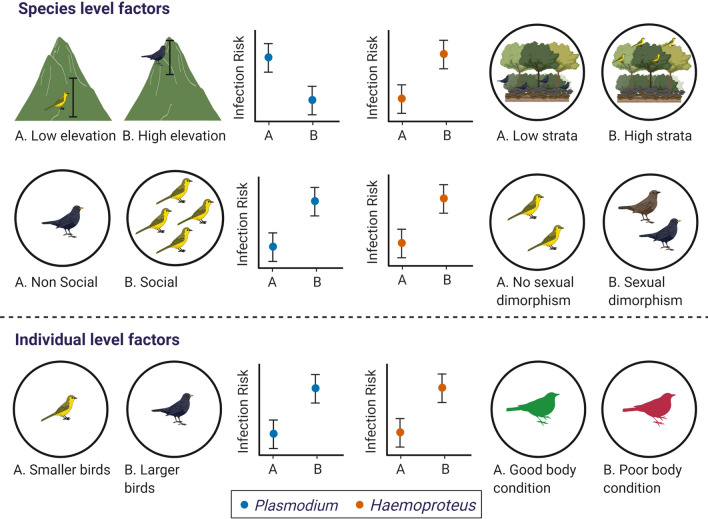
Our study shows that host ecological traits and host phylogeny differentially influence infection risk by Plasmodium (generalist parasite) and Haemoproteus (specialist parasite). For Plasmodium, we found that sociality, sexual dimorphism and foraging strata were important ecological predictors. For Haemoproteus, patterns of infection risk among host species were associated with sociality, species elevation and individual body condition. Interestingly, variance in infection risk explained by host phylogeny was higher for Haemoproteus parasites compared to Plasmodium.
Our study highlights that while host ecological traits promoting parasite exposure and host susceptibility are important determinants of infection risk, host phylogeny also contributes substantially to predicting patterns of haemosporidian infection risk in multi-host communities. Importantly, infection risk is driven by joint contributions of host ecology and host phylogeny and studying these effects together could increase our ability to better understand the drivers of infection risk and predict future disease threats.
确定宿主社区感染风险的模式和驱动因素对于阐明疾病动态和预测野生动物种群中的传染病风险至关重要。疟原虫属和血孢子虫属的血液寄生虫是一组广泛分布的、由媒介传播的原生动物寄生虫,它们影响着全球的鸟类种群。尽管它们分布广泛且具有非凡的多样性,但野生鸟类群落中血孢子虫感染风险的潜在因素仍知之甚少。虽然一些研究已经研究了鸟类血孢子虫风险的变化,但研究人员主要关注宿主生态特征,而没有考虑宿主的系统发育关系。在这项研究中,我们采用系统发育信息丰富的方法,研究了西高止山脉地方性鸟类群落中宿主生态特征与血孢子虫感染风险之间的关系。
我们使用了基于线粒体细胞色素 b 基因部分序列的数据,这些数据是从西高止山脉的 1177 只鸟类(28 个物种)的基因组 DNA 中扩增而来的,用于评估鸟类感染血孢子虫的情况。我们采用贝叶斯系统发育混合效应模型方法,测试了七种物种特异性和四种个体水平生态预测因子是否影响血孢子虫感染风险。我们还通过估计系统发育信号来检验宿主系统发育关系对观察到的血孢子虫感染风险变化模式的影响。
我们的研究表明,宿主生态特征和宿主系统发育会对疟原虫(寄生虫)和血孢子虫(寄生虫)的感染风险产生不同的影响。对于疟原虫,我们发现群居性、两性异形和觅食层是重要的生态预测因子。对于血孢子虫,宿主物种之间的感染风险模式与群居性、物种海拔和个体身体状况有关。有趣的是,与疟原虫相比,宿主系统发育解释的感染风险方差更高。
我们的研究强调,虽然促进寄生虫暴露和宿主易感性的宿主生态特征是感染风险的重要决定因素,但宿主系统发育也对预测多宿主群落中的血孢子虫感染风险模式有很大贡献。重要的是,感染风险是由宿主生态学和宿主系统发育的共同作用驱动的,同时研究这些影响可以提高我们更好地理解感染风险驱动因素和预测未来疾病威胁的能力。