Chen Yangming, Lei Yujie, Lin Jianbin, Huang Yunchao, Zhang Jiguang, Chen Kai, Sun Shihui, Lin Xing
Department of Thoracic Surgery, Shengli Clinical College of Fujian Medical University, Fujian Provincial Hospital, Fuzhou, Fujian 350001, People's Republic of China.
Department of Thoracic Surgery I, The Third Affiliated Hospital of Kunming Medical University, Yunnan Cancer Hospital, Yunnan Cancer Center, The International Cooperation Key Laboratory of Regional Tumor in High Altitude Area, Kunming, Yunnan 650106, People's Republic of China.
Onco Targets Ther. 2020 Oct 20;13:10707-10719. doi: 10.2147/OTT.S253730. eCollection 2020.
Recently, long noncoding RNAs (lncRNAs) have been identified as novel and potential therapeutic targets in various cancer types. Nonetheless, the levels and biological effects of lncRNAs in non-small cell lung cancer (NSCLC) remain largely unknown. In this study, we aimed to identify the effects of lncRNA-LINC01260 throughout the progression of NSCLC and explore the underlying mechanism.
Quantitative real-time PCR (qRT-PCR) and Western blot were performed to measure LINC01260, miR-562, and CYLD expression and protein levels. Luciferase reporter assay was employed to investigate the relationship between LINC01260 and miR-562, and miR-562 and CYLD, respectively. The viability and migration of cells were evaluated using CCK-8, colony formation, and transwell assays. The effects of LINC01260 were identified through tumorigenesis in vivo. ELISA was performed to detect the activity of NF-κB and p65 expression.
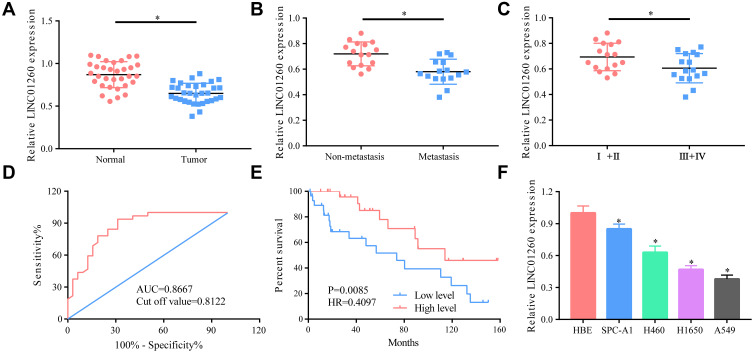
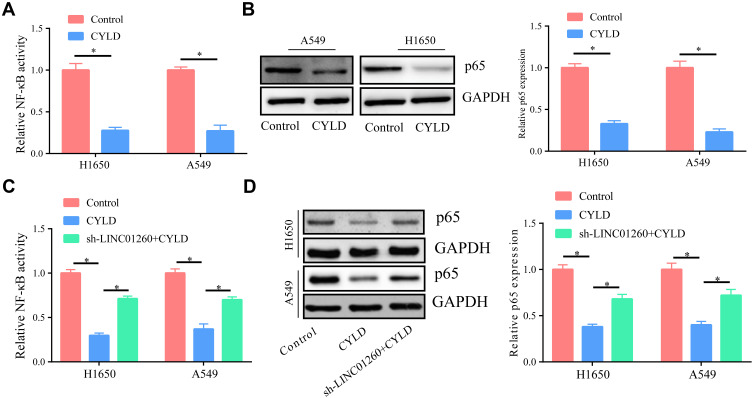
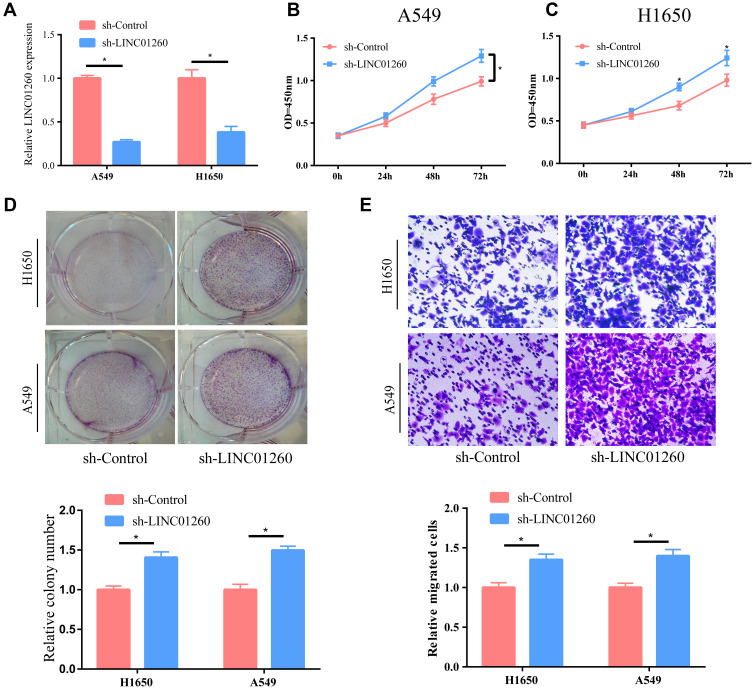
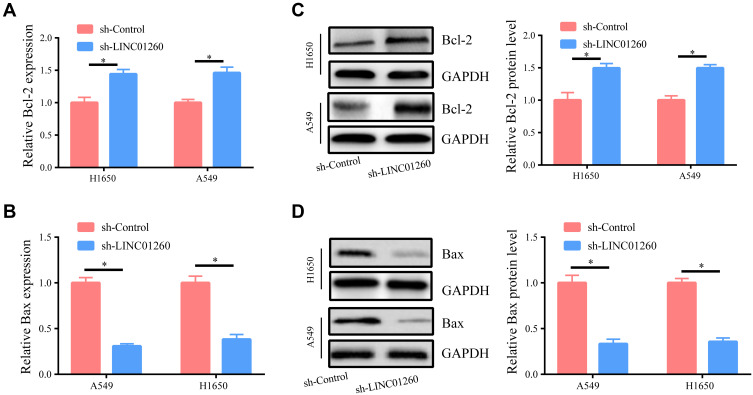
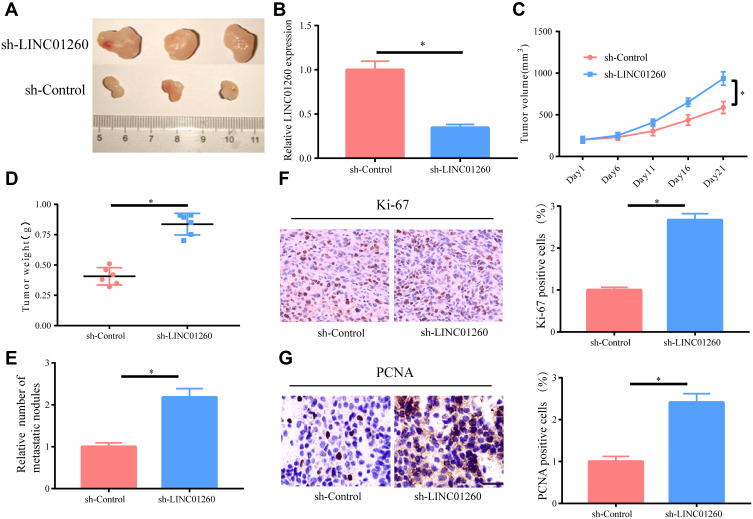
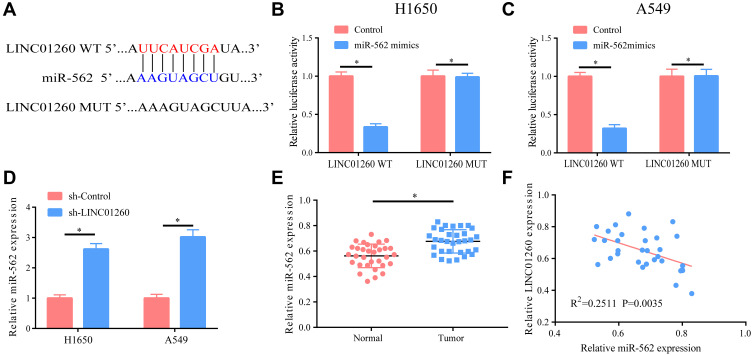
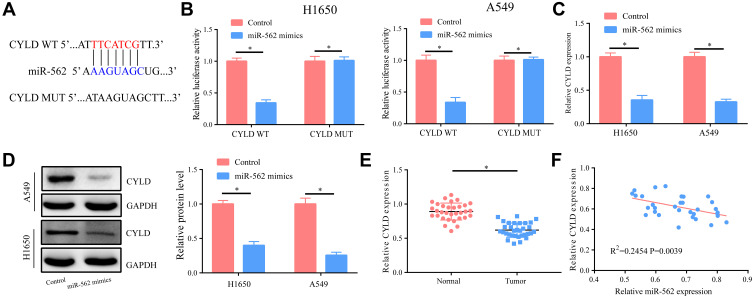
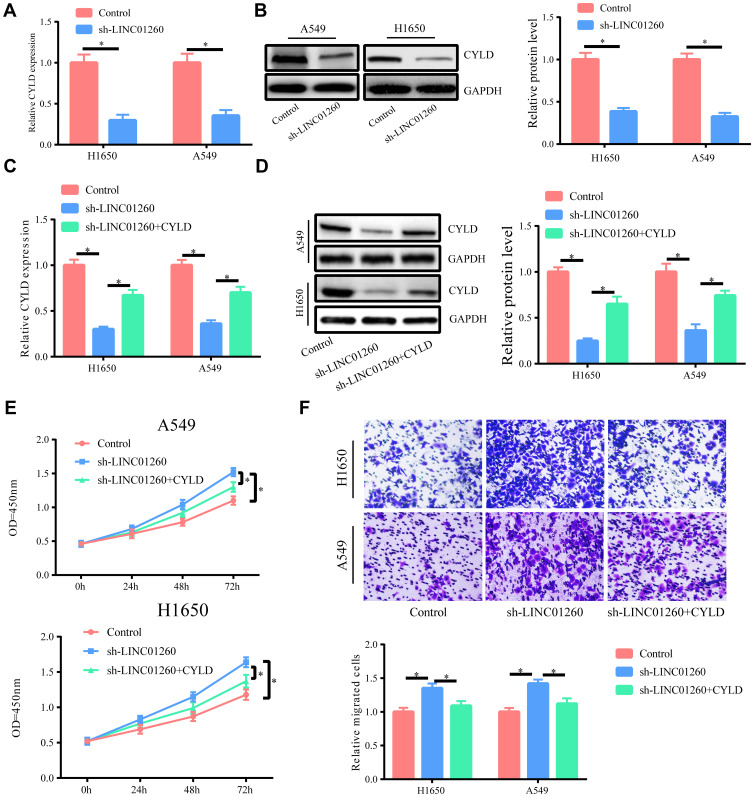
In NSCLC tissues and cell lines, LINC01260 expression was downregulated, which corresponded to a lower survival rate of patients with NSCLC. Knockdown of LINC01260 accelerated the proliferation, colony formation, and migration of NSCLC cells. Moreover, downregulation of LINC01260 inhibited apoptosis of NSCLC cells by regulating the expression of Bcl-2 and Bax proteins in vitro. In vivo, the downregulation of LINC01260 promoted tumor growth. miR-562 was identified as the target gene of LINC01260, which was upregulated in NSCLC tumors. Furthermore, CYLD was identified as the target gene of miR-562. The effects of LINC01260 were exerted by regulating CYLD via sponging miR-562. ELISA confirmed that the upregulation of CYLD inhibited NF-κB activity; however, the co-transfection of sh-LINC01260 partly reversed the inhibition. Additionally, CYLD reduced p65 expression; however, downregulation of LINC01260 slightly increased the expression level.
This study revealed a novel LINC01260/miR-562/CYLD/NF-κB pathway in the pathogenesis of NSCLC and suggested a potential therapeutic target for NSCLC.
最近,长链非编码RNA(lncRNAs)已被确定为多种癌症类型中的新型潜在治疗靶点。然而,lncRNAs在非小细胞肺癌(NSCLC)中的水平和生物学效应仍 largely未知。在本研究中,我们旨在确定lncRNA-LINC01260在NSCLC整个进展过程中的作用,并探索其潜在机制。
采用定量实时PCR(qRT-PCR)和蛋白质印迹法检测LINC01260、miR-562和CYLD的表达及蛋白水平。分别采用荧光素酶报告基因检测法研究LINC01260与miR-562、miR-562与CYLD之间的关系。使用CCK-8、集落形成和transwell检测法评估细胞的活力和迁移能力。通过体内肿瘤发生实验确定LINC01260的作用。采用ELISA法检测NF-κB的活性和p65的表达。
在NSCLC组织和细胞系中,LINC01260表达下调,这与NSCLC患者较低的生存率相关。敲低LINC01260可加速NSCLC细胞的增殖、集落形成和迁移。此外,在体外,下调LINC01260通过调节Bcl-2和Bax蛋白的表达抑制NSCLC细胞的凋亡。在体内,下调LINC012