Cai Huan, Liang Jialin, Liu Zhonghua, Fang Liang, Zheng Jinghong, Xu Jiahe, Chen Liyi, Sun Wen, Zhang Hao
Department of Rehabilitation, Zhongshan City People's Hospital, Zhongshan 528403, Guangdong, People's Republic of China.
Department of Endocrinology and Metabolism, Zhongshan City People's Hospital, Zhongshan 528403, Guangdong, People's Republic of China.
Nat Sci Sleep. 2020 Oct 21;12:783-790. doi: 10.2147/NSS.S265946. eCollection 2020.
Unfavorable sleep habits have been linked with ischemic stroke in observational studies, but the causality remains unclear. The aim of this study is to investigate the potential causal role of three sleep traits, including sleep duration, insomnia, and chronotype, in ischemic stroke and its subtypes.
We conducted two-sample Mendelian randomization (MR) analysis using single nucleotide polymorphisms associated with sleep duration, insomnia, and chronotype as instruments to estimate causal associations with ischemic stroke and its subtypes, among 34,217 ischemic stroke cases and 406,111 controls from the MEGASTROKE consortium. Inverse-variance weighted method was used as the main analyses. Alternative MR methods and sensitivity analyses were further performed.
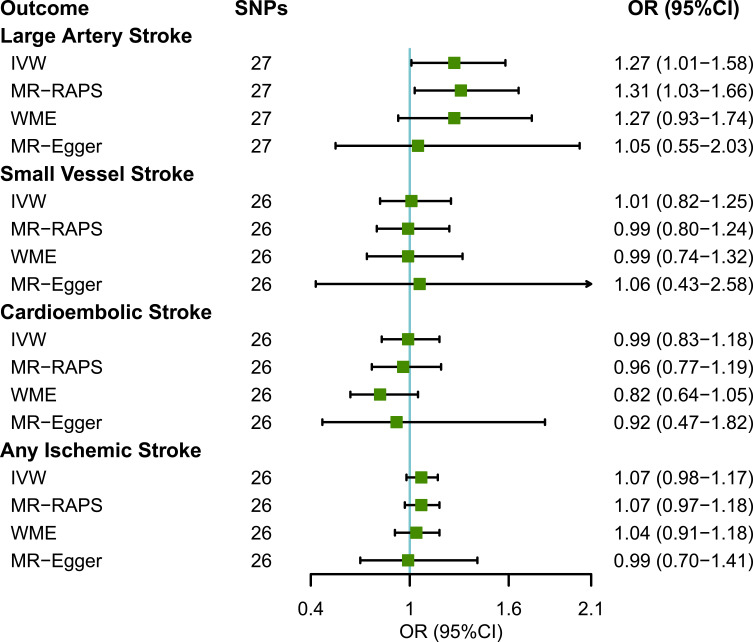
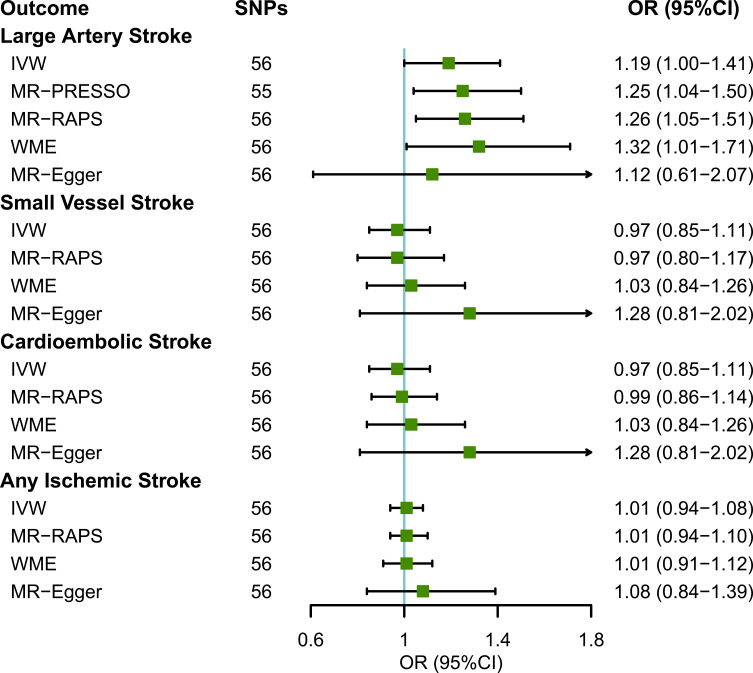
We found suggestive evidence that per doubling of genetic liability for short sleep duration (odds ratio [OR], 1.27; 95% confidence interval [CI], 1.01-1.58) and frequent insomnia symptoms (OR, 1.19; 95% CI, 1.00-1.41) were associated with a modest increase in risk of large artery stroke (LAS) but not with small vessel stroke, cardioembolic stroke, or any ischemic stroke. The association of frequent insomnia symptoms with LAS was stronger after the exclusion of the outlier (OR, 1.25; 95% CI, 1.04-1.50). No significant association was observed for chronotype with any ischemic stroke subtype. Results were overall robust to sensitivity analyses, and there was little evidence of horizontal pleiotropy.
We provided suggestive evidence for a potential causal role of short sleep duration and insomnia symptoms in LAS. Future researches are required to investigate whether improved sleep habits could help to mitigate LAS risk.
在观察性研究中,不良睡眠习惯与缺血性中风有关,但因果关系仍不明确。本研究的目的是调查三种睡眠特征,即睡眠时间、失眠和昼夜节律类型,在缺血性中风及其亚型中的潜在因果作用。
我们使用与睡眠时间、失眠和昼夜节律类型相关的单核苷酸多态性进行两样本孟德尔随机化(MR)分析,作为工具来估计与缺血性中风及其亚型的因果关联,数据来自MEGASTROKE联盟的34217例缺血性中风病例和406111例对照。采用逆方差加权法作为主要分析方法。进一步进行了替代MR方法和敏感性分析。
我们发现有提示性证据表明,睡眠时间短的遗传易感性每增加一倍(优势比[OR],1.27;95%置信区间[CI],1.01-1.58)和频繁出现失眠症状(OR,1.19;95%CI,1.00-1.41)与大动脉粥样硬化性卒中(LAS)风险适度增加相关,但与小血管性卒中、心源性栓塞性卒中和任何缺血性中风无关。排除异常值后,频繁失眠症状与LAS的关联更强(OR,1.25;95%CI,1.04-1.50)。未观察到昼夜节律类型与任何缺血性中风亚型之间存在显著关联。结果在敏感性分析中总体稳健,几乎没有水平多效性的证据。
我们提供了提示性证据,表明睡眠时间短和失眠症状在LAS中可能具有因果作用。未来需要进行研究,以调查改善睡眠习惯是否有助于降低LAS风险。