Islam Talat, Mahmood Khalid, Sadiq Misbah, Usman Bushra, Yousaf Sheikh Usman
Institute of Business Administration, University of the Punjab, Lahore, Pakistan.
Department of Information Management, Faculty of Economics and Management Sciences, University of the Punjab, Lahore, Pakistan.
Front Psychol. 2020 Oct 7;11:572526. doi: 10.3389/fpsyg.2020.572526. eCollection 2020.
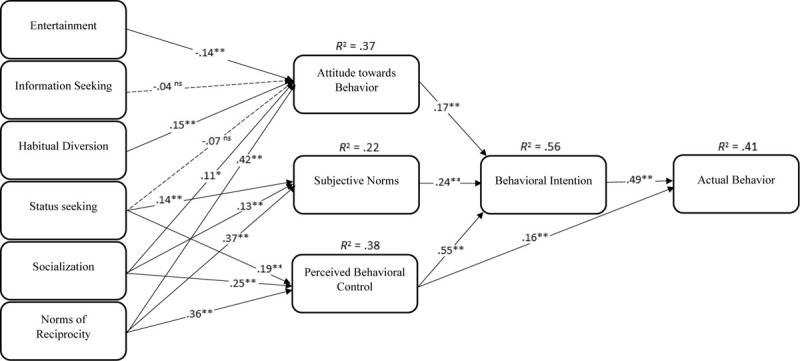
Using social media through mobile has become a major source of disseminating information; however, the motivations that impact social media users' intention and actual information-sharing behavior need further examination. To this backdrop, drawing on the uses and gratifications theory, theory of prosocial behavior, and theory of planned behavior, we aim to examine various motivations toward information-sharing behaviors in a specific context [coronavirus disease 2019 (COVID-19)]. We collected data from 388 knowledgeable workers through Google Forms and applied structural equation modeling to test the hypotheses. We noted that individuals behave seriously toward crisis-related information, as they share COVID-19 information on WhatsApp not only to be entertained and seek status or information but also to help others. Further, we noted norms of reciprocation, habitual diversion, and socialization as motivators that augment WhatsApp users' positive attitude toward COVID-19 information-sharing behavior.
通过手机使用社交媒体已成为信息传播的主要来源;然而,影响社交媒体用户信息分享意愿和实际行为的动机仍需进一步研究。在此背景下,借鉴使用与满足理论、亲社会行为理论和计划行为理论,我们旨在研究特定背景下(2019冠状病毒病,即COVID-19)信息分享行为的各种动机。我们通过谷歌表单收集了388名知识工作者的数据,并应用结构方程模型来检验假设。我们发现,个人对与危机相关的信息态度认真,因为他们在WhatsApp上分享COVID-19信息不仅是为了娱乐、寻求地位或信息,也是为了帮助他人。此外,我们发现互惠规范、习惯性转移和社交化是增强WhatsApp用户对COVID-19信息分享行为积极态度的动机。