Jiang Xue, Zheng Ya-Wen, Bao Shihui, Zhang Hailin, Chen Ruijie, Yao Qing, Kou Longfa
Municipal Key Laboratory of Paediatric Pharmacy, Department of Pharmacy, The Second Affiliated Hospital and Yuying Children's Hospital of Wenzhou Medical University, Wenzhou, China.
School of Pharmaceutical Sciences, Wenzhou Medical University, Wenzhou, China.
Drug Deliv. 2020 Dec;27(1):1562-1580. doi: 10.1080/10717544.2020.1840665.
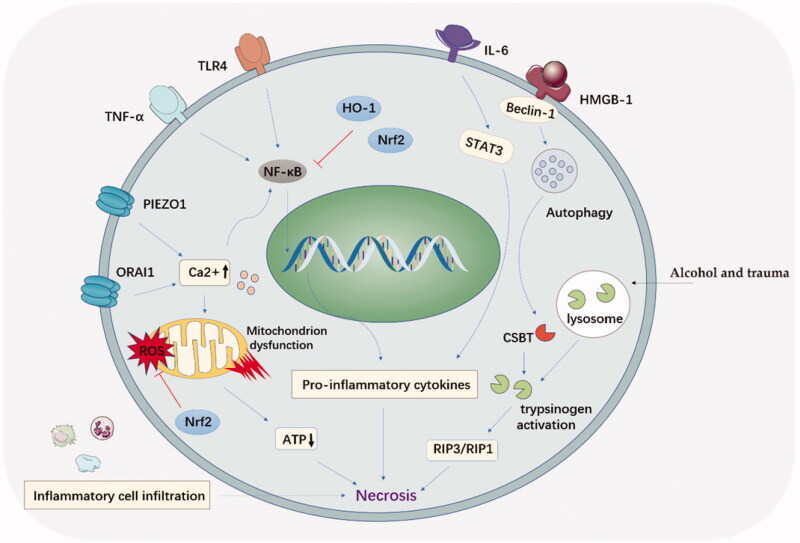
Acute pancreatitis is a sudden inflammation and only last for a short time, but might lead to a life-threatening emergency. Traditional drug therapy is an essential supportive method for acute pancreatitis treatment, yet, failed to achieve satisfactory therapeutic outcomes. To date, it is still challenging to develop therapeutic medicine to redress the intricate microenvironment promptly in the inflamed pancreas, and more importantly, avoid multi-organ failure. The understanding of the acute pancreatitis, including the causes, mechanism, and severity judgment, could help the scientists bring up more effective intervention and treatment strategies. New formulation approaches have been investigated to precisely deliver therapeutics to inflammatory lesions in the pancreas, and some even could directly attenuate the pancreatic damages. In this review, we will briefly introduce the involved pathogenesis and underlying mechanisms of acute pancreatitis, as well as the traditional Chinese medicine and the new drug option. Most of all, we will summarize the drug delivery strategies to reduce inflammation and potentially prevent the further development of pancreatitis, with an emphasis on the bifunctional nanoparticles that act as both drug delivery carriers and therapeutics.
急性胰腺炎是一种突发的炎症,仅持续较短时间,但可能导致危及生命的紧急情况。传统药物治疗是急性胰腺炎治疗的重要支持方法,然而,未能取得令人满意的治疗效果。迄今为止,开发能够迅速纠正胰腺炎症中复杂微环境的治疗药物,更重要的是,避免多器官功能衰竭,仍然具有挑战性。对急性胰腺炎的理解,包括病因、机制和严重程度判断,有助于科学家提出更有效的干预和治疗策略。人们已经研究了新的制剂方法,以将治疗药物精确地递送至胰腺的炎症病灶,有些方法甚至可以直接减轻胰腺损伤。在本综述中,我们将简要介绍急性胰腺炎的相关发病机制和潜在机制,以及中药和新药选择。最重要的是,我们将总结减少炎症并可能预防胰腺炎进一步发展的药物递送策略,重点是兼具药物递送载体和治疗剂功能的双功能纳米颗粒。