Sheng Kaixiang, Zhang Ping, Yao Xi, Li Jiawei, He Yongchun, Chen Jianghua
Kidney Disease Center, The First Affiliated Hospital, Zhejiang University School of Medicine, Hangzhou, China.
JMIR Med Inform. 2020 Oct 29;8(10):e20578. doi: 10.2196/20578.
The first-year survival rate among patients undergoing hemodialysis remains poor. Current mortality risk scores for patients undergoing hemodialysis employ regression techniques and have limited applicability and robustness.
We aimed to develop a machine learning model utilizing clinical factors to predict first-year mortality in patients undergoing hemodialysis that could assist physicians in classifying high-risk patients.
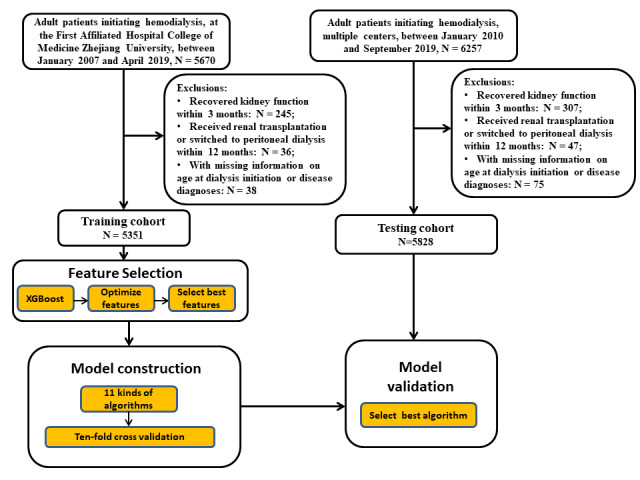
Training and testing cohorts consisted of 5351 patients from a single center and 5828 patients from 97 renal centers undergoing hemodialysis (incident only). The outcome was all-cause mortality during the first year of dialysis. Extreme gradient boosting was used for algorithm training and validation. Two models were established based on the data obtained at dialysis initiation (model 1) and data 0-3 months after dialysis initiation (model 2), and 10-fold cross-validation was applied to each model. The area under the curve (AUC), sensitivity (recall), specificity, precision, balanced accuracy, and F1 score were used to assess the predictive ability of the models.
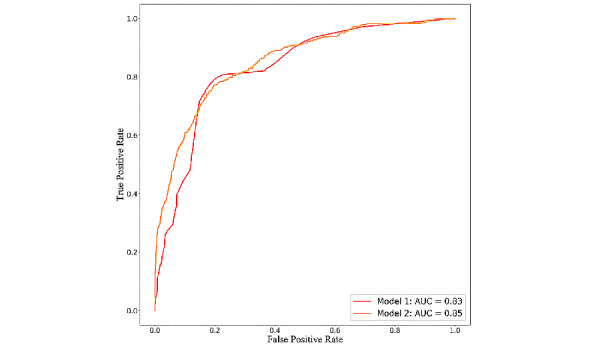
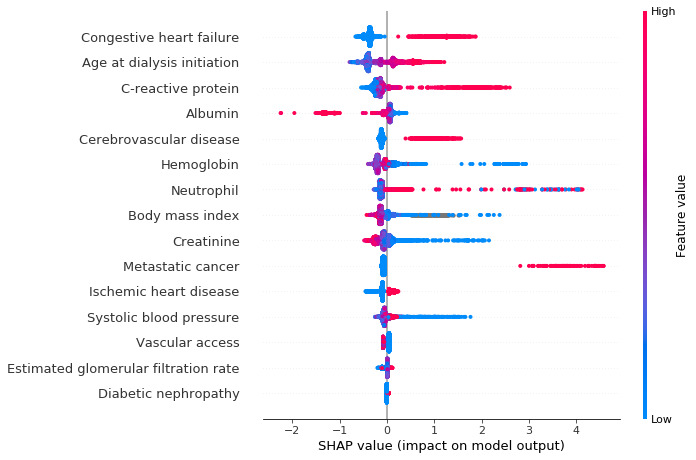
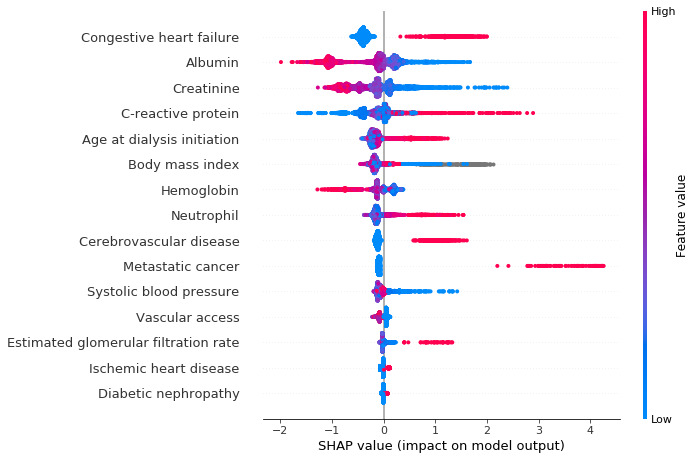
In the training and testing cohorts, 585 (10.93%) and 764 (13.11%) patients, respectively, died during the first-year follow-up. Of 42 candidate features, the 15 most important features were selected. The performance of model 1 (AUC 0.83, 95% CI 0.78-0.84) was similar to that of model 2 (AUC 0.85, 95% CI 0.81-0.86).
We developed and validated 2 machine learning models to predict first-year mortality in patients undergoing hemodialysis. Both models could be used to stratify high-risk patients at the early stages of dialysis.
接受血液透析的患者的第一年生存率仍然很低。目前用于接受血液透析患者的死亡率风险评分采用回归技术,其适用性和稳健性有限。
我们旨在开发一种利用临床因素预测接受血液透析患者第一年死亡率的机器学习模型,以帮助医生对高危患者进行分类。
训练队列和测试队列分别由来自单一中心的5351例患者和来自97个肾脏中心的5828例接受血液透析的患者(仅新发病例)组成。结局为透析第一年的全因死亡率。采用极端梯度提升算法进行模型训练和验证。基于透析开始时获得的数据(模型1)和透析开始后0 - 3个月的数据(模型2)建立两个模型,并对每个模型应用10倍交叉验证。采用曲线下面积(AUC)、敏感性(召回率)、特异性、精确率、平衡准确性和F1分数评估模型的预测能力。
在训练队列和测试队列中,分别有585例(10.93%)和764例(13.11%)患者在第一年随访期间死亡。在42个候选特征中,选择了15个最重要的特征。模型1的性能(AUC 0.83,95%CI 0.78 - 0.84)与模型2的性能(AUC 0.85,95%CI 0.81 - 0.86)相似。
我们开发并验证了2种机器学习模型来预测接受血液透析患者的第一年死亡率。两种模型均可用于在透析早期对高危患者进行分层。