Institute of Clinical Medicine, National Yang Ming Chiao Tung University School of Medicine, Taipei, Taiwan.
Stem Cell Research Center, National Yang Ming Chiao Tung University, Taipei, Taiwan.
J Med Internet Res. 2021 Sep 7;23(9):e27098. doi: 10.2196/27098.
Hemodialysis (HD) therapy is an indispensable tool used in critical care management. Patients undergoing HD are at risk for intradialytic adverse events, ranging from muscle cramps to cardiac arrest. So far, there is no effective HD device-integrated algorithm to assist medical staff in response to these adverse events a step earlier during HD.
We aimed to develop machine learning algorithms to predict intradialytic adverse events in an unbiased manner.
Three-month dialysis and physiological time-series data were collected from all patients who underwent maintenance HD therapy at a tertiary care referral center. Dialysis data were collected automatically by HD devices, and physiological data were recorded by medical staff. Intradialytic adverse events were documented by medical staff according to patient complaints. Features extracted from the time series data sets by linear and differential analyses were used for machine learning to predict adverse events during HD.
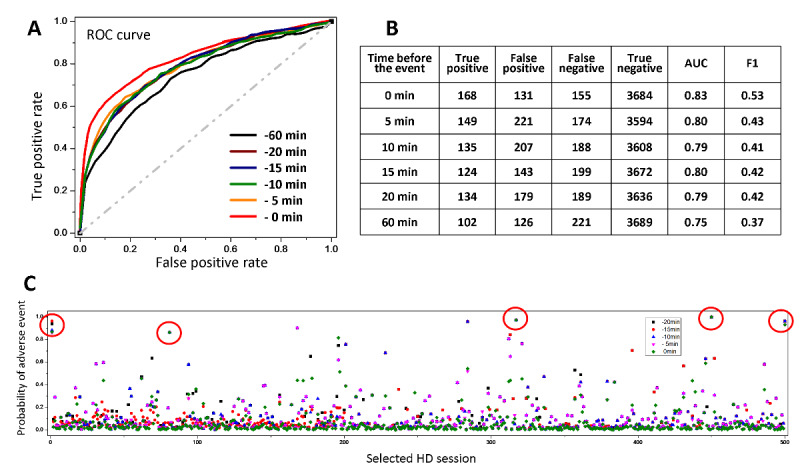
Time series dialysis data were collected during the 4-hour HD session in 108 patients who underwent maintenance HD therapy. There were a total of 4221 HD sessions, 406 of which involved at least one intradialytic adverse event. Models were built by classification algorithms and evaluated by four-fold cross-validation. The developed algorithm predicted overall intradialytic adverse events, with an area under the curve (AUC) of 0.83, sensitivity of 0.53, and specificity of 0.96. The algorithm also predicted muscle cramps, with an AUC of 0.85, and blood pressure elevation, with an AUC of 0.93. In addition, the model built based on ultrafiltration-unrelated features predicted all types of adverse events, with an AUC of 0.81, indicating that ultrafiltration-unrelated factors also contribute to the onset of adverse events.
Our results demonstrated that algorithms combining linear and differential analyses with two-class classification machine learning can predict intradialytic adverse events in quasi-real time with high AUCs. Such a methodology implemented with local cloud computation and real-time optimization by personalized HD data could warn clinicians to take timely actions in advance.
血液透析(HD)治疗是重症监护管理中不可或缺的工具。接受 HD 的患者有发生透析中不良事件的风险,从肌肉痉挛到心脏骤停不等。到目前为止,还没有有效的 HD 设备集成算法可以帮助医务人员在 HD 过程中更早地应对这些不良事件。
我们旨在以公正的方式开发用于预测透析中不良事件的机器学习算法。
从一家三级转诊中心接受维持性 HD 治疗的所有患者中收集了三个月的透析和生理时间序列数据。HD 设备自动采集透析数据,医务人员记录生理数据。医务人员根据患者的抱怨记录透析中不良事件。通过线性和差分分析从时间序列数据集提取的特征用于机器学习以预测 HD 期间的不良事件。
在 108 名接受维持性 HD 治疗的患者的 4 小时 HD 治疗期间收集了时间序列透析数据。共有 4221 次 HD 治疗,其中 406 次至少发生一次透析中不良事件。通过分类算法构建模型,并通过四折交叉验证进行评估。开发的算法预测了总体透析中不良事件,曲线下面积(AUC)为 0.83,灵敏度为 0.53,特异性为 0.96。该算法还预测了肌肉痉挛,AUC 为 0.85,血压升高,AUC 为 0.93。此外,基于超滤无关特征构建的模型预测了所有类型的不良事件,AUC 为 0.81,表明超滤无关因素也有助于不良事件的发生。
我们的结果表明,结合线性和差分分析与二类分类机器学习的算法可以以高 AUC 进行准实时预测透析中不良事件。通过个性化 HD 数据进行本地云计算和实时优化的这种方法可以及时提醒临床医生采取行动。