Department of Oncology, St. Jude Children's Research Hospital and Comprehensive Cancer Center, Memphis, Tennessee.
Department of Biostatistics, St. Jude Children's Research Hospital, Memphis, Tennessee.
Cancer. 2021 Jan 15;127(2):284-290. doi: 10.1002/cncr.33268. Epub 2020 Oct 29.
Provider implicit bias can negatively affect clinician-patient communication. In the current study, the authors measured implicit bias training among pediatric oncology providers and exposure to implicit association tests (IATs). They then assessed associations between IATs for race and socioeconomic status (SES) and recommendations for clinical trial enrollment.
A prospective multisite study was performed to measure implicit bias among oncology providers at St. Jude Children's Research Hospital and affiliate clinics. An IAT was used to assess bias in the domains of race and SES. Case vignettes were used to determine an association between bias and provider recommendation for trial enrollment. Data were analyzed using Student t tests or Wilcoxon tests for comparisons and Jonckheere-Terpstra tests were used for association.
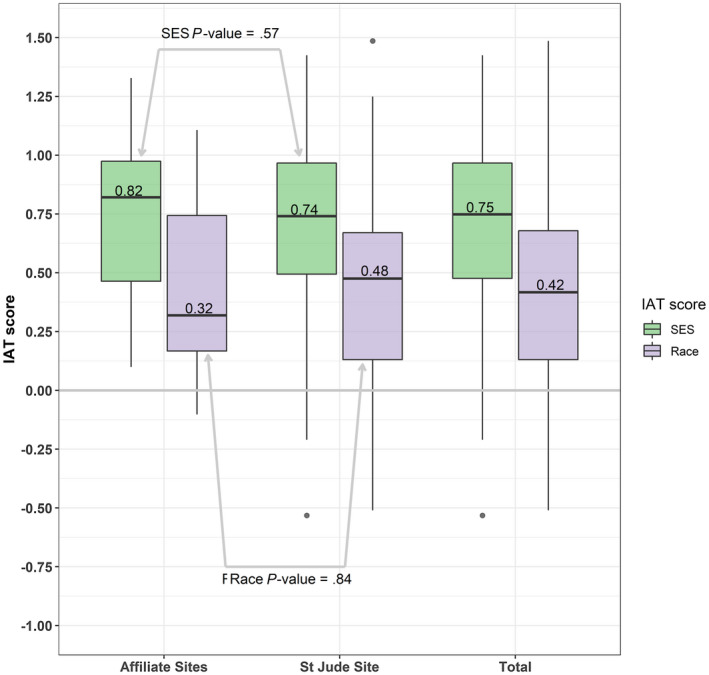
Of the 105 total participants, 95 (90%) had not taken an IAT and 97 (92%) had no prior implicit bias training. A large effect was found for (bias toward) high SES (Cohen d, 1.93) and European American race (Cohen d, 0.96). The majority of participants (90%) had a vignette score of 3 or 4, indicating recommendation for trial enrollment for most or all vignettes. IAT and vignette scores did not significantly differ between providers at St. Jude Children's Research Hospital or affiliate clinics. No association was found between IAT and vignette scores for race (P = .58) or SES (P = .82).
The authors noted a paucity of prior exposure to implicit bias self-assessments and training. Although these providers demonstrated preferences for high SES and European American race, this did not appear to affect recommendations for clinical trial enrollment as assessed by vignettes.
提供者的内隐偏见会对医患沟通产生负面影响。在本研究中,作者测量了儿科肿瘤学提供者的内隐偏见培训和对内隐联想测试(IAT)的接触。然后,他们评估了种族和社会经济地位(SES)的 IAT 与临床试验入组建议之间的关联。
进行了一项前瞻性多地点研究,以测量圣裘德儿童研究医院和附属诊所的肿瘤学提供者的内隐偏见。使用 IAT 评估种族和 SES 领域的偏见。病例案例用于确定偏见与提供者对试验入组的建议之间的关联。使用学生 t 检验或 Wilcoxon 检验进行比较分析,使用 Jonckheere-Terpstra 检验进行关联分析。
在 105 名参与者中,95 名(90%)未接受过 IAT,97 名(92%)没有接受过内隐偏见培训。发现 SES(高)(Cohen d,1.93)和欧洲裔美国人种族(Cohen d,0.96)的偏见有较大影响。大多数参与者(90%)的案例得分在 3 或 4 分,表明大多数或所有案例都建议参加试验。圣裘德儿童研究医院或附属诊所的提供者的 IAT 和案例得分之间没有显着差异。IAT 和案例得分之间的种族(P =.58)或 SES(P =.82)均无关联。
作者注意到先前对内隐偏见自我评估和培训的接触很少。尽管这些提供者表现出对高 SES 和欧洲裔美国人种族的偏好,但这似乎并没有影响案例评估的临床试验入组建议。