• 文献检索
  • 文档翻译
  • 深度研究
  • 学术资讯
  • Suppr Zotero 插件Zotero 插件
  • 邀请有礼
  • 套餐&价格
  • 历史记录
应用&插件
Suppr Zotero 插件Zotero 插件浏览器插件Mac 客户端Windows 客户端微信小程序
定价
高级版会员购买积分包购买API积分包
服务
文献检索文档翻译深度研究API 文档MCP 服务
关于我们
关于 Suppr公司介绍联系我们用户协议隐私条款
关注我们

Suppr 超能文献

核心技术专利:CN118964589B侵权必究
粤ICP备2023148730 号-1Suppr @ 2026

文献检索

告别复杂PubMed语法,用中文像聊天一样搜索,搜遍4000万医学文献。AI智能推荐,让科研检索更轻松。

立即免费搜索

文件翻译

保留排版,准确专业,支持PDF/Word/PPT等文件格式,支持 12+语言互译。

免费翻译文档

深度研究

AI帮你快速写综述,25分钟生成高质量综述,智能提取关键信息,辅助科研写作。

立即免费体验

关于新冠疫情的推特讨论与情绪:机器学习方法

Twitter Discussions and Emotions About the COVID-19 Pandemic: Machine Learning Approach.

作者信息

Xue Jia, Chen Junxiang, Hu Ran, Chen Chen, Zheng Chengda, Su Yue, Zhu Tingshao

机构信息

Factor-Inwentash Faculty of Social Work, University of Toronto, Toronto, ON, Canada.

Faculty of Information, University of Toronto, Toronto, ON, Canada.

出版信息

J Med Internet Res. 2020 Nov 25;22(11):e20550. doi: 10.2196/20550.

DOI:10.2196/20550
PMID:33119535
原文链接:https://pmc.ncbi.nlm.nih.gov/articles/PMC7690968/
Abstract

BACKGROUND

It is important to measure the public response to the COVID-19 pandemic. Twitter is an important data source for infodemiology studies involving public response monitoring.

OBJECTIVE

The objective of this study is to examine COVID-19-related discussions, concerns, and sentiments using tweets posted by Twitter users.

METHODS

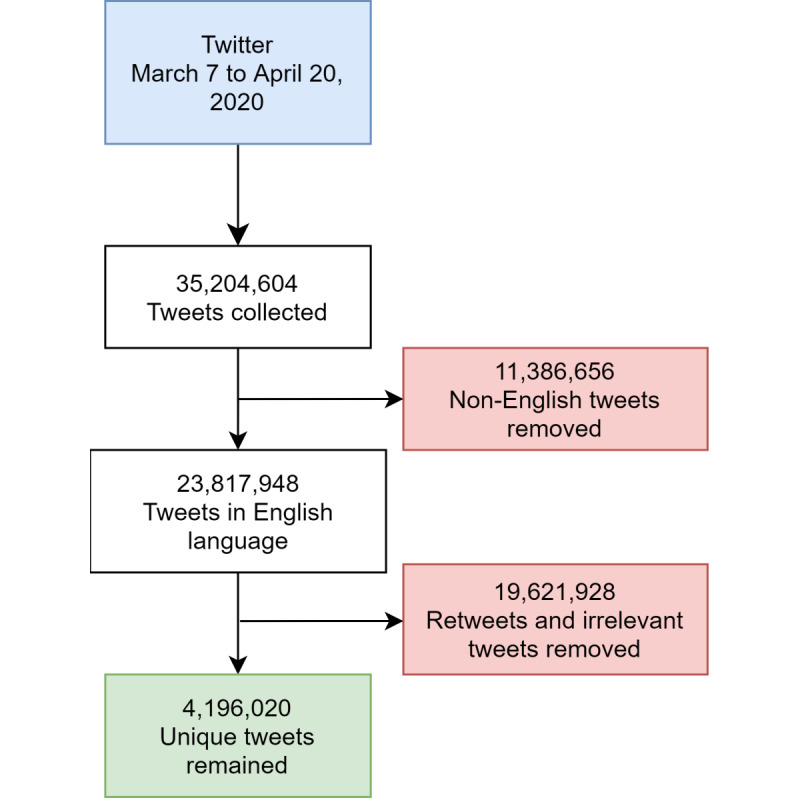
We analyzed 4 million Twitter messages related to the COVID-19 pandemic using a list of 20 hashtags (eg, "coronavirus," "COVID-19," "quarantine") from March 7 to April 21, 2020. We used a machine learning approach, Latent Dirichlet Allocation (LDA), to identify popular unigrams and bigrams, salient topics and themes, and sentiments in the collected tweets.

RESULTS

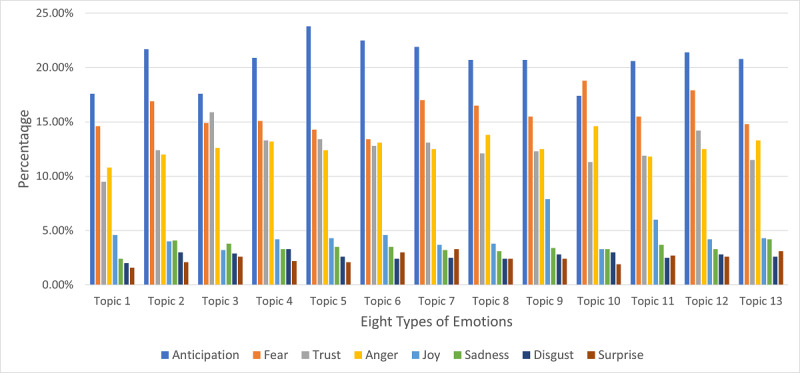
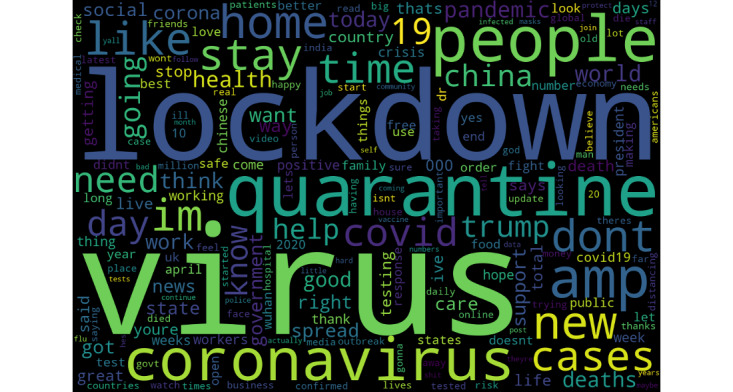
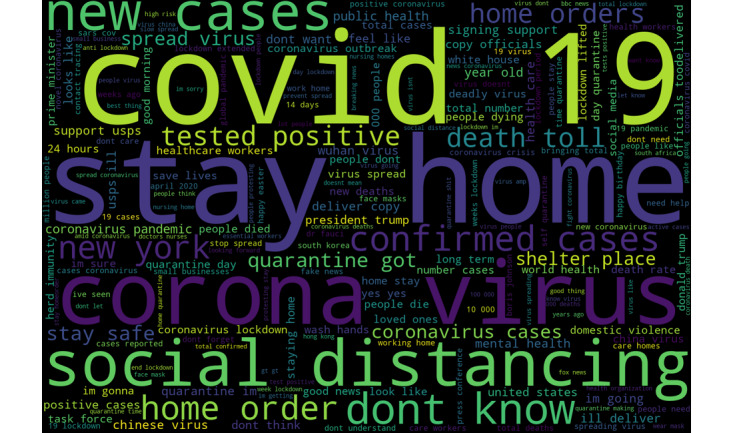
Popular unigrams included "virus," "lockdown," and "quarantine." Popular bigrams included "COVID-19," "stay home," "corona virus," "social distancing," and "new cases." We identified 13 discussion topics and categorized them into 5 different themes: (1) public health measures to slow the spread of COVID-19, (2) social stigma associated with COVID-19, (3) COVID-19 news, cases, and deaths, (4) COVID-19 in the United States, and (5) COVID-19 in the rest of the world. Across all identified topics, the dominant sentiments for the spread of COVID-19 were anticipation that measures can be taken, followed by mixed feelings of trust, anger, and fear related to different topics. The public tweets revealed a significant feeling of fear when people discussed new COVID-19 cases and deaths compared to other topics.

CONCLUSIONS

This study showed that Twitter data and machine learning approaches can be leveraged for an infodemiology study, enabling research into evolving public discussions and sentiments during the COVID-19 pandemic. As the situation rapidly evolves, several topics are consistently dominant on Twitter, such as confirmed cases and death rates, preventive measures, health authorities and government policies, COVID-19 stigma, and negative psychological reactions (eg, fear). Real-time monitoring and assessment of Twitter discussions and concerns could provide useful data for public health emergency responses and planning. Pandemic-related fear, stigma, and mental health concerns are already evident and may continue to influence public trust when a second wave of COVID-19 occurs or there is a new surge of the current pandemic.

摘要

背景

衡量公众对新冠疫情的反应很重要。推特是信息流行病学研究中监测公众反应的重要数据源。

目的

本研究的目的是利用推特用户发布的推文来审视与新冠疫情相关的讨论、担忧和情绪。

方法

我们使用20个主题标签(如“冠状病毒”“新冠疫情”“隔离”)的列表,分析了2020年3月7日至4月21日期间400万条与新冠疫情相关的推特消息。我们采用机器学习方法——潜在狄利克雷分配(LDA),来识别所收集推文中的热门单字和双字、显著主题以及情绪。

结果

热门单字包括“病毒”“封锁”和“隔离”。热门双字包括“新冠疫情”“居家”“冠状病毒”“社交距离”和“新增病例”。我们识别出13个讨论主题,并将它们分为5个不同主题:(1)减缓新冠疫情传播的公共卫生措施;(2)与新冠疫情相关的社会污名;(3)新冠疫情新闻、病例和死亡情况;(4)美国的新冠疫情;(5)世界其他地区的新冠疫情。在所有识别出的主题中,对新冠疫情传播的主要情绪是预期可以采取措施,其次是与不同主题相关的信任、愤怒和恐惧等复杂情绪。与其他主题相比,当人们讨论新冠疫情新增病例和死亡情况时,公众推文显示出明显的恐惧情绪。

结论

本研究表明,推特数据和机器学习方法可用于信息流行病学研究,有助于研究新冠疫情期间不断演变的公众讨论和情绪。随着情况迅速演变,推特上几个主题一直占据主导地位,如确诊病例和死亡率、预防措施、卫生当局和政府政策、新冠疫情污名以及负面心理反应(如恐惧)。对推特讨论和担忧进行实时监测和评估可为公共卫生应急响应和规划提供有用数据。与疫情相关的恐惧、污名和心理健康问题已经很明显,在新冠疫情第二波来袭或当前疫情出现新的激增时,可能会继续影响公众信任。

https://cdn.ncbi.nlm.nih.gov/pmc/blobs/0ff4/7690968/2e50aaa1ce6c/jmir_v22i11e20550_fig6.jpg
https://cdn.ncbi.nlm.nih.gov/pmc/blobs/0ff4/7690968/f34b0d97c40e/jmir_v22i11e20550_fig1.jpg
https://cdn.ncbi.nlm.nih.gov/pmc/blobs/0ff4/7690968/9a1ef27946fd/jmir_v22i11e20550_fig2.jpg
https://cdn.ncbi.nlm.nih.gov/pmc/blobs/0ff4/7690968/cc418323d5ba/jmir_v22i11e20550_fig3.jpg
https://cdn.ncbi.nlm.nih.gov/pmc/blobs/0ff4/7690968/02196ff4ca9e/jmir_v22i11e20550_fig4.jpg
https://cdn.ncbi.nlm.nih.gov/pmc/blobs/0ff4/7690968/6dc217525981/jmir_v22i11e20550_fig5.jpg
https://cdn.ncbi.nlm.nih.gov/pmc/blobs/0ff4/7690968/2e50aaa1ce6c/jmir_v22i11e20550_fig6.jpg
https://cdn.ncbi.nlm.nih.gov/pmc/blobs/0ff4/7690968/f34b0d97c40e/jmir_v22i11e20550_fig1.jpg
https://cdn.ncbi.nlm.nih.gov/pmc/blobs/0ff4/7690968/9a1ef27946fd/jmir_v22i11e20550_fig2.jpg
https://cdn.ncbi.nlm.nih.gov/pmc/blobs/0ff4/7690968/cc418323d5ba/jmir_v22i11e20550_fig3.jpg
https://cdn.ncbi.nlm.nih.gov/pmc/blobs/0ff4/7690968/02196ff4ca9e/jmir_v22i11e20550_fig4.jpg
https://cdn.ncbi.nlm.nih.gov/pmc/blobs/0ff4/7690968/6dc217525981/jmir_v22i11e20550_fig5.jpg
https://cdn.ncbi.nlm.nih.gov/pmc/blobs/0ff4/7690968/2e50aaa1ce6c/jmir_v22i11e20550_fig6.jpg

相似文献

1
Twitter Discussions and Emotions About the COVID-19 Pandemic: Machine Learning Approach.关于新冠疫情的推特讨论与情绪:机器学习方法
J Med Internet Res. 2020 Nov 25;22(11):e20550. doi: 10.2196/20550.
2
Topics, Trends, and Sentiments of Tweets About the COVID-19 Pandemic: Temporal Infoveillance Study.关于新冠疫情的推文主题、趋势和情绪:时间信息监测研究
J Med Internet Res. 2020 Oct 23;22(10):e22624. doi: 10.2196/22624.
3
Top Concerns of Tweeters During the COVID-19 Pandemic: Infoveillance Study.新冠疫情期间推特用户的主要担忧:信息监测研究
J Med Internet Res. 2020 Apr 21;22(4):e19016. doi: 10.2196/19016.
4
Tweet Topics and Sentiments Relating to COVID-19 Vaccination Among Australian Twitter Users: Machine Learning Analysis.澳大利亚推特用户与 COVID-19 疫苗接种相关的推文主题和情绪:机器学习分析。
J Med Internet Res. 2021 May 19;23(5):e26953. doi: 10.2196/26953.
5
Understanding Concerns, Sentiments, and Disparities Among Population Groups During the COVID-19 Pandemic Via Twitter Data Mining: Large-scale Cross-sectional Study.通过 Twitter 数据挖掘了解 COVID-19 大流行期间人群的关注点、情绪和差异:大规模横断面研究。
J Med Internet Res. 2021 Mar 5;23(3):e26482. doi: 10.2196/26482.
6
Social Network Analysis of COVID-19 Sentiments: Application of Artificial Intelligence.COVID-19 舆情的社会网络分析:人工智能的应用
J Med Internet Res. 2020 Aug 18;22(8):e22590. doi: 10.2196/22590.
7
Public discourse and sentiment during the COVID 19 pandemic: Using Latent Dirichlet Allocation for topic modeling on Twitter.新冠疫情期间的公共话语和情绪:在 Twitter 上使用潜在狄利克雷分配进行主题建模。
PLoS One. 2020 Sep 25;15(9):e0239441. doi: 10.1371/journal.pone.0239441. eCollection 2020.
8
Concerns Expressed by Chinese Social Media Users During the COVID-19 Pandemic: Content Analysis of Sina Weibo Microblogging Data.新冠疫情期间中国社交媒体用户表达的担忧:对新浪微博数据的内容分析
J Med Internet Res. 2020 Nov 26;22(11):e22152. doi: 10.2196/22152.
9
COVID-19 Vaccine-Related Discussion on Twitter: Topic Modeling and Sentiment Analysis.新冠疫苗相关推文的讨论:主题建模和情感分析。
J Med Internet Res. 2021 Jun 29;23(6):e24435. doi: 10.2196/24435.
10
Social Media Insights Into US Mental Health During the COVID-19 Pandemic: Longitudinal Analysis of Twitter Data.社交媒体洞察美国在 COVID-19 大流行期间的心理健康状况:对 Twitter 数据的纵向分析。
J Med Internet Res. 2020 Dec 14;22(12):e21418. doi: 10.2196/21418.

引用本文的文献

1
How politics affect pandemic forecasting: spatio-temporal early warning capabilities of different geo-social media topics in the context of state-level political leaning.政治如何影响疫情预测:在州级政治倾向背景下不同地理社交媒体话题的时空预警能力
Front Public Health. 2025 Jul 1;13:1618347. doi: 10.3389/fpubh.2025.1618347. eCollection 2025.
2
Exploring Public Sentiment on the Repurposing of Ivermectin for COVID-19 Treatment: Cross-Sectional Study Using Twitter Data.探索公众对伊维菌素用于治疗新冠肺炎的情绪:使用推特数据的横断面研究
JMIR Form Res. 2025 Mar 27;9:e50536. doi: 10.2196/50536.
3
COVID-19 Public Health Communication on X (Formerly Twitter): Cross-Sectional Study of Message Type, Sentiment, and Source.

本文引用的文献

1
An "Infodemic": Leveraging High-Volume Twitter Data to Understand Early Public Sentiment for the Coronavirus Disease 2019 Outbreak.一场“信息疫情”:利用大量推特数据来了解公众对2019年冠状病毒病疫情的早期情绪
Open Forum Infect Dis. 2020 Jun 30;7(7):ofaa258. doi: 10.1093/ofid/ofaa258. eCollection 2020 Jul.
2
The Hidden Pandemic of Family Violence During COVID-19: Unsupervised Learning of Tweets.新冠疫情期间家庭暴力的隐性大流行:推文的无监督学习
J Med Internet Res. 2020 Nov 6;22(11):e24361. doi: 10.2196/24361.
3
The COVID-19 social media infodemic.
关于X(原推特)上的新冠疫情公共卫生传播:信息类型、情感倾向及来源的横断面研究
JMIR Form Res. 2025 Mar 19;9:e59687. doi: 10.2196/59687.
4
Understanding Loneliness Through Analysis of Twitter and Reddit Data: Comparative Study.通过分析推特和红迪网数据理解孤独感:比较研究
Interact J Med Res. 2025 Mar 14;14:e49464. doi: 10.2196/49464.
5
Unveiling Topics and Emotions in Arabic Tweets Surrounding the COVID-19 Pandemic: Topic Modeling and Sentiment Analysis Approach.揭示围绕新冠疫情的阿拉伯语推文的主题与情感:主题建模与情感分析方法
JMIR Infodemiology. 2025 Feb 10;5:e53434. doi: 10.2196/53434.
6
Exploring motivation, goals, facilitators, and barriers to adopt health behaviors at retirement age: a focus group study.探索退休年龄人群采取健康行为的动机、目标、促进因素和障碍:一项焦点小组研究。
BMC Public Health. 2025 Jan 28;25(1):348. doi: 10.1186/s12889-025-21377-4.
7
Mapping the Mpox discourse: A network and sentiment analysis.绘制猴痘话语图谱:网络与情感分析
Explor Res Clin Soc Pharm. 2024 Oct 9;16:100521. doi: 10.1016/j.rcsop.2024.100521. eCollection 2024 Dec.
8
Unveiling public perceptions at the beginning of lockdown: an application of structural topic modeling and sentiment analysis in the UK and India.揭示封锁初期的公众看法:英国和印度的结构主题建模和情感分析应用。
BMC Public Health. 2024 Oct 15;24(1):2832. doi: 10.1186/s12889-024-20160-1.
9
Dissecting the infodemic: An in-depth analysis of COVID-19 misinformation detection on X (formerly Twitter) utilizing machine learning and deep learning techniques.剖析信息疫情:利用机器学习和深度学习技术对X(原推特)上新冠疫情错误信息检测的深入分析。
Heliyon. 2024 Sep 12;10(18):e37760. doi: 10.1016/j.heliyon.2024.e37760. eCollection 2024 Sep 30.
10
Machine learning and natural language processing to assess the emotional impact of influencers' mental health content on Instagram.利用机器学习和自然语言处理评估Instagram上有影响力者心理健康内容的情感影响。
PeerJ Comput Sci. 2024 Sep 19;10:e2251. doi: 10.7717/peerj-cs.2251. eCollection 2024.
新冠病毒肺炎疫情相关社交媒体信息疫情。
Sci Rep. 2020 Oct 6;10(1):16598. doi: 10.1038/s41598-020-73510-5.
4
Public discourse and sentiment during the COVID 19 pandemic: Using Latent Dirichlet Allocation for topic modeling on Twitter.新冠疫情期间的公共话语和情绪:在 Twitter 上使用潜在狄利克雷分配进行主题建模。
PLoS One. 2020 Sep 25;15(9):e0239441. doi: 10.1371/journal.pone.0239441. eCollection 2020.
5
Modern Senicide in the Face of a Pandemic: An Examination of Public Discourse and Sentiment About Older Adults and COVID-19 Using Machine Learning.大流行下的现代自杀:使用机器学习考察关于老年人和 COVID-19 的公共话语和情绪。
J Gerontol B Psychol Sci Soc Sci. 2021 Mar 14;76(4):e190-e200. doi: 10.1093/geronb/gbaa128.
6
Examining the Impact of COVID-19 Lockdown in Wuhan and Lombardy: A Psycholinguistic Analysis on Weibo and Twitter.考察武汉和伦巴第 COVID-19 封锁的影响:基于微博和推特的心理语言学分析。
Int J Environ Res Public Health. 2020 Jun 24;17(12):4552. doi: 10.3390/ijerph17124552.
7
The Peru Approach against the COVID-19 Infodemic: Insights and Strategies.秘鲁应对新冠疫情信息疫情的方法:见解与策略。
Am J Trop Med Hyg. 2020 Aug;103(2):583-586. doi: 10.4269/ajtmh.20-0536. Epub 2020 Jun 4.
8
Machine Learning to Detect Self-Reporting of Symptoms, Testing Access, and Recovery Associated With COVID-19 on Twitter: Retrospective Big Data Infoveillance Study.基于机器学习的方法在推特上检测与 COVID-19 相关的自我报告症状、检测途径和康复情况:回顾性大数据信息监测研究。
JMIR Public Health Surveill. 2020 Jun 8;6(2):e19509. doi: 10.2196/19509.
9
Tracking Social Media Discourse About the COVID-19 Pandemic: Development of a Public Coronavirus Twitter Data Set.追踪社交媒体上关于 COVID-19 大流行的讨论:公共冠状病毒 Twitter 数据集的开发。
JMIR Public Health Surveill. 2020 May 29;6(2):e19273. doi: 10.2196/19273.
10
Public Priorities and Concerns Regarding COVID-19 in an Online Discussion Forum: Longitudinal Topic Modeling.在线讨论论坛中关于新冠病毒病的公众优先事项与关切:纵向主题建模
J Gen Intern Med. 2020 Jul;35(7):2244-2247. doi: 10.1007/s11606-020-05889-w. Epub 2020 May 12.