Arifi Dorian, Resch Bernd, Santillana Mauricio, Knoblauch Steffen, Lautenbach Sven, Jaenisch Thomas, Morales Ivonne
IT:U Interdisciplinary Transformation University Austria, Linz, Austria.
Geoinformatics Department - Z_GIS, University of Salzburg, Salzburg, Austria.
Front Public Health. 2025 Jul 1;13:1618347. doi: 10.3389/fpubh.2025.1618347. eCollection 2025.
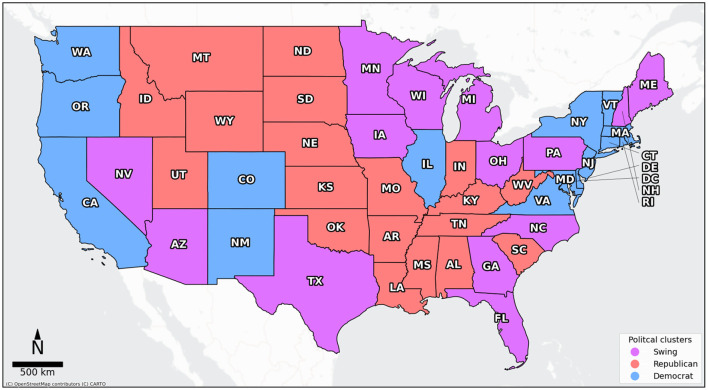
Due to political polarization, adherence to public health measures varied across US states during the COVID-19 pandemic. Although social media posts have been shown effective in anticipating COVID-19 surges, the impact of political leaning on the effectiveness of different topics for early warning remains mostly unexplored. Our study examines the spatio-temporal early warning potential of different geo-social media topics across republican, democrat, and swing states.
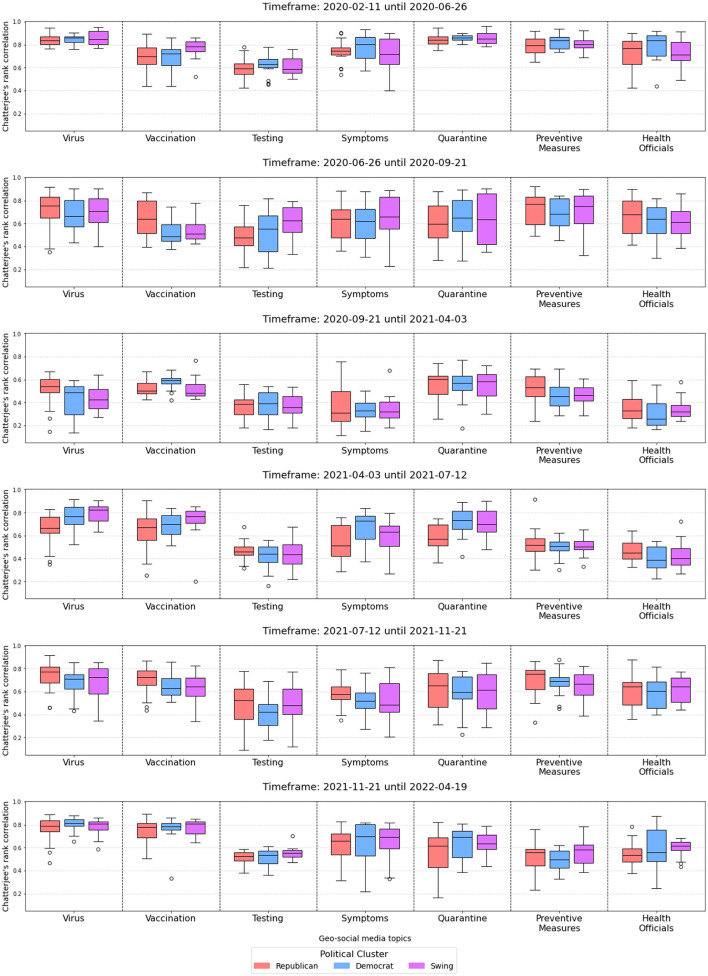
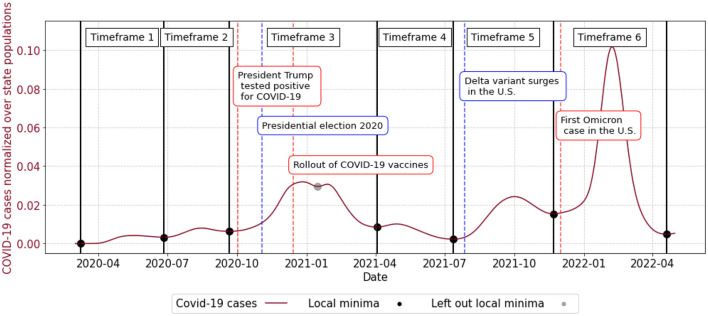
Using keyword filtering, we identified eight COVID-19-related geo-social media topics. We then utilized Chatterjee's rank correlation to assess their early warning capability for COVID-19 cases 7 to 42 days in advance across six infection waves. A mixed-effect model was used to evaluate the impact of timeframe and political leaning on the early warning capabilities of these topics.
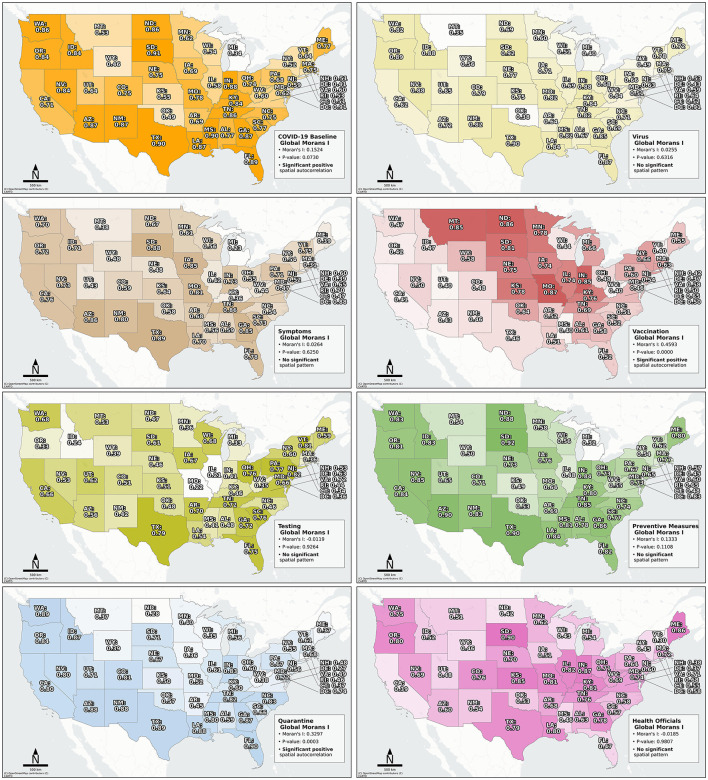
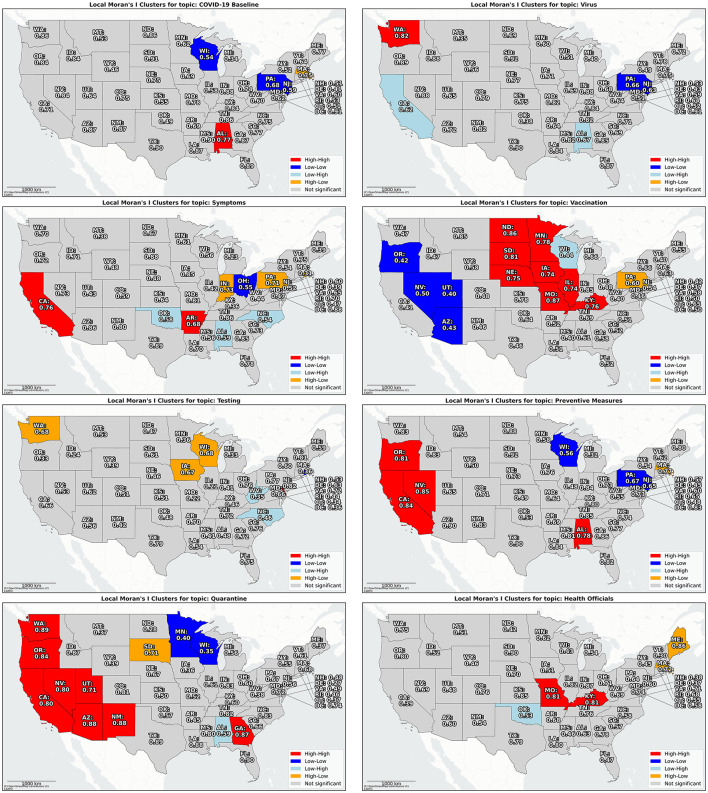
Many topics exhibited significant spatial clustering over time, with quarantine and vaccination-related posts occurring in opposing spatial regimes in the second timeframe. We also found significant variation in the early warning capabilities of geo-social media topics over time and across political clusters. In detail, quarantine related geo-social media post were significantly less correlated to COVID-19 cases in republican states than in democrat states. Further, preventive measure and quarantine-related posts exhibited declining correlations to COVID-19 cases over time, while the correlations of vaccine and virus-related posts with COVID-19 infections.
Our results highlight the need for a dynamic spatially targeted approach that accounts for both how regional geosocial media topics of interest change over time and the impact of local political ideology on their epidemiological early warning capabilities.
由于政治两极分化,在新冠疫情期间,美国各州对公共卫生措施的遵守情况各不相同。尽管社交媒体帖子已被证明在预测新冠疫情激增方面有效,但政治倾向对不同预警主题有效性的影响仍大多未被探索。我们的研究考察了不同地理社交媒体主题在共和党、民主党和摇摆州的时空预警潜力。
通过关键词过滤,我们识别出八个与新冠疫情相关的地理社交媒体主题。然后,我们利用查特吉秩相关来评估它们在六个感染波期间提前7至42天对新冠病例的预警能力。使用混合效应模型来评估时间框架和政治倾向对这些主题预警能力的影响。
许多主题随时间呈现出显著的空间聚类,在第二个时间框架内,与隔离和疫苗接种相关的帖子出现在相反的空间区域。我们还发现,地理社交媒体主题的预警能力随时间和政治集群存在显著差异。具体而言,与隔离相关的地理社交媒体帖子在共和党州与新冠病例的相关性显著低于民主党州。此外,与预防措施和隔离相关的帖子与新冠病例的相关性随时间下降,而疫苗和病毒相关帖子与新冠感染的相关性。
我们的结果凸显了一种动态的空间针对性方法的必要性,该方法既要考虑感兴趣的区域地理社交媒体主题如何随时间变化,也要考虑当地政治意识形态对其流行病学预警能力的影响。