• 文献检索
  • 文档翻译
  • 深度研究
  • 学术资讯
  • Suppr Zotero 插件Zotero 插件
  • 邀请有礼
  • 套餐&价格
  • 历史记录
应用&插件
Suppr Zotero 插件Zotero 插件浏览器插件Mac 客户端Windows 客户端微信小程序
定价
高级版会员购买积分包购买API积分包
服务
文献检索文档翻译深度研究API 文档MCP 服务
关于我们
关于 Suppr公司介绍联系我们用户协议隐私条款
关注我们

Suppr 超能文献

核心技术专利:CN118964589B侵权必究
粤ICP备2023148730 号-1Suppr @ 2026

文献检索

告别复杂PubMed语法,用中文像聊天一样搜索,搜遍4000万医学文献。AI智能推荐,让科研检索更轻松。

立即免费搜索

文件翻译

保留排版,准确专业,支持PDF/Word/PPT等文件格式,支持 12+语言互译。

免费翻译文档

深度研究

AI帮你快速写综述,25分钟生成高质量综述,智能提取关键信息,辅助科研写作。

立即免费体验

社交媒体洞察美国在 COVID-19 大流行期间的心理健康状况:对 Twitter 数据的纵向分析。

Social Media Insights Into US Mental Health During the COVID-19 Pandemic: Longitudinal Analysis of Twitter Data.

机构信息

Department of Applied Health Science, School of Public Health, Indiana University, Bloomington, IN, United States.

Luddy School of Informatics, Computing, and Engineering, Indiana University, Bloomington, IN, United States.

出版信息

J Med Internet Res. 2020 Dec 14;22(12):e21418. doi: 10.2196/21418.

DOI:10.2196/21418
PMID:33284783
原文链接:https://pmc.ncbi.nlm.nih.gov/articles/PMC7744146/
Abstract

BACKGROUND

The COVID-19 pandemic led to unprecedented mitigation efforts that disrupted the daily lives of millions. Beyond the general health repercussions of the pandemic itself, these measures also present a challenge to the world's mental health and health care systems. Considering that traditional survey methods are time-consuming and expensive, we need timely and proactive data sources to respond to the rapidly evolving effects of health policy on our population's mental health. Many people in the United States now use social media platforms such as Twitter to express the most minute details of their daily lives and social relations. This behavior is expected to increase during the COVID-19 pandemic, rendering social media data a rich field to understand personal well-being.

OBJECTIVE

This study aims to answer three research questions: (1) What themes emerge from a corpus of US tweets about COVID-19? (2) To what extent did social media use increase during the onset of the COVID-19 pandemic? and (3) Does sentiment change in response to the COVID-19 pandemic?

METHODS

We analyzed 86,581,237 public domain English language US tweets collected from an open-access public repository in three steps. First, we characterized the evolution of hashtags over time using latent Dirichlet allocation (LDA) topic modeling. Second, we increased the granularity of this analysis by downloading Twitter timelines of a large cohort of individuals (n=354,738) in 20 major US cities to assess changes in social media use. Finally, using this timeline data, we examined collective shifts in public mood in relation to evolving pandemic news cycles by analyzing the average daily sentiment of all timeline tweets with the Valence Aware Dictionary and Sentiment Reasoner (VADER) tool.

RESULTS

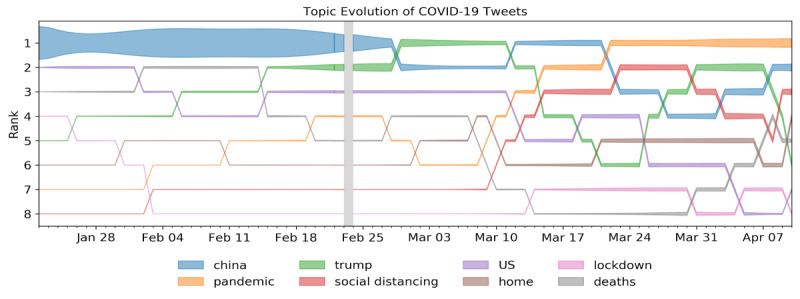
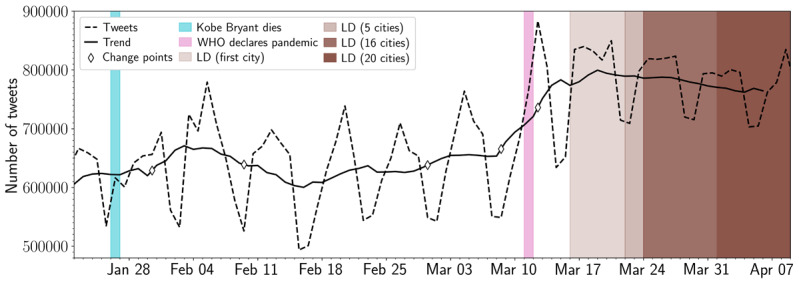
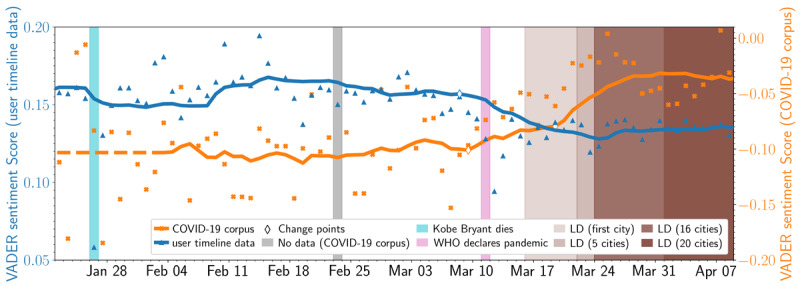
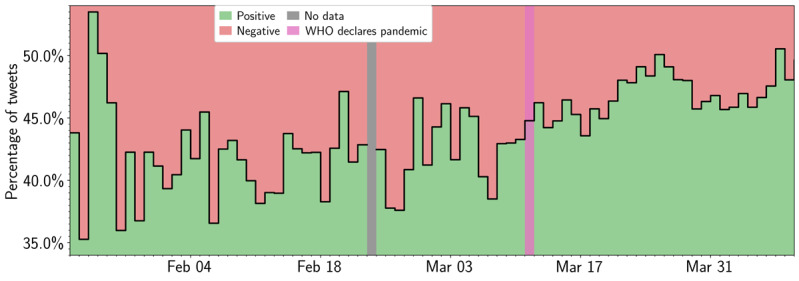
LDA topics generated in the early months of the data set corresponded to major COVID-19-specific events. However, as state and municipal governments began issuing stay-at-home orders, latent themes shifted toward US-related lifestyle changes rather than global pandemic-related events. Social media volume also increased significantly, peaking during stay-at-home mandates. Finally, VADER sentiment analysis scores of user timelines were initially high and stable but decreased significantly, and continuously, by late March.

CONCLUSIONS

Our findings underscore the negative effects of the pandemic on overall population sentiment. Increased use rates suggest that, for some, social media may be a coping mechanism to combat feelings of isolation related to long-term social distancing. However, in light of the documented negative effect of heavy social media use on mental health, social media may further exacerbate negative feelings in the long-term for many individuals. Thus, considering the overburdened US mental health care structure, these findings have important implications for ongoing mitigation efforts.

https://cdn.ncbi.nlm.nih.gov/pmc/blobs/5cdf/7744146/e7a1f174a049/jmir_v22i12e21418_fig5.jpg
https://cdn.ncbi.nlm.nih.gov/pmc/blobs/5cdf/7744146/6f64006582c3/jmir_v22i12e21418_fig1.jpg
https://cdn.ncbi.nlm.nih.gov/pmc/blobs/5cdf/7744146/08daee3f965e/jmir_v22i12e21418_fig2.jpg
https://cdn.ncbi.nlm.nih.gov/pmc/blobs/5cdf/7744146/32e5fa1bc0ba/jmir_v22i12e21418_fig3.jpg
https://cdn.ncbi.nlm.nih.gov/pmc/blobs/5cdf/7744146/00618e74c6ea/jmir_v22i12e21418_fig4.jpg
https://cdn.ncbi.nlm.nih.gov/pmc/blobs/5cdf/7744146/e7a1f174a049/jmir_v22i12e21418_fig5.jpg
https://cdn.ncbi.nlm.nih.gov/pmc/blobs/5cdf/7744146/6f64006582c3/jmir_v22i12e21418_fig1.jpg
https://cdn.ncbi.nlm.nih.gov/pmc/blobs/5cdf/7744146/08daee3f965e/jmir_v22i12e21418_fig2.jpg
https://cdn.ncbi.nlm.nih.gov/pmc/blobs/5cdf/7744146/32e5fa1bc0ba/jmir_v22i12e21418_fig3.jpg
https://cdn.ncbi.nlm.nih.gov/pmc/blobs/5cdf/7744146/00618e74c6ea/jmir_v22i12e21418_fig4.jpg
https://cdn.ncbi.nlm.nih.gov/pmc/blobs/5cdf/7744146/e7a1f174a049/jmir_v22i12e21418_fig5.jpg
摘要

背景

COVID-19 大流行导致了前所未有的缓解措施,扰乱了数百万人的日常生活。除了大流行本身对一般健康的影响外,这些措施也对世界的精神健康和医疗保健系统构成了挑战。考虑到传统的调查方法既费时又昂贵,我们需要及时和积极主动的数据源来应对卫生政策对我们人口精神健康的迅速变化的影响。现在,许多美国人使用 Twitter 等社交媒体平台来表达日常生活和社会关系中最细微的细节。预计在 COVID-19 大流行期间,这种行为会增加,使社交媒体数据成为了解个人幸福感的丰富领域。

目的

本研究旨在回答三个研究问题:(1)关于 COVID-19 的美国推特语料库中出现了哪些主题?(2)在 COVID-19 大流行开始时,社交媒体的使用增加了多少?以及(3)情绪是否会因 COVID-19 大流行而改变?

方法

我们分三步分析了从开放获取公共存储库中收集的 8658.123 万条公共领域英语美国推特数据。首先,我们使用潜在狄利克雷分配 (LDA)主题建模来描述随时间演变的标签的演变。其次,我们通过下载 20 个美国主要城市的 354738 名个人的推特时间线,增加了这一分析的粒度,以评估社交媒体使用的变化。最后,使用这些时间线数据,我们通过分析所有时间线推特的平均日常情绪,使用 Valence Aware Dictionary 和 Sentiment Reasoner (VADER) 工具来研究与不断演变的大流行病新闻周期相关的公众情绪的集体转变。

结果

在数据集的早期阶段生成的 LDA 主题与 COVID-19 特定事件相对应。然而,随着州和市政府开始发布就地避难令,潜在的主题转向了与美国相关的生活方式改变,而不是与全球大流行相关的事件。社交媒体的使用量也显著增加,在就地避难令期间达到峰值。最后,用户时间线的 VADER 情绪分析分数最初较高且稳定,但到 3 月底后显著且持续下降。

结论

我们的研究结果强调了大流行对总体人口情绪的负面影响。使用率的增加表明,对于某些人来说,社交媒体可能是一种应对长期社交隔离相关孤立感的机制。然而,鉴于大量使用社交媒体对心理健康的负面影响,从长期来看,社交媒体可能会进一步加剧许多人的负面情绪。因此,考虑到美国精神卫生保健结构负担过重,这些发现对正在进行的缓解努力具有重要意义。

相似文献

1
Social Media Insights Into US Mental Health During the COVID-19 Pandemic: Longitudinal Analysis of Twitter Data.社交媒体洞察美国在 COVID-19 大流行期间的心理健康状况:对 Twitter 数据的纵向分析。
J Med Internet Res. 2020 Dec 14;22(12):e21418. doi: 10.2196/21418.
2
Topics, Trends, and Sentiments of Tweets About the COVID-19 Pandemic: Temporal Infoveillance Study.关于新冠疫情的推文主题、趋势和情绪:时间信息监测研究
J Med Internet Res. 2020 Oct 23;22(10):e22624. doi: 10.2196/22624.
3
Emergency Physician Twitter Use in the COVID-19 Pandemic as a Potential Predictor of Impending Surge: Retrospective Observational Study.《COVID-19 大流行期间急诊医师在 Twitter 上的使用情况可能预示着即将出现的疫情高峰:回顾性观察研究》
J Med Internet Res. 2021 Jul 14;23(7):e28615. doi: 10.2196/28615.
4
Twitter Discussions and Emotions About the COVID-19 Pandemic: Machine Learning Approach.关于新冠疫情的推特讨论与情绪:机器学习方法
J Med Internet Res. 2020 Nov 25;22(11):e20550. doi: 10.2196/20550.
5
Top Concerns of Tweeters During the COVID-19 Pandemic: Infoveillance Study.新冠疫情期间推特用户的主要担忧:信息监测研究
J Med Internet Res. 2020 Apr 21;22(4):e19016. doi: 10.2196/19016.
6
Monitoring the Emotional Response to the COVID-19 Pandemic Using Sentiment Analysis: A Case Study in Mexico.使用情感分析监测对 COVID-19 大流行的情绪反应:墨西哥的案例研究。
Comput Intell Neurosci. 2022 May 18;2022:4914665. doi: 10.1155/2022/4914665. eCollection 2022.
7
Digital Epidemiology of Prescription Drug References on X (Formerly Twitter): Neural Network Topic Modeling and Sentiment Analysis.X(前身为 Twitter)上处方药引用的数字流行病学:神经网络主题建模和情感分析。
J Med Internet Res. 2024 Aug 23;26:e57885. doi: 10.2196/57885.
8
Using Natural Language Processing to Explore "Dry January" Posts on Twitter: Longitudinal Infodemiology Study.使用自然语言处理技术探索 Twitter 上关于“干一月”的帖子:纵向信息流行病学研究。
J Med Internet Res. 2022 Nov 18;24(11):e40160. doi: 10.2196/40160.
9
Changes in Public Response Associated With Various COVID-19 Restrictions in Ontario, Canada: Observational Infoveillance Study Using Social Media Time Series Data.加拿大安大略省与各种 COVID-19 限制相关的公众反应变化:使用社交媒体时间序列数据的观察性 Infoveillance 研究。
J Med Internet Res. 2021 Aug 25;23(8):e28716. doi: 10.2196/28716.
10
Public Perception of the COVID-19 Pandemic on Twitter: Sentiment Analysis and Topic Modeling Study.公众对 Twitter 上 COVID-19 大流行的看法:情感分析和主题建模研究。
JMIR Public Health Surveill. 2020 Nov 11;6(4):e21978. doi: 10.2196/21978.

引用本文的文献

1
Seasonal body image dissatisfaction: a bi-hemispheric panel analysis of social media users across 4 years.季节性身体形象不满:对社交媒体用户进行的为期4年的双半球面板分析
Eat Weight Disord. 2025 Aug 31;30(1):72. doi: 10.1007/s40519-025-01782-9.
2
Public Medical Appeals and Government Online Responses: Big Data Analysis Based on Chinese Digital Governance Platforms.公共医疗诉求与政府在线回应:基于中国数字治理平台的大数据分析
J Med Internet Res. 2025 Aug 6;27:e70087. doi: 10.2196/70087.
3
Towards using Tweet sentiment for infectious disease detection.

本文引用的文献

1
Social Data: Biases, Methodological Pitfalls, and Ethical Boundaries.社会数据:偏见、方法陷阱与伦理边界
Front Big Data. 2019 Jul 11;2:13. doi: 10.3389/fdata.2019.00013. eCollection 2019.
2
Effects of Covid-19 Lockdown on Mental Health and Sleep Disturbances in Italy.意大利新冠封锁对心理健康和睡眠障碍的影响。
Int J Environ Res Public Health. 2020 Jul 2;17(13):4779. doi: 10.3390/ijerph17134779.
3
Mining Social Media Data for Biomedical Signals and Health-Related Behavior.挖掘社交媒体数据中的生物医学信号及与健康相关的行为。
利用推文情感进行传染病检测
PLoS One. 2025 Jun 2;20(6):e0325166. doi: 10.1371/journal.pone.0325166. eCollection 2025.
4
Understanding Loneliness Through Analysis of Twitter and Reddit Data: Comparative Study.通过分析推特和红迪网数据理解孤独感:比较研究
Interact J Med Res. 2025 Mar 14;14:e49464. doi: 10.2196/49464.
5
Understanding Health-Related Discussions on Reddit: Development of a Topic Assignment Method and Exploratory Analysis.理解Reddit上与健康相关的讨论:一种主题分配方法的开发与探索性分析。
JMIR Form Res. 2025 Jan 29;9:e55309. doi: 10.2196/55309.
6
Examining hurricane-related social media topics longitudinally and at scale: A transformer-based approach.纵向大规模研究与飓风相关的社交媒体话题:一种基于Transformer的方法。
PLoS One. 2025 Jan 24;20(1):e0316852. doi: 10.1371/journal.pone.0316852. eCollection 2025.
7
Finding polarized communities and tracking information diffusion on Twitter: a network approach on the Irish Abortion Referendum.在推特上寻找极化社区并追踪信息传播:关于爱尔兰堕胎公投的网络方法
R Soc Open Sci. 2025 Jan 15;12(1):240454. doi: 10.1098/rsos.240454. eCollection 2025 Jan.
8
Public Health Discussions on Social Media: Evaluating Automated Sentiment Analysis Methods.社交媒体上的公共卫生讨论:评估自动情感分析方法
JMIR Form Res. 2025 Jan 8;9:e57395. doi: 10.2196/57395.
9
Web-browsing patterns reflect and shape mood and mental health.网络浏览模式反映并塑造情绪和心理健康。
Nat Hum Behav. 2025 Jan;9(1):133-146. doi: 10.1038/s41562-024-02065-6. Epub 2024 Nov 21.
10
Digital Epidemiology of Prescription Drug References on X (Formerly Twitter): Neural Network Topic Modeling and Sentiment Analysis.X(前身为 Twitter)上处方药引用的数字流行病学:神经网络主题建模和情感分析。
J Med Internet Res. 2024 Aug 23;26:e57885. doi: 10.2196/57885.
Annu Rev Biomed Data Sci. 2020 Jul;3:433-458. doi: 10.1146/annurev-biodatasci-030320-040844. Epub 2020 May 4.
4
A scoping review of the use of Twitter for public health research.关于推特在公共卫生研究中应用的范围综述。
Comput Biol Med. 2020 Jul;122:103770. doi: 10.1016/j.compbiomed.2020.103770. Epub 2020 May 16.
5
The Impact of Social Media on Panic During the COVID-19 Pandemic in Iraqi Kurdistan: Online Questionnaire Study.社交媒体对伊拉克库尔德斯坦地区新冠疫情期间恐慌情绪的影响:在线问卷调查研究
J Med Internet Res. 2020 May 19;22(5):e19556. doi: 10.2196/19556.
6
Evidence from internet search data shows information-seeking responses to news of local COVID-19 cases.从互联网搜索数据中可以看出,人们会根据当地 COVID-19 病例的相关新闻来搜索信息。
Proc Natl Acad Sci U S A. 2020 May 26;117(21):11220-11222. doi: 10.1073/pnas.2005335117. Epub 2020 May 4.
7
Estimating geographic subjective well-being from Twitter: A comparison of dictionary and data-driven language methods.基于 Twitter 数据估算地理位置的主观幸福感:词典方法和数据驱动语言方法的比较
Proc Natl Acad Sci U S A. 2020 May 12;117(19):10165-10171. doi: 10.1073/pnas.1906364117. Epub 2020 Apr 27.
8
Mental Health and the Covid-19 Pandemic.心理健康与新冠疫情
N Engl J Med. 2020 Aug 6;383(6):510-512. doi: 10.1056/NEJMp2008017. Epub 2020 Apr 13.
9
COVID-19 Exposes the Cracks in Our Already Fragile Mental Health System.新冠疫情暴露了我们本就脆弱的心理健康系统中的漏洞。
Am J Public Health. 2020 Apr 9;110(7):e1-e2. doi: 10.2105/AJPH.2020.305699.
10
The pandemic of social media panic travels faster than the COVID-19 outbreak.社交媒体恐慌的传播速度比新冠疫情的爆发还要快。
J Travel Med. 2020 May 18;27(3). doi: 10.1093/jtm/taaa031.