AIM ImmunoTech Inc., Philadelphia, Pennsylvania, United States of America.
Vanderbilt University School of Medicine, Nashville, Tennessee, United States of America.
PLoS One. 2020 Oct 29;15(10):e0240403. doi: 10.1371/journal.pone.0240403. eCollection 2020.
Rintatolimod is a selective TLR3 agonist, which has demonstrated clinical activity for ME/CFS in Phase II and Phase III double-blind, placebo-controlled, randomized, multi-site clinical trials.
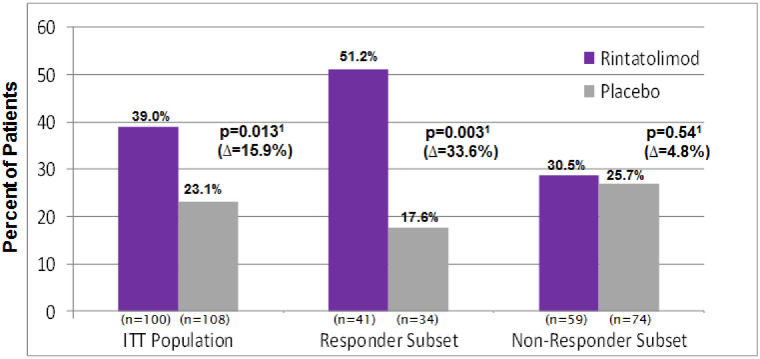
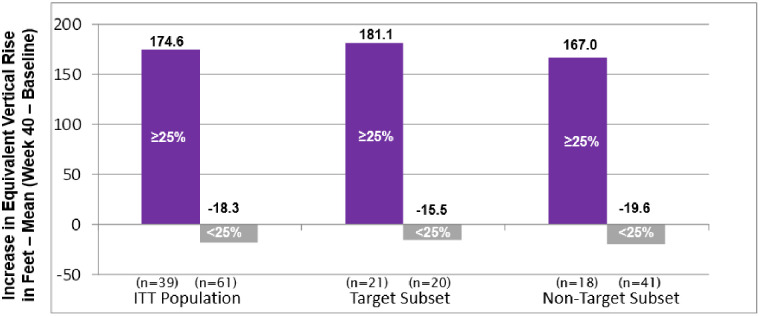
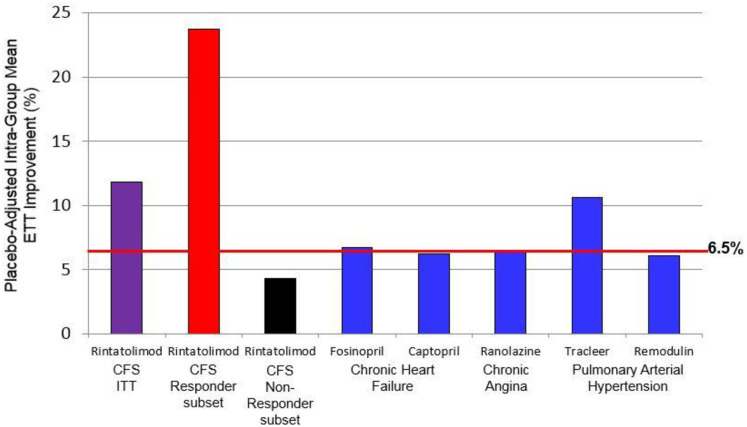
A hypothesis-based post-hoc analysis of the Intent to Treat (ITT) population diagnosed with ME/CFS from 12 independent clinical sites of a Phase III trial was performed to evaluate the effect of rintatolimod therapy based on disease duration. The clinical activity of rintatolimod was evaluated by exercise treadmill tolerance (ETT) using a modified Bruce protocol. The ITT population (n = 208) was divided into two subsets of symptom duration. Patients with symptom duration of 2-8 years were identified as the Target Subset (n = 75); the remainder (<2 year plus >8 year) were identified as the Non-Target Subset (n = 133). Placebo-adjusted percentage improvements in exercise duration and the vertical rise for the Target Subset (n = 75) were more than twice that of the ITT population. The Non-Target Subset (n = 133) failed to show any clinically significant ETT response to rintatolimod when compared to placebo. Within the Target Subset, 51.2% of rintatolimod-treated patients improved their exercise duration by ≥25% (p = 0.003) despite reduced statistical power from division of the original ITT population into two subsets.
CONCLUSION/SIGNIFICANCE: Analysis of ETT from a Phase III trial has identified within the ITT population, a subset of ME/CFS patients with ≥2 fold increased exercise response to rintatolimod. Substantial improvement in physical performance was seen for the majority (51.2%) of these severely debilitated patients who improved exercise duration by ≥25%. This magnitude of exercise improvement was associated with clinically significant enhancements in quality of life. The data indicate that ME/CFS patients have a relatively short disease duration window (<8 years) to expect a significant response to rintatolimod under the dosing conditions utilized in this Phase III clinical trial. These results may have direct relevance to the cognitive impairment and fatigue being experienced by patients clinically recovered from COVID-19 and free of detectable SARS-CoV-2.
ClinicalTrials.gov: NCT00215800.
Rintatolimod 是一种选择性 TLR3 激动剂,在 II 期和 III 期双盲、安慰剂对照、随机、多中心临床试验中已显示出对 ME/CFS 的临床疗效。
对 III 期试验 12 个独立临床中心诊断为 ME/CFS 的意向治疗(ITT)人群进行了基于假设的事后分析,以评估基于疾病持续时间的 Rintatolimod 治疗效果。使用改良 Bruce 方案的跑步机耐力(ETT)评估 Rintatolimod 的临床疗效。ITT 人群(n=208)分为两个症状持续时间亚组。将症状持续时间为 2-8 年的患者确定为目标亚组(n=75);其余(<2 年加>8 年)为非目标亚组(n=133)。与安慰剂相比,目标亚组(n=75)的运动时间和垂直升高的安慰剂调整百分比改善超过两倍。与安慰剂相比,非目标亚组(n=133)的 Rintatolimod 对 ETT 没有任何临床显著反应。在目标亚组中,51.2%的 Rintatolimod 治疗患者的运动时间改善≥25%(p=0.003),尽管将原始 ITT 人群分为两个亚组后统计效力降低。
结论/意义:对 III 期试验的 ETT 分析确定,在 ITT 人群中,有一个 ME/CFS 患者亚组对 Rintatolimod 的运动反应增加了 2 倍以上。对于这些严重衰弱的患者中的大多数(51.2%),身体表现有了实质性的改善,他们的运动时间改善了≥25%。这种运动改善程度与生活质量的临床显著提高相关。数据表明,ME/CFS 患者的疾病持续时间窗口相对较短(<8 年),在 III 期临床试验中使用的给药条件下,预计对 Rintatolimod 有显著反应。这些结果可能与临床康复且无 SARS-CoV-2 可检测的 COVID-19 患者经历的认知障碍和疲劳直接相关。
ClinicalTrials.gov:NCT00215800。