Morikawa Keisuke, Tabira Kazuyuki, Takemura Hiroyuki, Inaba Shogo, Kusuki Haruka, Hashitsume Yu, Suzuki Yuta, Tenpaku Yosuke, Yasuma Taro, D'Alessandro-Gabazza Corina N, Gabazza Esteban, Hataji Osamu
Department of Rehabilitation, Matsusaka Municipal Hospital, Tonomachi 1550, Matsusaka, Mie 515-8544, Japan.
Department of Health of Science, Kio University Graduate School, Umamichu 4-2-2, Kitakatura-Gigunkoryocho, Nara 635-0832, Japan.
J Clin Med. 2020 Oct 27;9(11):3455. doi: 10.3390/jcm9113455.
Medical nutrition therapy is important in the management of chronic obstructive pulmonary disease (COPD) patients. Determination of resting energy expenditure is essential to define therapeutic goals for medical nutrition. Previous studies proposed the use of equations to predict resting energy expenditure. No prediction equation is currently available for the Japanese population. The objective of this study was to develop an equation to predict resting energy expenditure in Japanese chronic obstructive pulmonary disease patients. To this end, we investigated clinical variables that correlate with the resting energy expenditure.
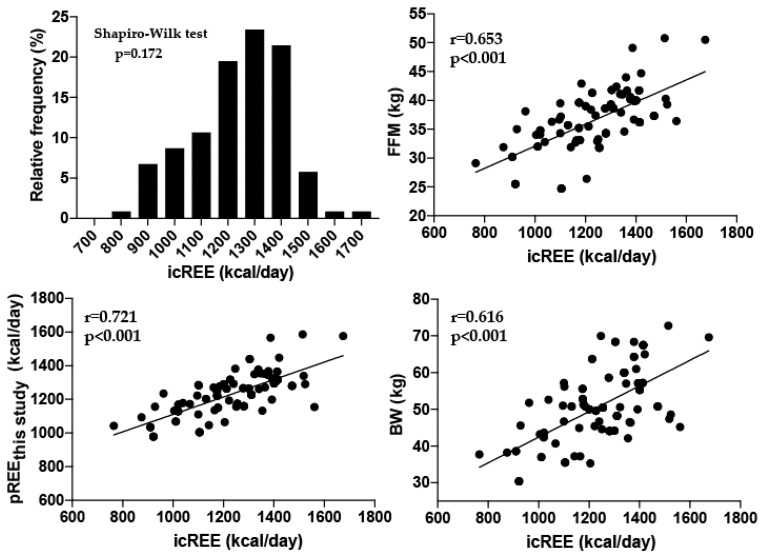
This study included 102 COPD patients admitted at the Matsusaka Municipal Hospital Respiratory Center. We measured resting energy expenditure by indirect calorimetry and explored the relationship of resting energy expenditure with clinical variables by univariate and stepwise linear regression analysis.
The resting energy expenditure by indirect calorimetry was significantly correlated with fat-free mass, body weight, body mass index, height, gender, and pulmonary function test by univariate analysis. In the stepwise linear regression analysis, the fat-free mass, body weight, and age remained significantly correlated with indirect calorimetry's resting energy expenditure. The fat-free mass, body weight, and age explained 50.5% of the resting energy expenditure variation.
Fat-free mass, body weight, and age were significantly correlated with resting energy expenditure by stepwise linear regression analysis, and they were used to define a predictive equation for Japanese COPD patients.
医学营养治疗在慢性阻塞性肺疾病(COPD)患者的管理中至关重要。确定静息能量消耗对于明确医学营养的治疗目标至关重要。先前的研究提出使用公式来预测静息能量消耗。目前尚无适用于日本人群的预测公式。本研究的目的是开发一个用于预测日本慢性阻塞性肺疾病患者静息能量消耗的公式。为此,我们调查了与静息能量消耗相关的临床变量。
本研究纳入了松阪市立医院呼吸中心收治的102例COPD患者。我们通过间接测热法测量静息能量消耗,并通过单因素和逐步线性回归分析探讨静息能量消耗与临床变量之间的关系。
通过单因素分析,间接测热法测得的静息能量消耗与去脂体重、体重、体重指数、身高、性别和肺功能测试显著相关。在逐步线性回归分析中,去脂体重、体重和年龄与间接测热法测得的静息能量消耗仍显著相关。去脂体重、体重和年龄解释了静息能量消耗变异的50.5%。
通过逐步线性回归分析,去脂体重、体重和年龄与静息能量消耗显著相关,它们被用于定义日本COPD患者的预测公式。