Liu Chang, Zhao Qian, Yu Xijie
Department of Endocrinology and Metabolism, Laboratory of Endocrinology and Metabolism, National Clinical Research Center for Geriatrics, West China Hospital, Sichuan University, Chengdu, China.
Department of General Practice, West China Hospital, Sichuan University, Chengdu, China.
Front Oncol. 2020 Oct 2;10:561595. doi: 10.3389/fonc.2020.561595. eCollection 2020.
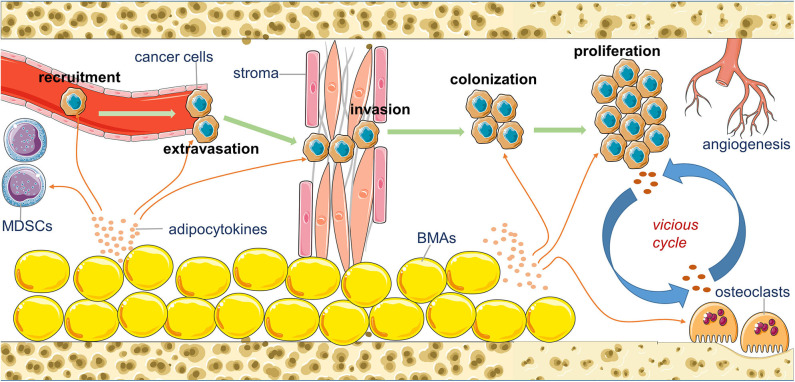
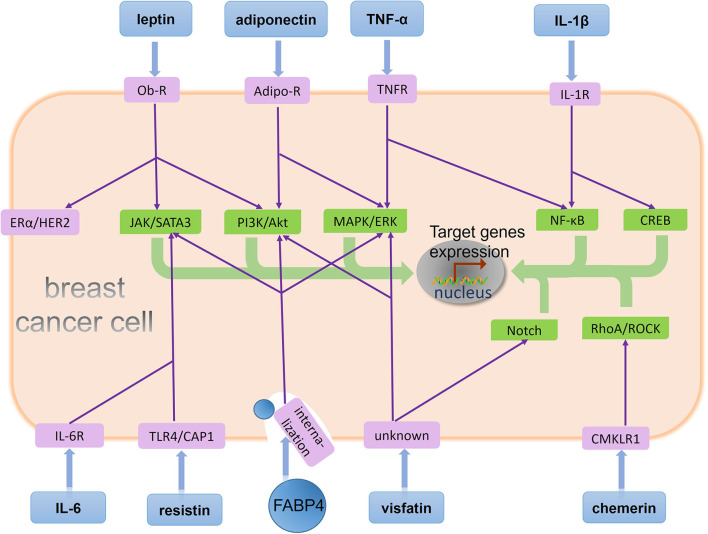
Accumulating discoveries highlight the importance of interaction between marrow stromal cells and cancer cells for bone metastasis. Bone is the most common metastatic site of breast cancer and bone marrow adipocytes (BMAs) are the most abundant component of the bone marrow microenvironment. BMAs are unique in their origin and location, and recently they are found to serve as an endocrine organ that secretes adipokines, cytokines, chemokines, and growth factors. It is reasonable to speculate that BMAs contribute to the modification of bone metastatic microenvironment and affecting metastatic breast cancer cells in the bone marrow. Indeed, BMAs may participate in bone metastasis of breast cancer through regulation of recruitment, invasion, survival, colonization, proliferation, angiogenesis, and immune modulation by their production of various adipocytokines. In this review, we provide an overview of research progress, focusing on adipocytokines secreted by BMAs and their potential roles for bone metastasis of breast cancer, and investigating the mechanisms mediating the interaction between BMAs and metastatic breast cancer cells. Based on current findings, BMAs may function as a pivotal modulator of bone metastasis of breast cancer, therefore targeting BMAs combined with conventional treatment programs might present a promising therapeutic option.
越来越多的研究发现凸显了骨髓基质细胞与癌细胞之间的相互作用在骨转移中的重要性。骨是乳腺癌最常见的转移部位,而骨髓脂肪细胞(BMA)是骨髓微环境中最丰富的成分。BMA在其起源和位置上具有独特性,最近发现它们可作为一种内分泌器官,分泌脂肪因子、细胞因子、趋化因子和生长因子。据推测,BMA有助于改变骨转移微环境并影响骨髓中的转移性乳腺癌细胞,这是合理的。事实上,BMA可能通过产生各种脂肪细胞因子调节募集、侵袭、存活、定植、增殖、血管生成和免疫调节,从而参与乳腺癌的骨转移。在这篇综述中,我们概述了研究进展,重点关注BMA分泌的脂肪细胞因子及其在乳腺癌骨转移中的潜在作用,并研究介导BMA与转移性乳腺癌细胞相互作用的机制。基于目前的研究结果,BMA可能是乳腺癌骨转移的关键调节因子,因此将针对BMA的治疗与传统治疗方案相结合可能是一种有前景的治疗选择。