Wieder Robert
Rutgers New Jersey Medical School and the Cancer Institute of New Jersey, 185 South Orange Avenue, MSB F671, Newark, NJ 07103, USA.
Cancers (Basel). 2023 Jun 1;15(11):3021. doi: 10.3390/cancers15113021.
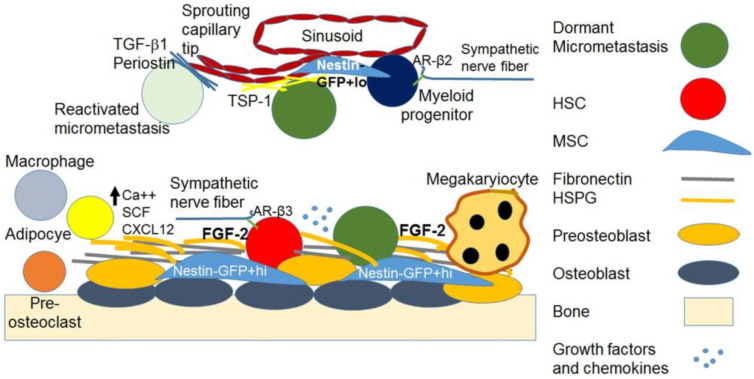
Up to 40% of patients with breast cancer (BC) have metastatic cells in the bone marrow (BM) at the initial diagnosis of localized disease. Despite definitive systemic adjuvant therapy, these cells survive in the BM microenvironment, enter a dormant state and recur stochastically for more than 20 years. Once they begin to proliferate, recurrent macrometastases are not curable, and patients generally succumb to their disease. Many potential mechanisms for initiating recurrence have been proposed, but no definitive predictive data have been generated. This manuscript reviews the proposed mechanisms that maintain BC cell dormancy in the BM microenvironment and discusses the data supporting specific mechanisms for recurrence. It addresses the well-described mechanisms of secretory senescence, inflammation, aging, adipogenic BM conversion, autophagy, systemic effects of trauma and surgery, sympathetic signaling, transient angiogenic bursts, hypercoagulable states, osteoclast activation, and epigenetic modifications of dormant cells. This review addresses proposed approaches for either eliminating micrometastases or maintaining a dormant state.
高达40%的乳腺癌(BC)患者在局部疾病初诊时骨髓(BM)中存在转移细胞。尽管进行了明确的全身辅助治疗,但这些细胞在骨髓微环境中存活,进入休眠状态,并在20多年间随机复发。一旦它们开始增殖,复发性大转移就无法治愈,患者通常会死于该疾病。已经提出了许多引发复发的潜在机制,但尚未产生明确的预测数据。本文综述了在骨髓微环境中维持乳腺癌细胞休眠的机制,并讨论了支持复发特定机制的数据。它阐述了分泌性衰老、炎症、衰老、骨髓脂肪生成转化、自噬、创伤和手术的全身影响、交感神经信号传导、短暂性血管生成爆发、高凝状态、破骨细胞激活以及休眠细胞的表观遗传修饰等已被充分描述的机制。本综述探讨了消除微转移或维持休眠状态的建议方法。