Department of Nutrition, Institute of Basic Medical Sciences, Faculty of Medicine, University of Oslo, Oslo, Norway.
Institute of Clinical Medicine, Faculty of Medicine, University of Oslo, Oslo, Norway.
Diabetologia. 2021 Feb;64(2):410-423. doi: 10.1007/s00125-020-05296-0. Epub 2020 Oct 29.
AIMS/HYPOTHESIS: Obesity and insulin resistance may be associated with elevated plasma concentration of branched-chain amino acids (BCAAs) and impaired BCAA metabolism. However, it is unknown whether the insulin-sensitising effect of long-term exercise can be explained by concomitant change in BCAAs and their metabolism.
We included 26 sedentary overweight and normal-weight middle-aged men from the MyoGlu clinical trial, with or without dysglycaemia, for 12 weeks of supervised intensive exercise intervention, including two endurance and two resistance sessions weekly. Insulin sensitivity was measured as the glucose infusion rate (GIR) from a hyperinsulinaemic-euglycaemic clamp. In addition, maximum oxygen uptake, upper and lower body strength and adipose tissue depots (using MRI and spectroscopy) were measured, and subcutaneous white adipose tissue (ScWAT) and skeletal muscle (SkM) biopsies were harvested both before and after the 12 week intervention. In the present study we have measured plasma BCAAs and related metabolites using CG-MS/MS and HPLC-MS/MS, and performed global mRNA-sequencing pathway analysis on ScWAT and SkM.
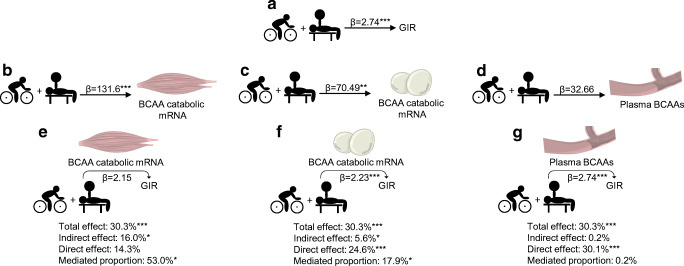
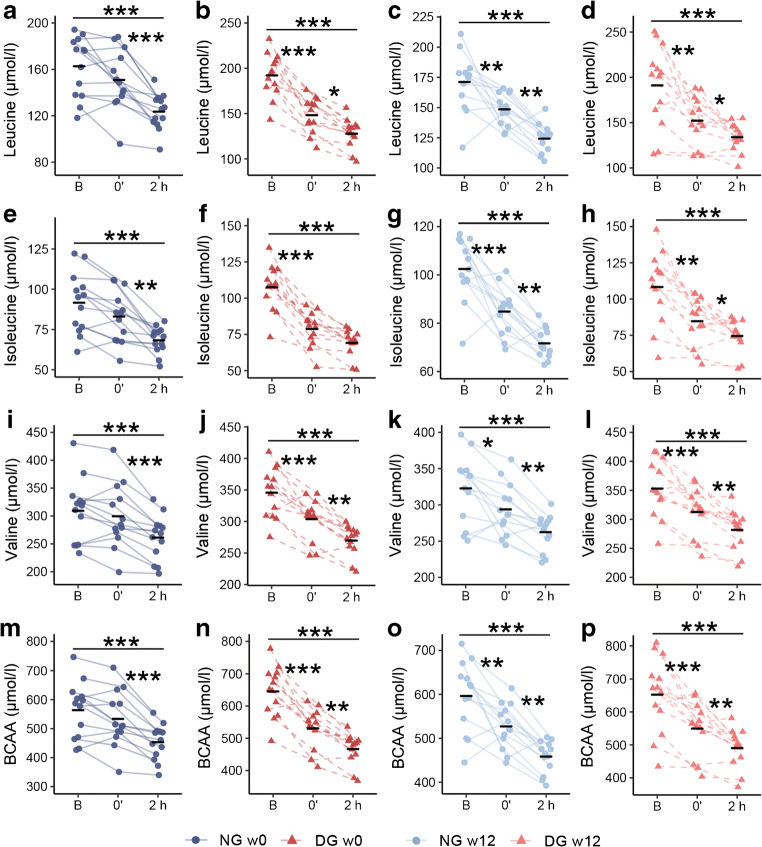
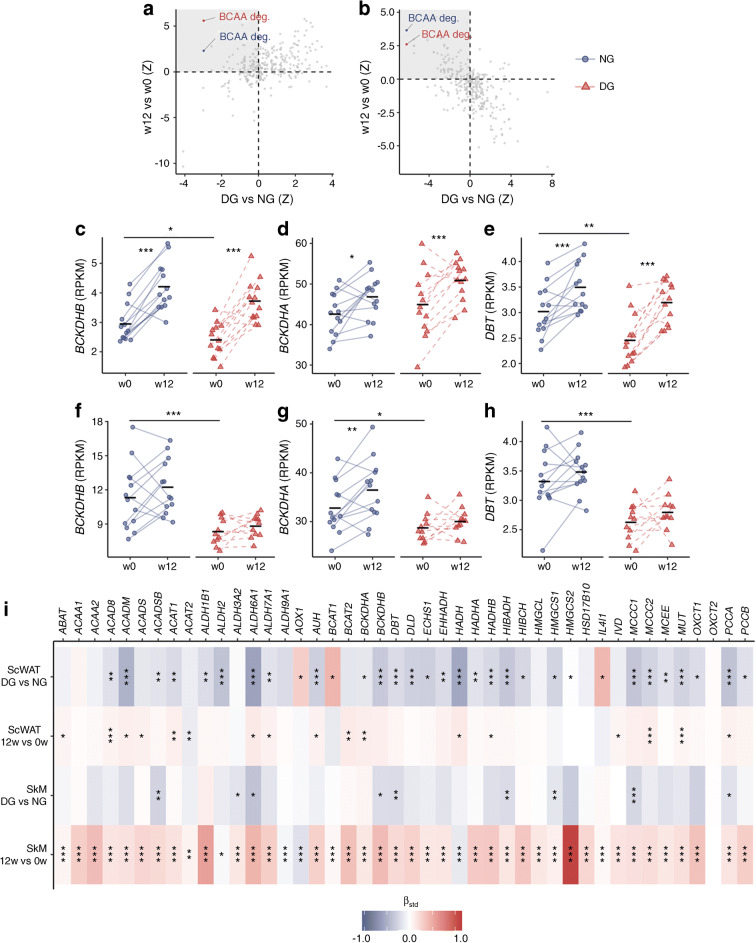
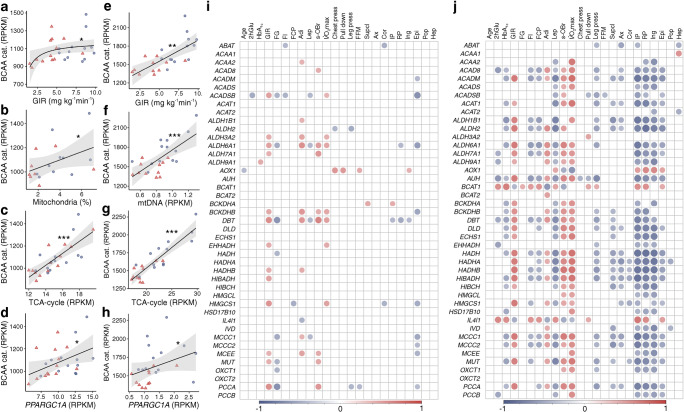
In MyoGlu, men with dysglycaemia displayed lower GIR, more fat mass and higher liver fat content than normoglycaemic men at baseline, and 12 weeks of exercise increased GIR, improved body composition and reduced liver fat content similarly for both groups. In our current study we observed higher plasma concentrations of BCAAs (14.4%, p = 0.01) and related metabolites, such as 3-hydroxyisobutyrate (19.4%, p = 0.034) in dysglycaemic vs normoglycaemic men at baseline. Baseline plasma BCAA levels correlated negatively to the change in GIR (ρ = -0.41, p = 0.037) and [Formula: see text] (ρ = -0.47, p = 0.015) after 12 weeks of exercise and positively to amounts of intraperitoneal fat (ρ = 0.40, p = 0.044) and liver fat (ρ = 0.58, p = 0.01). However, circulating BCAAs and related metabolites did not respond to 12 weeks of exercise, with the exception of isoleucine, which increased in normoglycaemic men (10 μmol/l, p = 0.01). Pathway analyses of mRNA-sequencing data implied reduced BCAA catabolism in both SkM and ScWAT in men with dysglycaemia compared with men with normoglycaemia at baseline. Gene expression levels related to BCAA metabolism correlated positively with GIR and markers of mitochondrial content in both SkM and ScWAT, and negatively with fat mass generally, and particularly with intraperitoneal fat mass. mRNA-sequencing pathway analysis also implied increased BCAA metabolism after 12 weeks of exercise in both groups and in both tissues, including enhanced expression of the gene encoding branched-chain α-ketoacid dehydrogenase (BCKDH) and reduced expression of the BCKDH phosphatase in both groups and tissues. Gene expression of SLC25A44, which encodes a mitochondrial BCAA transporter, was increased in SkM in both groups, and gene expression of BCKDK, which encodes BCKDH kinase, was reduced in ScWAT in dysglycaemic men. Mediation analyses indicated a pronounced effect of enhanced SkM (53%, p = 0.022), and a moderate effect of enhanced ScWAT (18%, p = 0.018) BCAA metabolism on improved insulin sensitivity after 12 weeks of exercise, based on mRNA sequencing. In comparison, plasma concentration of BCAAs did not mediate any effect in this regard.
CONCLUSION/INTERPRETATION: Plasma BCAA concentration was largely unresponsive to long-term exercise and unrelated to exercise-induced insulin sensitivity. On the other hand, the insulin-sensitising effect of long-term exercise in men may be explained by enhanced SkM and, to a lesser degree, also by enhanced ScWAT BCAA catabolism. Graphical abstract.
目的/假设:肥胖和胰岛素抵抗可能与血浆支链氨基酸 (BCAA) 浓度升高和 BCAA 代谢受损有关。然而,尚不清楚长期运动的胰岛素增敏作用是否可以通过同时改变 BCAAs 及其代谢来解释。
我们纳入了 MyoGlu 临床试验中 26 名久坐的超重和正常体重的中年男性,无论是否存在糖代谢异常,均接受 12 周的强化监督运动干预,每周包括两次耐力运动和两次阻力运动。胰岛素敏感性通过高胰岛素-正常血糖钳夹测定葡萄糖输注率(GIR)来衡量。此外,还测量了最大摄氧量、上下肢力量和脂肪组织蓄积(使用 MRI 和光谱),并在 12 周干预前后采集了皮下白色脂肪组织 (ScWAT) 和骨骼肌 (SkM) 活检。在本研究中,我们使用 CG-MS/MS 和 HPLC-MS/MS 测量了血浆支链氨基酸 (BCAA) 及其相关代谢物,并对 ScWAT 和 SkM 进行了全局 mRNA 测序通路分析。
在 MyoGlu 中,与血糖正常的男性相比,糖代谢异常的男性在基线时的 GIR 较低,脂肪量更多,肝脏脂肪含量更高,而 12 周的运动增加了 GIR,改善了身体成分,并减少了两组的肝脏脂肪含量。在我们目前的研究中,我们观察到糖代谢异常的男性血浆 BCAAs(14.4%,p=0.01)和相关代谢物(如 3-羟基异丁酸酯(19.4%,p=0.034))的浓度高于血糖正常的男性。基线时血浆 BCAA 水平与 12 周运动后 GIR 的变化(ρ=-0.41,p=0.037)和 [Formula: see text](ρ=-0.47,p=0.015)呈负相关,与腹腔内脂肪量(ρ=0.40,p=0.044)和肝脏脂肪量(ρ=0.58,p=0.01)呈正相关。然而,循环 BCAAs 和相关代谢物对 12 周的运动没有反应,除了异亮氨酸,它在血糖正常的男性中增加(10μmol/l,p=0.01)。SkM 和 ScWAT 中 mRNA 测序数据的途径分析表明,与血糖正常的男性相比,糖代谢异常的男性在基线时 BCAA 分解代谢减少。与 BCAA 代谢相关的基因表达水平与 GIR 和 SkM 和 ScWAT 中线粒体含量的标志物呈正相关,与脂肪量总体呈负相关,特别是与腹腔内脂肪量呈负相关。12 周运动后的 mRNA 测序途径分析也表明两组和两组组织中的 BCAA 代谢增加,包括 BCKDH 编码基因的表达增强和两组和组织中 BCKDH 磷酸酶的表达减少。SkM 中编码线粒体 BCAA 转运体的 SLC25A44 基因的表达增加,而糖代谢异常男性的 ScWAT 中 BCKDK 基因的表达减少,BCKDH 激酶编码基因。中介分析表明,SkM 的增强作用显著(53%,p=0.022),ScWAT 的增强作用适度(18%,p=0.018),这是 12 周运动后胰岛素敏感性改善的主要原因,基于 mRNA 测序。相比之下,血浆 BCAAs 浓度在这方面没有任何作用。
结论/解释:长期运动对血浆支链氨基酸浓度的影响不大,与运动引起的胰岛素敏感性无关。另一方面,长期运动对男性胰岛素敏感性的增敏作用可能是通过增强 SkM 和在较小程度上也通过增强 ScWAT 的支链氨基酸分解代谢来解释的。