Department of Respiratory Medicine, Japanese Red Cross Kyoto Daini Hospital, Kyoto, Japan.
Department of Thoracic Surgery, Japanese Red Cross Kyoto Daini Hospital, Kyoto, Japan.
Thorac Cancer. 2021 Jan;12(1):97-105. doi: 10.1111/1759-7714.13720. Epub 2020 Oct 30.
First-line chemoimmunotherapy (CIT) has improved overall survival (OS) and progression-free survival (PFS) outcomes among patients with non-small cell lung cancer (NSCLC). The immunological and nutritional statuses of patients fluctuate during treatment using immune checkpoint inhibitors, and are closely related to treatment outcomes. However, it is unclear whether these markers are significant in patients who are receiving CIT.
This retrospective single-center study evaluated 34 consecutive Japanese patients with NSCLC who were treated using first-line CIT. Previously reported markers that reflect immunological and nutritional statuses were evaluated at three time points: at the start of CIT, after three weeks, and at the end of induction therapy.
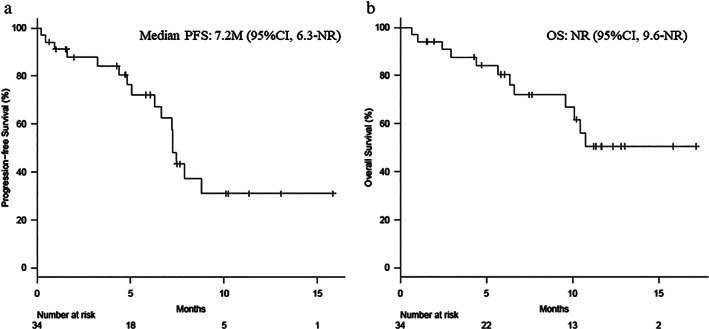
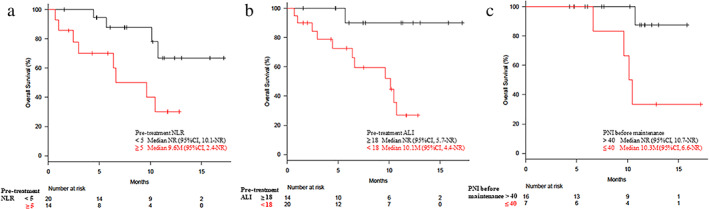
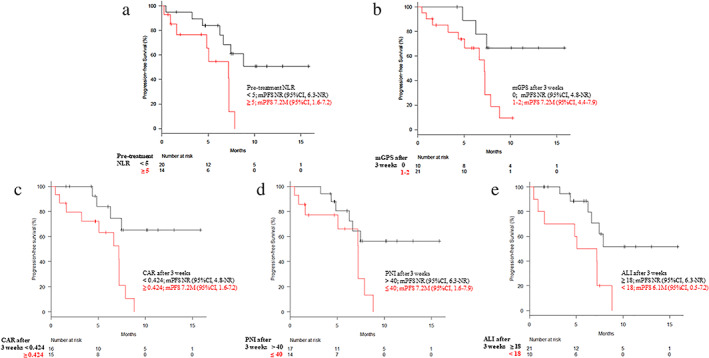
The median PFS was 7.2 months (95% confidence interval: 6.3 months-not reached) and the median OS was not reached (95% confidence interval: 9.6 months-not reached). The PFS duration was significantly associated with the baseline neutrophil-to-lymphocyte ratio and the three-week values for the modified Glasgow prognostic score, C-reactive protein-albumin ratio, prognostic nutrition index, and advanced lung cancer inflammation index. The OS duration was significantly associated with the pre-treatment values for the neutrophil-to-lymphocyte ratio and advanced lung cancer inflammation index, as well as the prognostic nutrition index at the end of induction therapy.
Immunological and nutritional markers could be useful for predicting the outcomes of CIT for Japanese patients with advanced non-small cell lung cancer. The timing of their evaluation may also be important.
SIGNIFICANT FINDINGS OF THE STUDY: Overall survival in patients receiving first-line chemoimmunotherapy for advanced lung cancer were associated with pretreatment values of neutrophil-to-lymphocyte ratio, advanced lung cancer inflammation index, and the prognostic nutrition index at the end of induction therapy.
Repetitive evaluation of immunological and nutritional markers may be useful for guiding prognostication and treatment selection for Japanese patients with advanced lung cancer.
一线化疗免疫治疗(CIT)改善了非小细胞肺癌(NSCLC)患者的总生存期(OS)和无进展生存期(PFS)。在使用免疫检查点抑制剂治疗期间,患者的免疫和营养状况波动,与治疗结果密切相关。然而,目前尚不清楚这些标志物在接受 CIT 的患者中是否具有重要意义。
本回顾性单中心研究评估了 34 例接受一线 CIT 治疗的连续日本 NSCLC 患者。评估了反映免疫和营养状况的先前报道的标志物,在三个时间点进行评估:CIT 开始时、三周后和诱导治疗结束时。
中位 PFS 为 7.2 个月(95%置信区间:6.3 个月-未达到),中位 OS 未达到(95%置信区间:9.6 个月-未达到)。PFS 持续时间与基线中性粒细胞与淋巴细胞比值和三周时改良格拉斯哥预后评分、C 反应蛋白-白蛋白比值、预后营养指数和晚期肺癌炎症指数显著相关。OS 持续时间与治疗前中性粒细胞与淋巴细胞比值和晚期肺癌炎症指数以及诱导治疗结束时的预后营养指数显著相关。
免疫和营养标志物可用于预测日本晚期非小细胞肺癌患者接受 CIT 的结局。评估的时间点也可能很重要。