• 文献检索
  • 文档翻译
  • 深度研究
  • 学术资讯
  • Suppr Zotero 插件Zotero 插件
  • 邀请有礼
  • 套餐&价格
  • 历史记录
应用&插件
Suppr Zotero 插件Zotero 插件浏览器插件Mac 客户端Windows 客户端微信小程序
定价
高级版会员购买积分包购买API积分包
服务
文献检索文档翻译深度研究API 文档MCP 服务
关于我们
关于 Suppr公司介绍联系我们用户协议隐私条款
关注我们

Suppr 超能文献

核心技术专利:CN118964589B侵权必究
粤ICP备2023148730 号-1Suppr @ 2026

文献检索

告别复杂PubMed语法,用中文像聊天一样搜索,搜遍4000万医学文献。AI智能推荐,让科研检索更轻松。

立即免费搜索

文件翻译

保留排版,准确专业,支持PDF/Word/PPT等文件格式,支持 12+语言互译。

免费翻译文档

深度研究

AI帮你快速写综述,25分钟生成高质量综述,智能提取关键信息,辅助科研写作。

立即免费体验

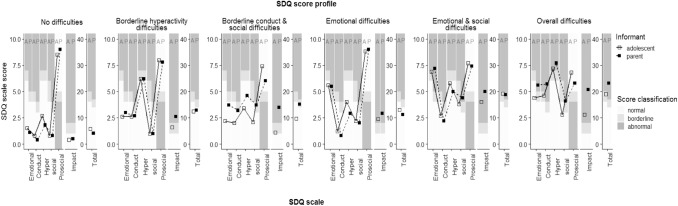
联合自评和家长评定的 SDQ 评分模式可预测照护使用情况和精神科诊断。

The combined self- and parent-rated SDQ score profile predicts care use and psychiatric diagnoses.

机构信息

Heymans Institute for Psychological Research, University of Groningen, Groningen, The Netherlands.

Department of Psychiatry, Child and Adolescent Psychiatry, University Medical Center Groningen (UMCG), University of Groningen, Groningen, The Netherlands.

出版信息

Eur Child Adolesc Psychiatry. 2021 Dec;30(12):1983-1994. doi: 10.1007/s00787-020-01667-5. Epub 2020 Oct 30.

DOI:10.1007/s00787-020-01667-5
PMID:33125550
原文链接:https://pmc.ncbi.nlm.nih.gov/articles/PMC8563533/
Abstract

The Strengths and Difficulties Questionnaire (SDQ) is widely used, based on evidence of its value for screening. This evidence primarily regards the single informant total difficulties scale and separate difficulties subscales. We assessed to what degree adolescents' SDQ profiles that combined all self- and parent-rated subscales were associated with use of care and psychiatric diagnoses, and examined the added value thereof over using only a single informant and the total scale. Cluster analysis was used to identify common SDQ profiles based on self- and parent-reports among adolescents aged 12-17 in mental healthcare (n = 4282), social care (n = 124), and the general population (n = 1293). We investigated associations of the profiles with 'care use' and 'DSM-IV diagnoses', depending on gender. We identified six common SDQ profiles: five profiles with varying types and severities of reported difficulties, pertaining to 95% of adolescents in care, and one without difficulties, pertaining to 55% of adolescents not in care. The types of reported difficulties in the profiles matched DSM-IV diagnoses for 88% of the diagnosed adolescents. The SDQ profiles were found to be more useful for predicting care use and diagnoses than SDQ scores reported by the adolescent as single informant and the total difficulties scale. The latter indicated the presence of problems among 42-63% of the adolescents in care, missing a substantial number of adolescents with reported emotional difficulties and borderline problem severity. These findings advocate the use of combined self- and parent-rated SDQ score profiles for screening.

摘要

《长处与困难问卷》(SDQ)应用广泛,其价值已得到充分验证,可用于筛查。这些证据主要涉及单一信息源的总困难量表和单独的困难分量表。我们评估了综合所有自我报告和家长报告的子量表的青少年 SDQ 特征与使用护理和精神科诊断的关联程度,并检验了其相对于仅使用单一信息源和总量表的附加价值。聚类分析用于根据精神卫生保健(n=4282)、社会保健(n=124)和一般人群(n=1293)中 12-17 岁青少年的自我报告和家长报告,识别 SDQ 特征。我们根据性别调查了这些特征与“护理使用”和“DSM-IV 诊断”的关联。我们确定了六个常见的 SDQ 特征:五个具有不同类型和严重程度报告困难的特征,涉及护理中的 95%的青少年,一个没有困难的特征,涉及未接受护理的 55%的青少年。在这些特征中报告的困难类型与 DSM-IV 诊断相符,占诊断青少年的 88%。研究发现,与青少年作为单一信息源和总困难量表报告的 SDQ 得分相比,SDQ 特征更有助于预测护理使用和诊断。后者表明,在接受护理的青少年中,42%-63%存在问题,错过了相当数量报告有情绪困难和边缘问题严重程度的青少年。这些发现提倡使用综合自我和家长评定的 SDQ 评分特征进行筛查。
https://cdn.ncbi.nlm.nih.gov/pmc/blobs/1b23/8563533/e3e4fd128ce8/787_2020_1667_Fig1_HTML.jpg

相似文献

1
The combined self- and parent-rated SDQ score profile predicts care use and psychiatric diagnoses.联合自评和家长评定的 SDQ 评分模式可预测照护使用情况和精神科诊断。
Eur Child Adolesc Psychiatry. 2021 Dec;30(12):1983-1994. doi: 10.1007/s00787-020-01667-5. Epub 2020 Oct 30.
2
Using the Dutch multi-informant Strengths and Difficulties Questionnaire (SDQ) to predict adolescent psychiatric diagnoses.使用荷兰多 informant 优势与困难问卷(SDQ)预测青少年精神科诊断。
Eur Child Adolesc Psychiatry. 2018 Oct;27(10):1347-1359. doi: 10.1007/s00787-018-1127-y. Epub 2018 Feb 24.
3
The Strengths and Difficulties Questionnaire (SDQ): the factor structure and scale validation in U.S. adolescents.长处与困难问卷(SDQ):美国青少年的因子结构和量表验证。
J Abnorm Child Psychol. 2013 May;41(4):583-95. doi: 10.1007/s10802-012-9696-6.
4
The Strengths and Difficulties Questionnaire Self-Report: A Valid Instrument for the Identification of Emotional and Behavioral Problems.长处与困难问卷(自我报告版):一种有效识别情绪和行为问题的工具。
Acad Pediatr. 2019 May-Jun;19(4):471-476. doi: 10.1016/j.acap.2018.12.008. Epub 2019 Jan 10.
5
Validity and reliability of the strengths and difficulties questionnaire in 5-6 year olds: differences by gender or by parental education?5-6 岁儿童长处和困难问卷的有效性和可靠性:性别或父母教育程度的差异?
PLoS One. 2012;7(5):e36805. doi: 10.1371/journal.pone.0036805. Epub 2012 May 18.
6
Six years ahead: a longitudinal analysis regarding course and predictive value of the Strengths and Difficulties Questionnaire (SDQ) in children and adolescents.六年展望:儿童和青少年长处和困难问卷(SDQ)的过程和预测价值的纵向分析。
Eur Child Adolesc Psychiatry. 2015 Jun;24(6):715-25. doi: 10.1007/s00787-014-0640-x. Epub 2014 Dec 2.
7
Screening for mental health disorders in active childhood epilepsy: population-based data.活动性儿童癫痫患者心理健康障碍的筛查:基于人群的数据。
Epilepsy Res. 2014 Dec;108(10):1917-26. doi: 10.1016/j.eplepsyres.2014.09.028. Epub 2014 Oct 13.
8
Psychometric properties of the parent strengths and difficulties questionnaire in the general population of German children and adolescents: results of the BELLA study.德国儿童和青少年普通人群中父母版优势与困难问卷的心理测量特性:贝拉研究结果
Eur Child Adolesc Psychiatry. 2008 Dec;17 Suppl 1:99-105. doi: 10.1007/s00787-008-1011-2.
9
Validating Screening Tool in Malayalam for Mental Disorders.验证马拉雅拉姆语版精神障碍筛查工具
Indian J Pediatr. 2015 Jul;82(7):595-600. doi: 10.1007/s12098-015-1727-1. Epub 2015 Mar 17.
10
Evaluating the psychometric properties of the parent-rated Strengths and Difficulties Questionnaire in a nationally representative sample of Canadian children and adolescents aged 6 to 17 years.评估家长评定的 Strengths and Difficulties Questionnaire 在加拿大 6 至 17 岁儿童和青少年全国代表性样本中的心理计量特性。
Health Rep. 2020 Aug 19;31(8):13-20. doi: 10.25318/82-003-x202000800002-eng.

引用本文的文献

1
The extent to which child- and parent-report Revised Children's Anxiety and Depression Scale, short Mood and Feeling Questionnaire, Strength and Difficulty Questionnaire and child-report KIDSCREEN identify the same young people as at risk of mental health conditions.儿童报告和家长报告的修订版儿童焦虑与抑郁量表、简短情绪与感受问卷、长处与困难问卷以及儿童报告的儿童生活质量量表在确定哪些年轻人有心理健康问题风险方面的一致性程度。
Br J Psychiatry. 2025 Mar 26:1-10. doi: 10.1192/bjp.2025.5.
2
The Strengths and Difficulties Questionnaire as a Valuable Screening Tool for Identifying Core Symptoms and Behavioural and Emotional Problems in Children with Neuropsychiatric Disorders.长处与困难问卷作为一种有价值的筛查工具,可用于识别神经精神障碍儿童的核心症状及行为和情绪问题。
Int J Environ Res Public Health. 2022 Jun 23;19(13):7731. doi: 10.3390/ijerph19137731.
3

本文引用的文献

1
A tutorial on regression-based norming of psychological tests with GAMLSS.基于 GAMLSS 的心理测验回归定标教程。
Psychol Methods. 2021 Jun;26(3):357-373. doi: 10.1037/met0000348. Epub 2020 Aug 27.
2
Validity Aspects of the Strengths and Difficulties Questionnaire (SDQ) Adolescent Self-Report and Parent-Report Versions Among Dutch Adolescents.荷兰青少年中优势与困难问卷(SDQ)青少年自评版和家长评版的效度方面
Assessment. 2021 Mar;28(2):601-616. doi: 10.1177/1073191119858416. Epub 2019 Jul 1.
3
The Strengths and Difficulties Questionnaire Self-Report: A Valid Instrument for the Identification of Emotional and Behavioral Problems.
Assessment of child psychological attributes using strength and difficulties questionnaire for prediction of child behavior at first dental visit: a cross-sectional study.使用长处与困难问卷评估儿童心理特质以预测首次牙科就诊时的儿童行为:一项横断面研究。
BDJ Open. 2022 Apr 8;8(1):10. doi: 10.1038/s41405-022-00103-x.
4
Psychometric Properties of the Strengths and Difficulties Questionnaire-Dysregulation Profile in Italian Early Adolescents.意大利青少年早期优势与困难问卷失调量表的心理测量特性
Children (Basel). 2021 Dec 3;8(12):1123. doi: 10.3390/children8121123.
长处与困难问卷(自我报告版):一种有效识别情绪和行为问题的工具。
Acad Pediatr. 2019 May-Jun;19(4):471-476. doi: 10.1016/j.acap.2018.12.008. Epub 2019 Jan 10.
4
Dutch norms for the Strengths and Difficulties Questionnaire (SDQ) - parent form for children aged 2-18 years.荷兰版《长处和困难问卷》(SDQ)- 家长用 2-18 岁儿童版。
Health Qual Life Outcomes. 2018 Jun 14;16(1):123. doi: 10.1186/s12955-018-0948-1.
5
Using the Dutch multi-informant Strengths and Difficulties Questionnaire (SDQ) to predict adolescent psychiatric diagnoses.使用荷兰多 informant 优势与困难问卷(SDQ)预测青少年精神科诊断。
Eur Child Adolesc Psychiatry. 2018 Oct;27(10):1347-1359. doi: 10.1007/s00787-018-1127-y. Epub 2018 Feb 24.
6
Enrolment of children in psychosocial care: problems upon entry, care received, and outcomes achieved.儿童入组心理社会关怀:入组时的问题、接受的关怀和取得的成果。
Eur Child Adolesc Psychiatry. 2018 May;27(5):625-635. doi: 10.1007/s00787-017-1048-1. Epub 2017 Nov 8.
7
Cohort Profile: Tracing Achievements, Key processes and Efforts in professional care for Children and Adolescents REsearch; TAKECARE.队列简介:追踪儿童和青少年专业护理研究中的成就、关键过程与努力;TAKECARE研究
Int J Epidemiol. 2016 Dec 1;45(6):1767-1775. doi: 10.1093/ije/dyu237.
8
Mental health in Dutch adolescents: a TRAILS report on prevalence, severity, age of onset, continuity and co-morbidity of DSM disorders.荷兰青少年的心理健康:TRAILS关于精神疾病诊断与统计手册(DSM)障碍的患病率、严重程度、发病年龄、连续性和共病情况的报告
Psychol Med. 2015 Jan;45(2):345-60. doi: 10.1017/S0033291714001469. Epub 2014 Jun 20.
9
The strengths and difficulties questionnaire as a predictor of parent-reported diagnosis of autism spectrum disorder and attention deficit hyperactivity disorder.作为家长报告的自闭症谱系障碍和注意力缺陷多动障碍诊断预测指标的长处与困难问卷。
PLoS One. 2013 Dec 3;8(12):e80247. doi: 10.1371/journal.pone.0080247. eCollection 2013.
10
The Strengths and Difficulties Questionnaire (SDQ): the factor structure and scale validation in U.S. adolescents.长处与困难问卷(SDQ):美国青少年的因子结构和量表验证。
J Abnorm Child Psychol. 2013 May;41(4):583-95. doi: 10.1007/s10802-012-9696-6.