Research Institute of Molecular Pathology (IMP), Vienna BioCenter (VBC), Campus-Vienna-Biocenter 1, 1030 Vienna, Austria.
Research Institute of Molecular Pathology (IMP), Vienna BioCenter (VBC), Campus-Vienna-Biocenter 1, 1030 Vienna, Austria.
Curr Biol. 2020 Dec 21;30(24):5058-5065.e5. doi: 10.1016/j.cub.2020.09.066. Epub 2020 Oct 29.
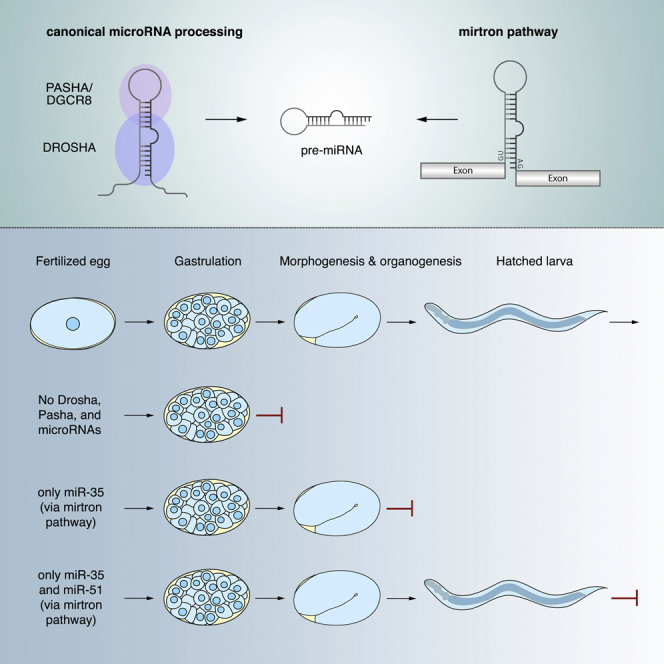
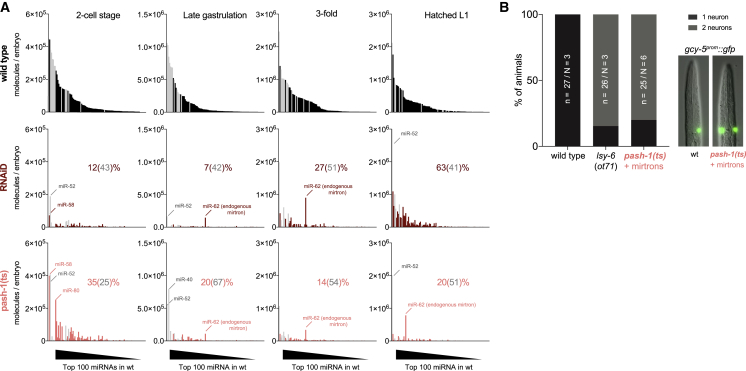
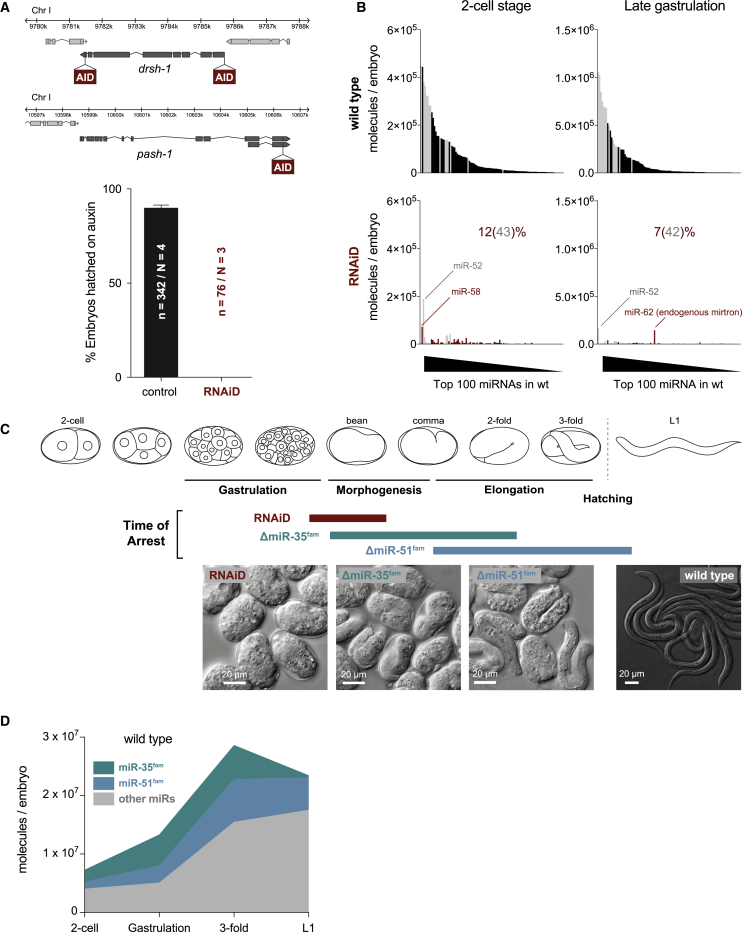
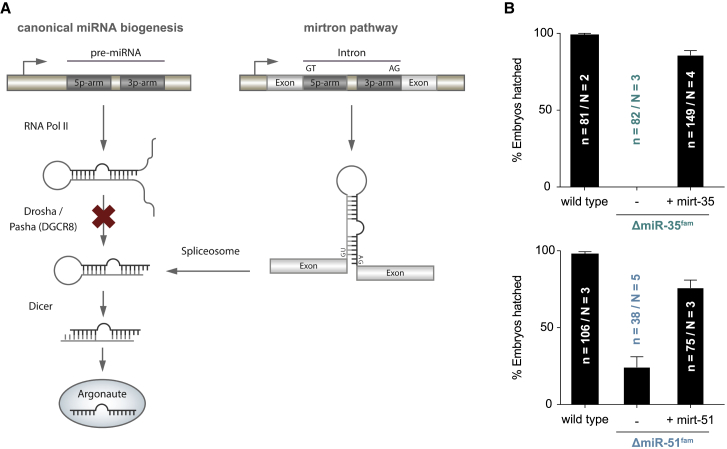
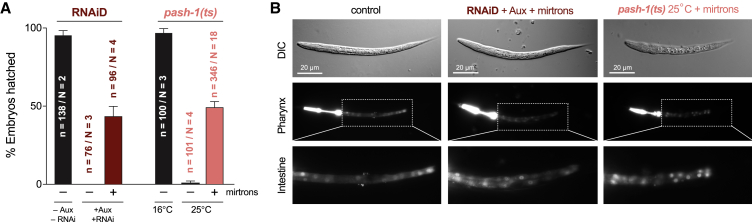
MicroRNAs (miRNAs) are a class of post-transcriptional repressors with diverse roles in animal development and physiology [1]. The Microprocessor complex, composed of Drosha and Pasha/DGCR8, is necessary for the biogenesis of all canonical miRNAs and essential for the early stages of animal embryogenesis [2-8]. However, the cause for this requirement is largely unknown. Animals often express hundreds of miRNAs, and it remains unclear whether the Microprocessor is required to produce one or few essential miRNAs or many individually non-essential miRNAs. Additionally, both Drosha and Pasha/DGCR8 bind and cleave a variety of non-miRNA substrates [9-15], and it is unknown whether these activities account for the Microprocessor's essential requirement. To distinguish between these possibilities, we developed a system in C. elegans to stringently deplete embryos of Microprocessor activity. Using a combination of auxin-inducible degradation (AID) and RNA interference (RNAi), we achieved Drosha and Pasha/DGCR8 depletion starting in the maternal germline, resulting in Microprocessor and miRNA-depleted embryos, which fail to undergo morphogenesis or form organs. Using a Microprocessor-bypass strategy, we show that this early embryonic arrest is rescued by the addition of just two miRNAs, one miR-35 and one miR-51 family member, resulting in morphologically normal larvae. Thus, just two out of ∼150 canonical miRNAs are sufficient for morphogenesis and organogenesis, and the processing of these miRNAs accounts for the essential requirement for Drosha and Pasha/DGCR8 during the early stages of C. elegans embryonic development. VIDEO ABSTRACT.
微小 RNA(miRNA)是一类在后转录水平起调控作用的分子,在动物发育和生理过程中具有广泛的功能[1]。Microprocessor 复合物由 Drosha 和 Pasha/DGCR8 组成,是所有经典 miRNA 生物发生所必需的,对于动物胚胎早期发育也至关重要[2-8]。然而,造成这种必需性的原因在很大程度上尚不清楚。动物通常表达数百种 miRNA,目前仍不清楚 Microprocessor 是否需要产生一种或少数几种必需的 miRNA,还是产生许多单独非必需的 miRNA。此外,Drosha 和 Pasha/DGCR8 都能结合和切割多种非 miRNA 底物[9-15],而这些活性是否解释了 Microprocessor 的必需性要求尚不清楚。为了区分这些可能性,我们在秀丽隐杆线虫中开发了一种严格耗尽 Microprocessor 活性的系统。我们结合使用生长素诱导降解(AID)和 RNA 干扰(RNAi),从母系生殖系开始实现 Drosha 和 Pasha/DGCR8 的耗尽,导致 Microprocessor 和 miRNA 耗尽的胚胎无法进行形态发生或形成器官。通过使用 Microprocessor 旁路策略,我们表明,通过添加仅两种 miRNA(miR-35 和一种 miR-51 家族成员)即可挽救这种早期胚胎阻滞,从而产生形态正常的幼虫。因此,仅两种约 150 种经典 miRNA 就足以进行形态发生和器官发生,并且这些 miRNA 的加工解释了 Drosha 和 Pasha/DGCR8 在秀丽隐杆线虫胚胎发育早期的必需性要求。视频摘要。