Yeom Kyu-Hyeon, Lee Yoontae, Han Jinju, Suh Mi Ra, Kim V Narry
Department of Biological Sciences and Research Center for Functional Cellulomics, Seoul National University, Seoul 151-742, Korea.
Nucleic Acids Res. 2006;34(16):4622-9. doi: 10.1093/nar/gkl458. Epub 2006 Sep 8.
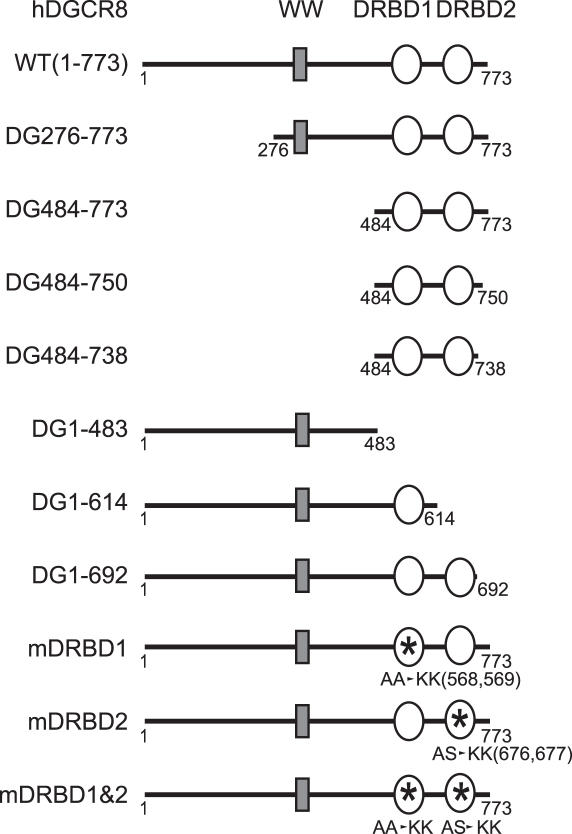
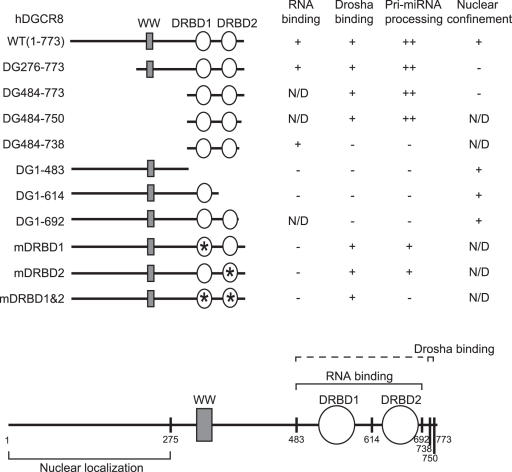
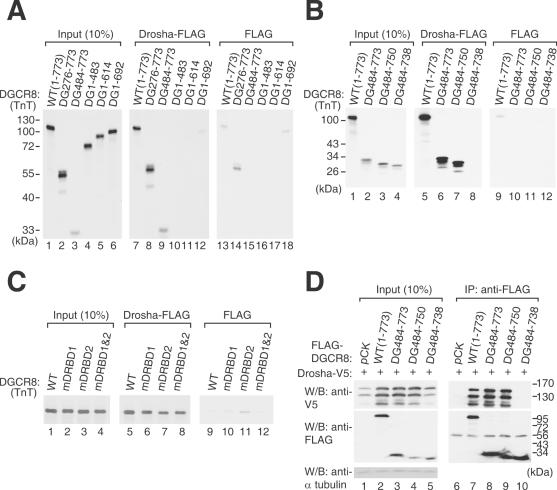
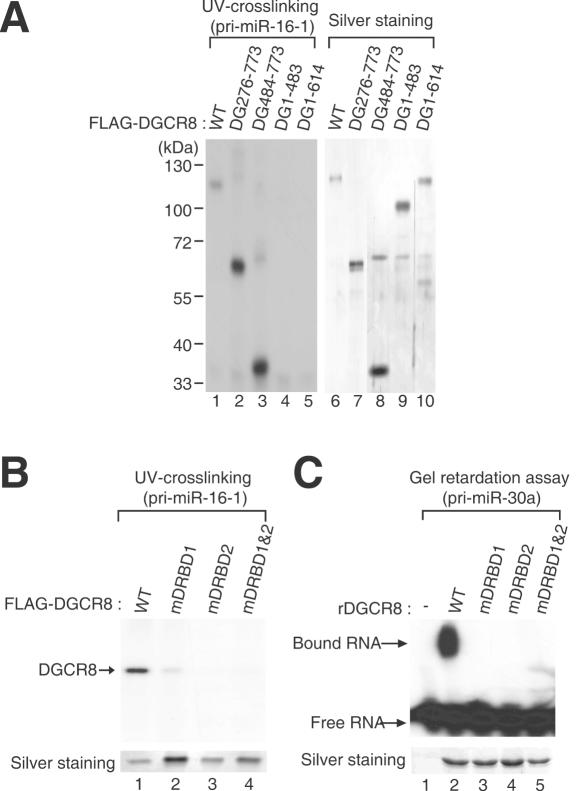
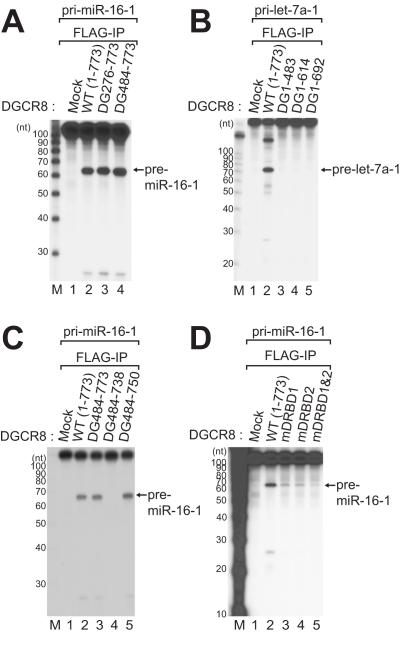
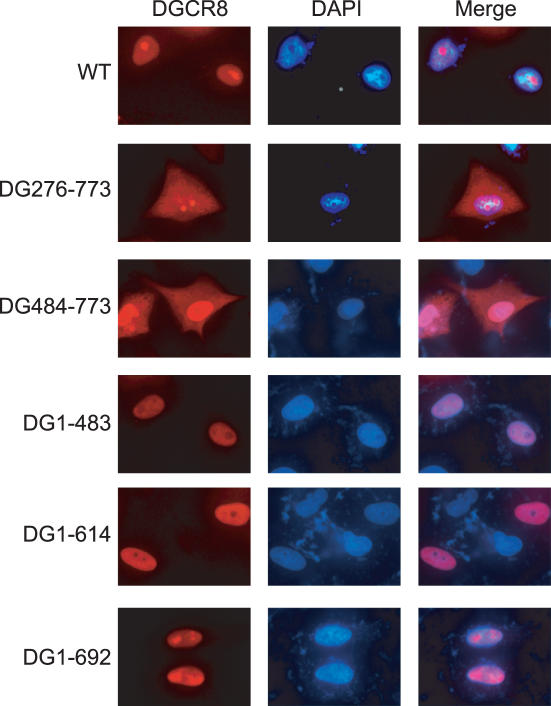
DGCR8/Pasha is an essential cofactor for Drosha, a nuclear RNase III that cleaves the local hairpin structures embedded in long primary microRNA transcripts (pri-miRNAs) in eukaryotes. Although our knowledge of pri-miRNA processing has significantly advanced in recent years, the precise role of DGCR8 in this pathway remains unclear. In our present study, we dissect the domains in DGCR8 that contribute to the processing of pri-miRNAs and the subcellular localization of DGCR8. Drosha is stabilized through an interaction between its middle domain and the conserved C-terminal domain of DGCR8. Furthermore, DGCR8, but not Drosha, can directly and stably interact with pri-miRNAs, and the tandem dsRNA-binding domains (dsRBDs) in DGCR8 are responsible for this recognition. Moreover, the DGCR8 N-terminal region upstream of its dsRBDs is unnecessary for pri-miRNA processing but is critical for nuclear localization. Our study thus provides further insights into the mechanism of action of the Drosha-DGCR8 complex in pri-miRNA processing.
DGCR8/Pasha是Drosha的一种必需辅助因子,Drosha是一种核核糖核酸酶III,可切割真核生物长链初级微小RNA转录本(pri-miRNA)中嵌入的局部发夹结构。尽管近年来我们对pri-miRNA加工的了解有了显著进展,但DGCR8在该途径中的精确作用仍不清楚。在我们目前的研究中,我们剖析了DGCR8中有助于pri-miRNA加工和DGCR8亚细胞定位的结构域。Drosha通过其中间结构域与DGCR8保守的C末端结构域之间的相互作用而稳定。此外,DGCR8而非Drosha可直接且稳定地与pri-miRNA相互作用,并且DGCR8中的串联双链RNA结合结构域(dsRBD)负责这种识别。此外,DGCR8 dsRBD上游的N末端区域对于pri-miRNA加工并非必需,但对核定位至关重要。因此,我们的研究为Drosha-DGCR8复合物在pri-miRNA加工中的作用机制提供了进一步的见解。